
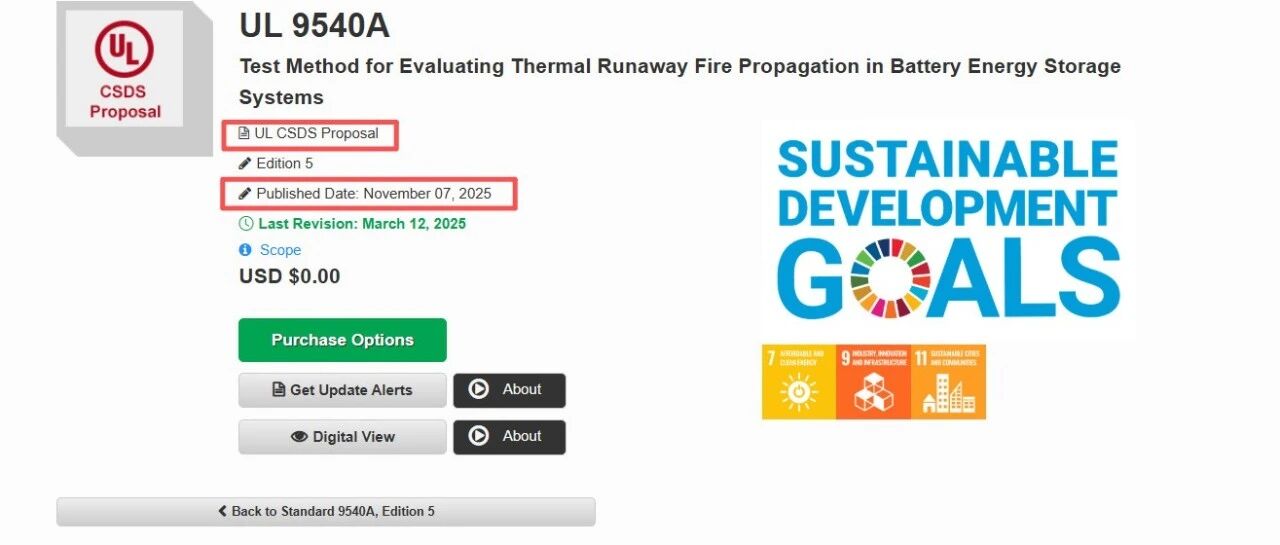
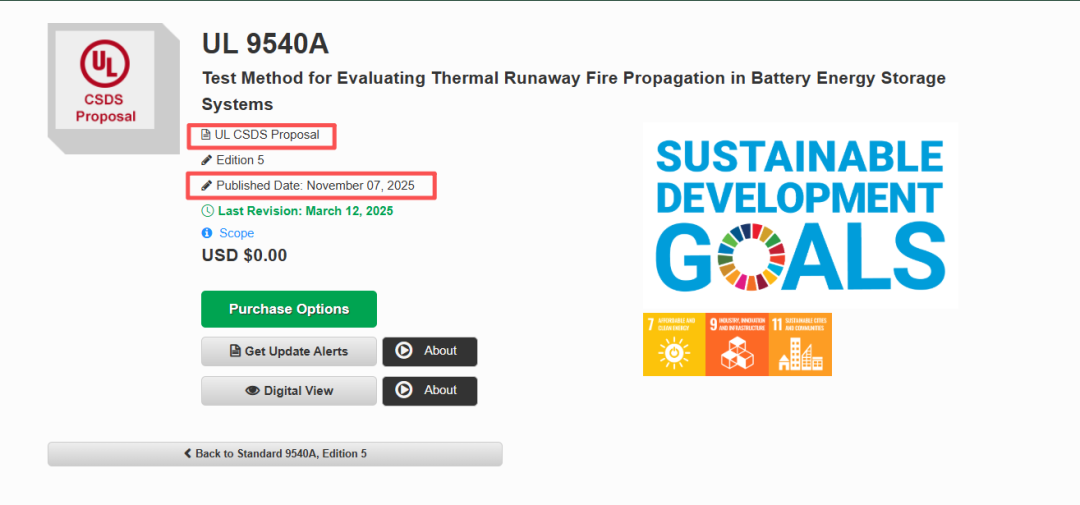
On 7 November 2025 UL Solutions published the latest CSDS proposal for the fifth edition of UL 9540A, the test method for evaluating thermal runaway fire propagation in battery energy storage systems. The update concentrates on the large-scale fire testing part of the installation level, systematically revising key areas including terminology, test logic, ventilation conditions, performance criteria, and the explosion and ventilation testing in Annex C. The proposal is currently out for comment, with a deadline of 22 December 2025.
The proposal marks the start of another cycle of refinement for UL 9540A. In particular, it sets clearer and more practicable requirements for large-scale burn testing, the route for verifying the fire safety of large energy storage systems under extreme conditions.
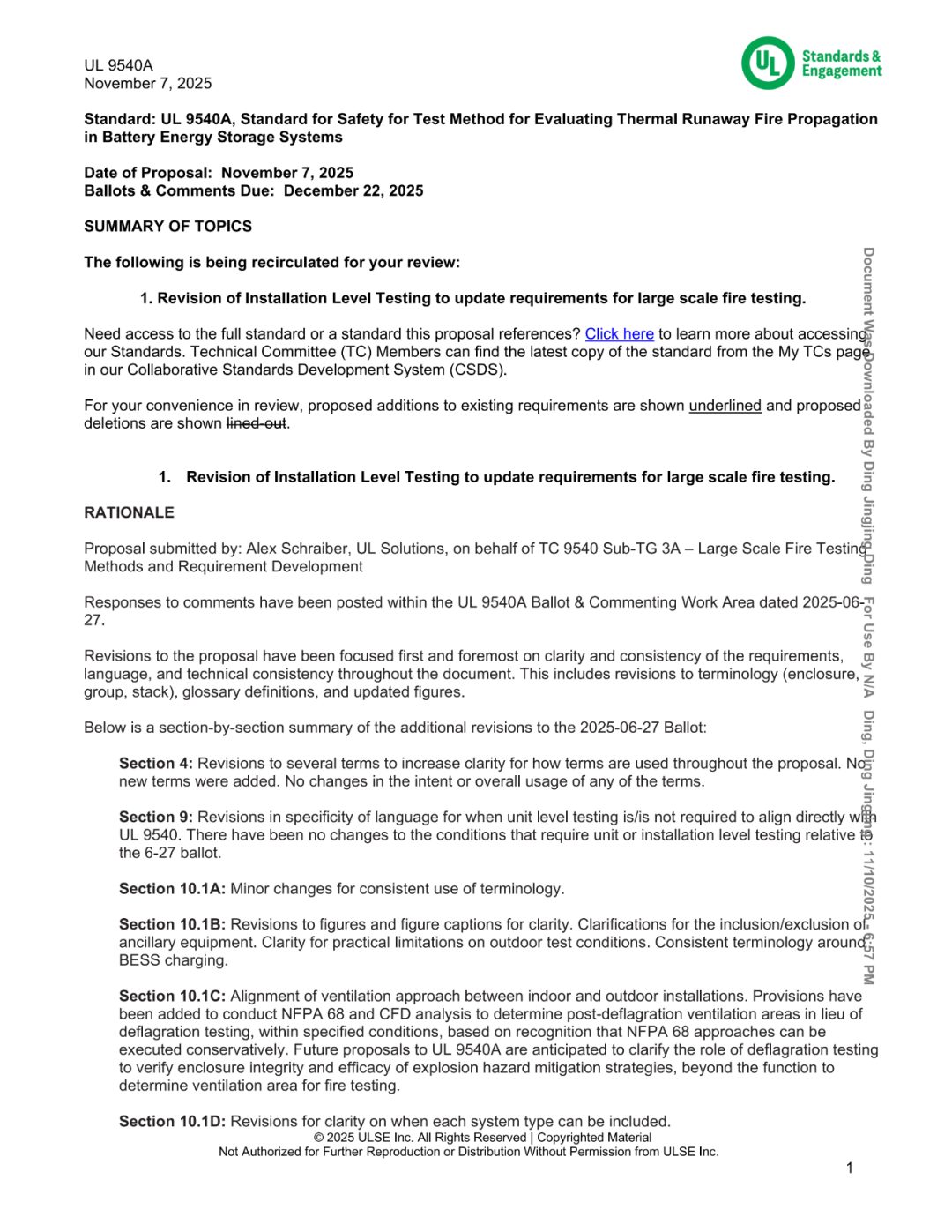
According to UL, the revision was initiated mainly by the working group developing the large-scale fire test method and requirements. Its core aims are to:
improve the consistency of language and structure and reduce ambiguity of interpretation;
comprehensively update terms, definitions and figures;
while keeping the overall test logic unchanged, strengthen the repeatability of installation-level testing and draw clear boundaries around the scenarios to which it applies.
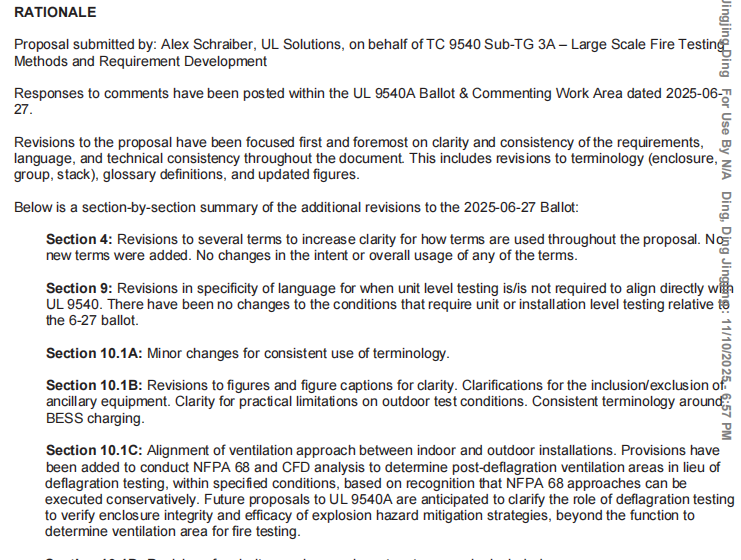
Put simply, this revision is a systematic fine-tuning aimed at practical problems in carrying out the test. The proposal states explicitly: "The primary focus of this revision is clarity and consistency of requirements and a unified technical logic throughout."

Key changes
The changes are concentrated in Sections 9 and 10 and the related annexes. The main points are as follows.
Terms and definitions (Section 4)
Core terms such as "Enclosure", "Group" and "Stack" have been revised, as has the definition of "Active Thermal Runaway Propagation Prevention System", which is now clearly distinguished from active fire protection systems. This makes the use of terms throughout the proposal clearer.
Test scope and conditions (Sections 9–10)
① Stricter requirements for a "representative test configuration": spacing, orientation and ancillary equipment must match the final installation, so that the test is not optimised in ways that depart from reality.
② The "Level 1/Level 2 performance levels" for the indoor test have been removed, to avoid inconsistency with NFPA 855.
Ventilation and explosion protection (Section 10.1C and Annex C)
This is the central focus of the revision.
NFPA 68 analysis and CFD simulation may be used instead of an actual explosion test to determine the vent area, provided the calculation is conservative and supported by a validation report;
Deflagration vent areas must be open from the start of the test, to simulate the worst-case conditions for fire development in the post-deflagration venting phase;
For products with no doors or vents, openings must not be added artificially;
Annex C adds two deflagration scenarios, "partial volume" and "full volume", and allows cells to be used instead of gas in the test.
How fire protection systems take part (Section 10.1D)
① Building-level active fire protection systems (such as sprinklers) may remain in operation;
② Thermal runaway propagation prevention systems must be switched off in the initiating module, so that they do not actively suppress the fire, and kept on in the target enclosures so that their protection can be assessed;
③ Liquid cooling or immersion cooling systems: non-flammable coolant in the initiating module must be drained, but the other modules stay as they are; flammable coolant must be retained. No cooling system circulates in the initiating enclosure.
More specific target configurations and measurement methods (Section 10.1E)
A complete target (an adjacent BESS containing complete battery modules) is subject to less stringent performance criteria; a simplified target (empty modules or partial cells) is subject to stricter criteria.
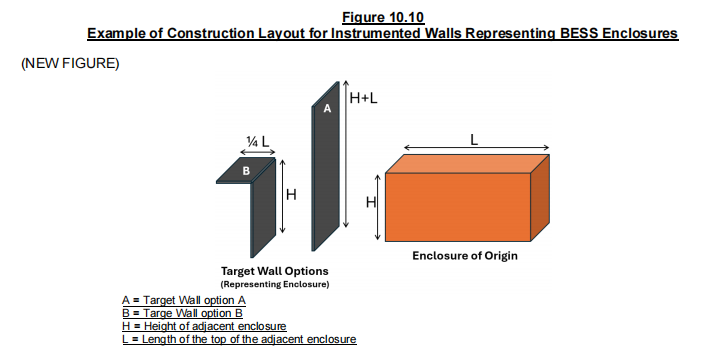
A method of constructing an instrumented wall is added, to simulate the heat exposure of an adjacent BESS.
Ignition and fire initiation (Section 10.1F)
Section 10.1F requires that ignition be real, in the right place and sustained long enough for the thermal runaway propagation test to be valid.
① Location of the ignition source: it must be placed near the cell vents so that it can ignite the flammable gases produced by thermal runaway; if the system ducts the gases away, ignition sources must also be placed at the outlets.
② Duration of ignition: ignition must continue until a developed fire condition is reached for the test to be valid.
③ Choice of initiation point: the location most likely to propagate must be chosen, generally a module with the highest energy density, towards the outside and low down; for indoor systems, initiation on the second tier is recommended to verify vertical propagation.
④ Validity: even if the fire does not burn through completely because of the construction or protective materials, the test is still valid and does not count as a failure.
Requirements for stacked BESS (Section 10.1G)
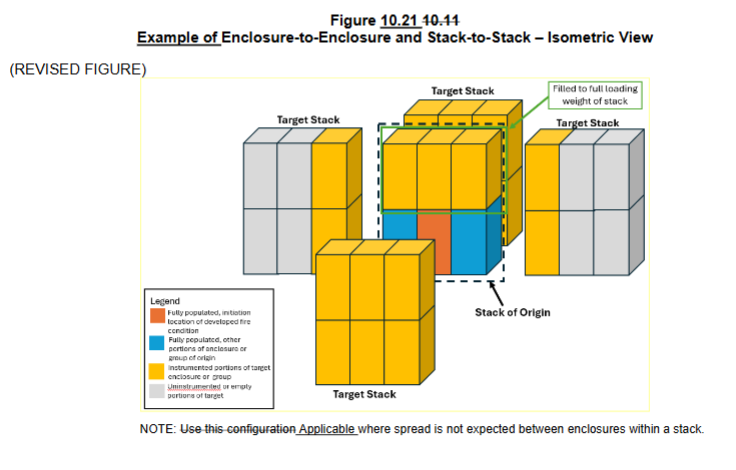
In response to the recent trend for vertically stacked storage cabinets, vertical fire spread paths are brought into the test requirements.
The proposal consolidates the previous clauses for indoor and outdoor stacked tests and adds guidance on stacking loads.
Clearer test termination conditions (Section 10.1I)
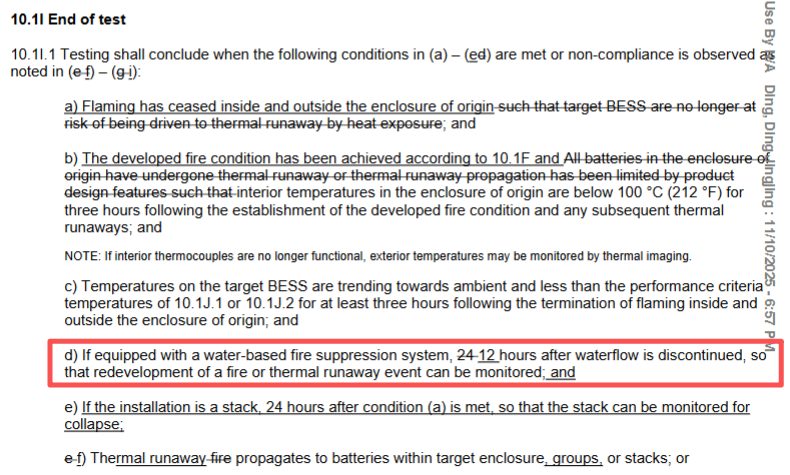
The conditions for ending the test are tied directly to the performance criteria: once a criterion is not met, the test is considered ended.
The post-fire monitoring period for indoor tests is cut from 24 hours to 12 hours, to make the test more practicable.
Performance criteria (Section 10.1J)
The performance criteria have been adjusted to refer more consistently to the cell venting temperature.
Measurements for cells and modules are aligned with the cell venting temperature.
Enclosures are aligned with 110% of the cell venting temperature.
An exception has been added for outdoor equipment to allow brief deviations from the performance criteria.
For indoor installations, the Level 1/Level 2 classification has been removed. This does not affect how the test is carried out; it removes the concept of performance levels, which had not been harmonised with NFPA 855.
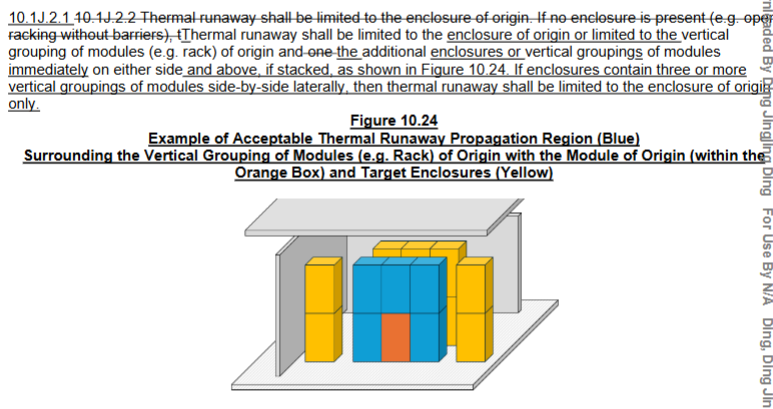
For indoor systems, specific details on the acceptable extent of thermal runaway propagation have been added, and the requirements for enclosures, partitions and stacks have been clarified.
The post-fire monitoring period for indoor tests has been cut from 24 hours to 12 hours to improve practicality. It may be extended at the request of the test sponsor.
The language for indoor and outdoor stacked BESS has been aligned.
Test report and record requirements (Section 10.1K)
① A new requirement to record the basis for the chosen ventilation strategy (for example, which door was opened, why, and whether it was calculated to NFPA 68);
② A requirement to state clearly the status of protection systems, the method of initiating thermal runaway, the layout of temperature measurement points, the volume of gas released and similar details;
③ A unified report format, making it easier to compare results between laboratories.
Annex A
Provides a test framework for purpose-built buildings that do not meet the fire spread limits of 10.1J.2, stressing that test objectives must be agreed with the local authority having jurisdiction, fire engineers and insurers. This is basic guidance and is not expected to be a common or typical approach.
Annex C: deflagration testing
① The deflagration test framework is substantially clarified, allowing several methods of simulation using gas or cells;
② Two test scenarios are introduced: full volume and partial volume;
③ It is made clear that the purpose of the test is to support the large-scale fire test in Section 10, not to give a stand-alone pass/fail result. In future this part is likely to become a separate test standard, split from UL 9540A.
This revision can be seen as UL 9540A evolving from a "test method" into a "verification system":
More precise terms and subjects: unified definitions of BESS forms;
More engineering-based test logic: NFPA 68 and CFD analysis introduced;
More data-driven criteria: limits calculated from the thermal characteristics of the cells;
More standardised documentation: supporting comparison of data between laboratories;
A more systematic overall approach: fire testing and protection design integrated.
This also means that, in future, manufacturers dealing with UL 9540A cannot focus only on passing a single test. They will need up-front justification and coordinated design across system architecture, explosion protection, thermal management, gas venting paths and more.

First published on our WeChat channel: read the original