
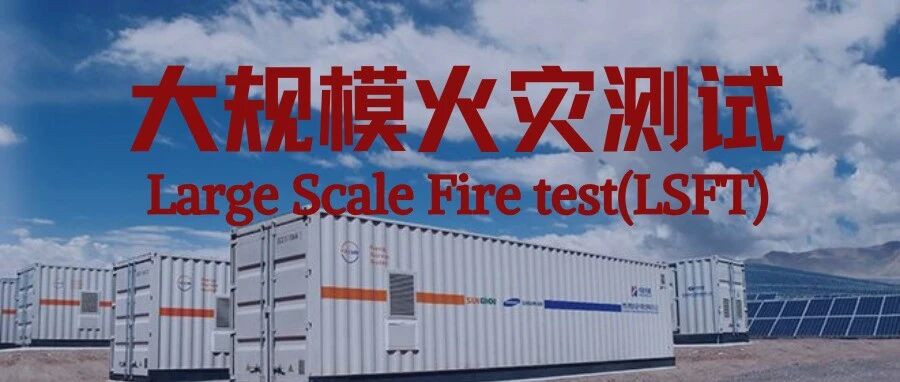
In recent years the fire risk of energy storage systems (ESS) has become a focus of global attention. In 2024 the Moss Landing energy storage plant suffered two fires within two months, destroying 70% of its equipment and exposing the limits of traditional test methods. Figures from CAL FIRE (the California Department of Forestry and Fire Protection) show that energy storage fire incidents in the state rose by 47% year on year in 2023. Frequent energy storage incidents have exposed gaps in existing fire codes, and the existing standards cannot effectively assess the fire risk of large energy storage systems.
New York State, likewise, after several energy storage fires, revised its fire code in 2024 to strengthen the safety requirements for energy storage systems. Lithium-ion battery storage projects with a capacity of more than 600 kWh must undergo large-scale burn propagation testing, with UL 9540A or an equivalent standard as the reference test method. The test must show that a fire in a single unit does not spread to other equipment, and a laboratory report proving safety must be submitted.
Section 1207.1.5 of the California Fire Code explicitly requires energy storage systems entering California to pass a Large Scale Fire Test (LSFT) to verify their safety under extreme conditions. This marks a shift in energy storage safety regulation from "reactive response" to "proactive prevention", and the requirement has directly prompted the global energy storage industry to re-examine its fire test standards.
How the test standards have evolved
A free-for-all
Before NFPA 855 was updated, fire testing in the energy storage industry was a case of everyone doing their own thing.
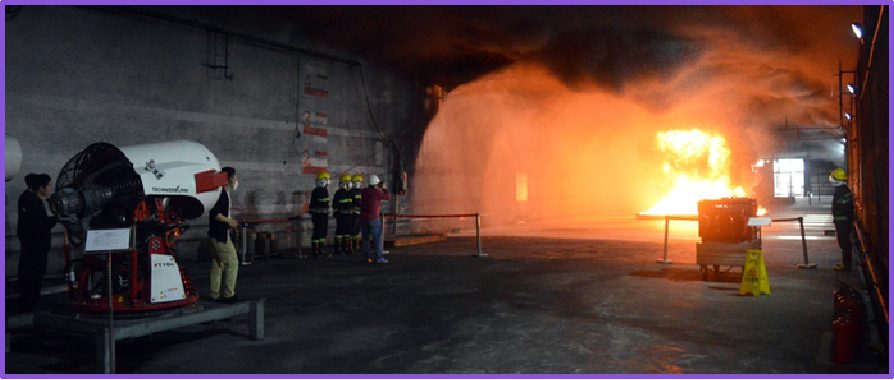
In June 2024 Sungrow carried out the world's first real-system burn test of its 20 MWh PowerTitan 2.0, showing no fire propagation and verifying its fire protection design. BYD, Powin and other manufacturers also designed their own test programmes around their own technologies: BYD passed a CSA TS-800 test in December of the same year, and Trina Storage has also carried out a container burn test.
But these tests lacked a common standard and differed in their details, so the data could hardly be mutually recognised or compared, and fire authorities (AHJs) and insurers gave them only limited recognition.
The key changes in NFPA 855:2026
NFPA 855, Standard for the Installation of Stationary Energy Storage Systems, is the core code for energy storage in the US. In 2024 the UL 9540A technical committee set up a dedicated task group to develop a test method for very large-scale fire tests, while the NFPA 855 technical committee formed a working group which, together with the UL 9540A group, developed "guidance on conducting large-scale fire tests".
In February 2025, balloting on the draft NFPA 855:2026 closed. The new edition adds Annexes G.8, G.9 and G.11 to Annex G of the 2023 edition. Section G.11 separates large-scale fire testing from UL 9540A testing for the first time, raising LSFT to core test guidance with requirements distinct from UL 9540A. This change marks the move of large-scale fire testing from "optional" to "mandatory", with markedly greater scientific rigour.
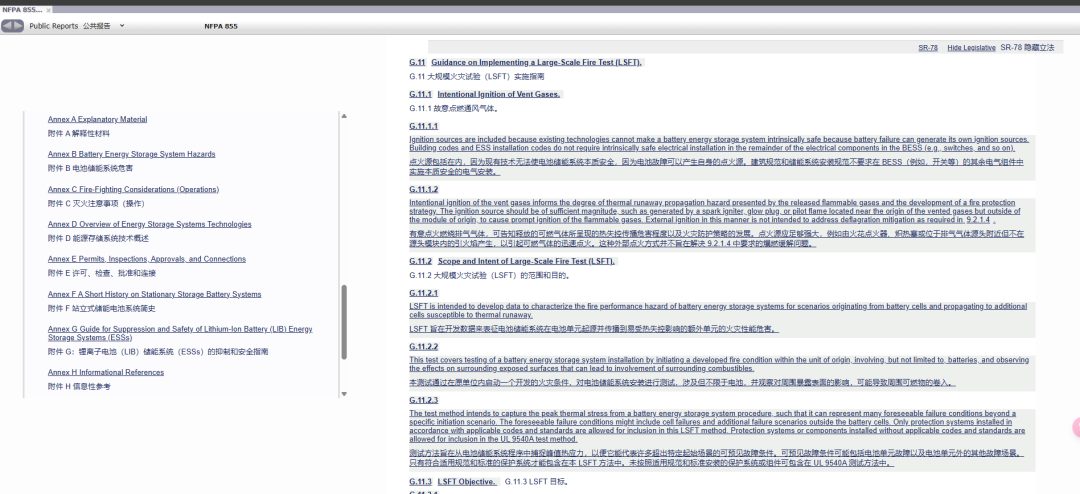
The change has reshaped the rules of the industry. Previously, NFPA 855 accepted UL 9540A installation-level testing as equivalent to a large-scale fire test, but in practice this was found not to meet the needs of fire authorities (AHJs). UL 9540A, for example, only requires a single battery rack to be tested, whereas G.11 requires the interaction between several racks to be verified, which is closer to a real fire.
International standards: alignment and differences
CSA C800: the large-scale fire test standard for energy storage published by the Canadian Standards Association (CSA/ANSI C800:25, which succeeded the technical specification CSA TS-800 published in 2024). It shares the aims of NFPA 855 G.11 but differs in details such as test duration and burning conditions. BYD and other companies have already passed its predecessor, TS-800, but NFPA 855 G.11 may in future carry more authority in North America and worldwide.
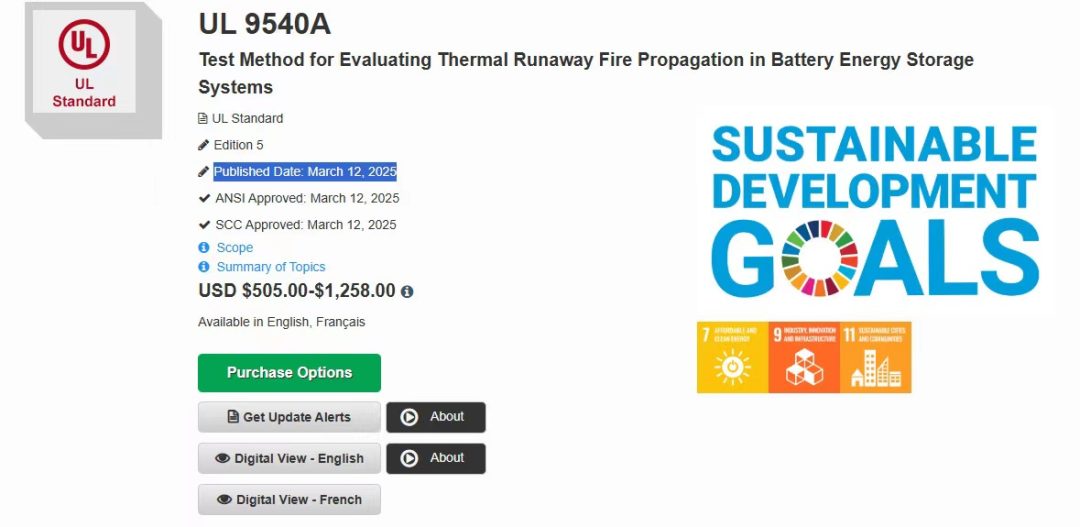
UL 9540A annex: UL 9540A is the test standard referenced by NFPA 855, and the two form a coordinated system. The fifth edition of UL 9540A was finally published on 12 March 2025, completing its latest revision. Notably, UL also plans to publish a dedicated annex on large-scale fire testing in the first half of 2025, expected to be closely compatible with NFPA 855 G.11 and further strengthening the harmonisation of the standards. This annex may well become the mainstream in future, and manufacturers should keep an eye on updates to the standards. We will be watching closely.
Why large-scale fire testing matters
Battery fires in energy storage cannot be ruled out entirely, but large-scale fire testing can quantify the limits of fire spread. By simulating something closer to a real "worst case", it tests how fire spreads within a battery energy storage system, the effect on neighbouring units and the fire performance of the system as a whole. These data feed directly into the design of installation spacing and reduce the risk of a chain reaction.
Leading companies now treat large-scale fire testing as a strategic investment. Passing a large-scale fire test verifies how an energy storage system or its components behave under extreme fire conditions and assesses the system's safety with respect to thermal runaway, fire spread and toxic gas release. For deployment in North America, this gives solid assurance whether for AHJ approval, project delivery or insurance premiums.
For project developers, large-scale fire test data directly influence siting decisions. Under NFPA 855 G.11, systems that pass the test can be installed at much smaller spacing, which is a significant cost-saving for a project; the importance of the test speaks for itself.
What comes next
As NFPA 855:2026 takes effect, global fire standards for energy storage will converge faster. UL 9540A is the test tool and NFPA 855 the compliance guide; each revision of NFPA 855 has been linked to a revision of UL 9540A, and the two have a symbiotic "code requirement – test method" relationship. Several countries have adopted this model. Although a tariff war is under way, it has also boosted exports to countries other than the US, and whether the destination is the US, Singapore or Southeast Asia, exported products will not be able to avoid large-scale fire testing in future.
Faced with these changes, companies need capabilities across the whole "testing – certification – compliance" chain to meet market access requirements in North America and worldwide. Only by carrying out NFPA 855 pre-compliance testing early and preparing for overseas markets in advance can they get ahead.
Huahui Fire, a leading third-party laboratory in China, offers NFPA 855 compliance review, large-scale fire testing, full UL 9540A testing, NFPA 68/69 simulation and assessment, and hazard mitigation analysis (HMA).
With NFPA 855 G.11 and the UL 9540A annex coming into effect, large-scale fire testing has gone from an "optional extra" to a "survival threshold" for the energy storage industry. Companies need to prepare early to seize the initiative. Choosing a recognised laboratory and gaining a deep understanding of NFPA 855, large-scale fire testing and global energy storage compliance requirements will be a key asset in global competition. For companies, embracing the change in testing is both the inevitable response to risk and a key strategy for winning the market.

First published on our WeChat channel: read the original