

Against the background of the global energy transition, energy storage, a key pillar of renewable energy, has grown rapidly in recent years. In 2024 the energy storage tender market remained active, and the requirements in centralised cell procurement, its core element, changed profoundly in several respects. These changes reflect the industry's technical progress and the importance the market attaches to the quality and safety of energy storage cells. The procurement requirements show a steady rise in what the market expects of cells, from performance and quality to testing and certification, and each of these brings new challenges and opportunities for cell manufacturers.
314Ah cells overtake
In the fierce competition of the 2024 energy storage cell market, a quiet change reshaped the industry. 314Ah cells went from gathering momentum in the first half of the year to a strong rise in the second, becoming the focus of the market and ending the long dominance of 280Ah cells.
At the start of the year, 280Ah cells, with their mature technology and market base, were still the mainstream in cell procurement. They were widely used in all kinds of energy storage projects and were the first choice of many owners and integrators. However, as energy demand kept rising and storage technology iterated rapidly, the major battery makers saw the market's appetite for cells with higher energy density and better value for money. In the second quarter they stepped up R&D and production investment and accelerated volume production of 314Ah cells.
This quickly set off a chain reaction. From the start of the second half of the year, owners' demand for 314Ah cells was released on a large scale. In GWh-scale centralised cell procurement by state-owned enterprises such as Guoneng Xinkong and China Electrical Equipment Group, 314Ah cells took more than 70 % of individual lots. China Energy Storage Equipment Group went further, with an 11.1 GWh centralised procurement of 314Ah cells that became a focus of the industry, and many other state-owned enterprises and integrators followed. By incomplete statistics, tenders in 2024 that explicitly specified 314Ah cells exceeded 20 GWh.
The rise of 314Ah cells was no accident. On the one hand, they made a step change in key performance indicators such as energy density and cycle life, better meeting projects' need for efficient, long-lasting storage. On the other, the cost advantage of volume production gave them far better value for money than comparable products, lowering project costs for owners and integrators and making them more competitive. But 314Ah cells also place higher demands on product quality and performance; after all, safety has always been the central issue in energy storage. This is reflected in the tenders too.
Higher performance and quality requirements
Energy storage tenders in 2024 set stricter requirements for 280Ah and 314Ah cells. Cycle life of more than 6,000 cycles and a calendar life of at least 15 years were required, and efficiency requirements kept rising. The new standards GB/T 36276-2023 (lithium-ion batteries for electrical energy storage) and GB/T 44026-2024 (technical specification for prefabricated-cabin lithium-ion battery energy storage systems) set clear energy efficiency requirements at cell, module, rack and system level. For example, cell efficiency at 25 °C must be at least 93 %, and the initial charge–discharge energy efficiency of modules and racks at least 94 % and 95 % respectively. At room temperature (25 °C), the charge–discharge energy efficiency must be at least 88 % for a DC cabin and at least 83 % for an AC cabin.
Some buyers even require cell energy efficiency above 94.5 % at 0.5P. This raises the maximum cell temperature during overcharge and thermal runaway by 30 °C to 50 °C, increasing the risk of thermal runaway and fire. These rising requirements push cell makers to keep optimising their technology, and while pursuing economic returns they also pose greater challenges for cell safety.
Chinese standards set the quality benchmark
China's steadily improving system of standards plays a key role in controlling cell quality. Standards such as GB/T 36276-2023 (lithium-ion batteries for electrical energy storage) and GB/T 44026-2024 (technical specification for prefabricated-cabin lithium-ion battery energy storage systems) specify key indicators such as energy efficiency and safety performance in detail, from the individual cell up to the system. Their implementation gives clear guidance for the design, production and application of energy storage cells, gives cell makers a basis for their R&D and production, and provides the market with a uniform yardstick for quality, supporting healthy and orderly market development.
Overseas certification opens international markets
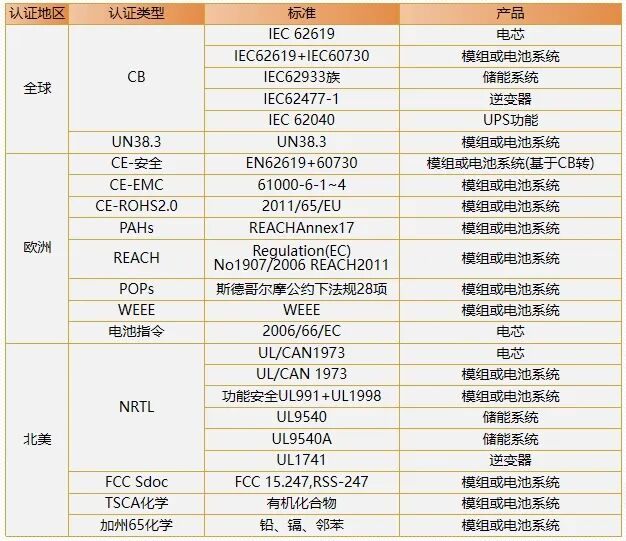
As the cell market becomes more international, overseas certification matters more and more. According to a tendering platform, a company in Jiangxi, in its 2025 centralised procurement of energy storage system components (cells), explicitly gave priority in shortlisting to cells certified to IEC 62619, UL 1973, UL 9540A and UN 38.3. IEC, UL and UN certifications are key requirements overseas. They take time — North American UL certification typically takes 8–16 working weeks and European CE 3–6 working weeks — and exported cells must also pass other reviews such as UN 38.3 for lithium batteries and transport classification. But these certifications are a prerequisite for cell makers to enter international markets.
By incomplete statistics, Chinese cell makers and system integrators are actively exploring overseas markets, and by the end of October 2024 overseas orders for energy storage batteries exceeded 52 GWh, with leading companies such as CATL and Hithium winning overseas contracts. From what we understand, companies are not only competing hard on IEC 62619, UL 1973, UL 9540A and UN 38.3 certification at cell level; at container level they are also adding large-scale fire tests, UL 9540B and NFPA 68/69 testing to meet export requirements. Overseas certification is not just an endorsement of product quality but a key to expanding into international markets and competing globally.
How certification and quality are linked
Testing and certification are closely tied to cell quality. Rigorous certification testing checks comprehensively whether a cell's performance, safety and other indicators meet international standards. For example, UL 1973 certification mainly assesses the safety of energy storage batteries, including electrical and thermal safety, while IEC 62619 certification focuses on battery performance and reliability. Only by passing these certifications can a cell show that it can operate stably and be used safely in complex international markets. The certification process also drives cell makers to keep improving their manufacturing processes and quality control systems, optimising every step to international standards — from raw material purchasing and production monitoring to final inspection — and so raising overall product quality.
The changes in energy storage cell procurement requirements in 2024, above all the steady rise in quality requirements and the growing importance of testing and certification, are an inevitable trend in the industry's development. As the market matures and technology advances, procurement requirements for energy storage cells will continue to move towards higher quality, greater safety and greater internationalisation. Testing and certification are the gateway to the market for energy storage products; only by actively meeting certification challenges at home and abroad can a company hold its own in a fiercely competitive market.

First published on our WeChat channel: read the original