
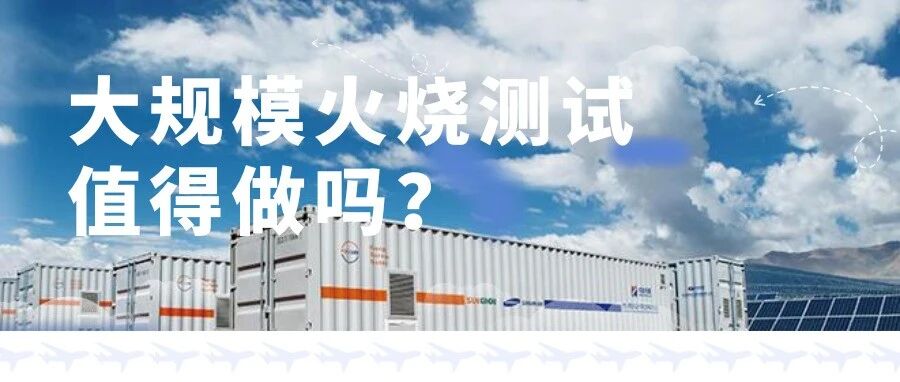
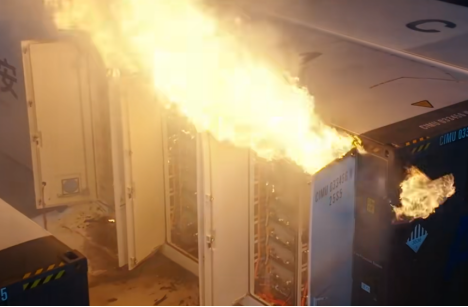
One test burns a complete energy storage container, at a direct cost of more than RMB 1 million. The energy storage industry's recent rush to burn containers has made many wince. From leading Chinese integrators such as BYD and Sungrow to international giants such as Tesla and Fluence, more than ten companies have now publicised their large-scale fire test results. Interestingly, until recently there was no fully established, unified mandatory standard for large-scale fire testing of energy storage, in China or abroad, yet manufacturers have been paying out of their own pockets to burn money. What goes up in flames is not just energy storage equipment but hard cash invested in R&D. Is such a "luxury" test really worth it?
The market got there first
To understand the logic of these "money-burning tests", we first need a clear view of where the industry stands.
In the past few years, fires at energy storage stations around the world have occurred from time to time, and safety anxiety has become a chronic drag on the industry. Downstream plant investors, insurers and fire authorities are demanding ever higher safety from energy storage equipment. The frequent lithium battery plant fires in the United States, for example, have left AHJs (authorities having jurisdiction) deeply dissatisfied and insurers with heavy losses. California's fire code explicitly requires energy storage systems entering California to pass a large-scale fire test (LSFT), providing data as close as possible to a real "worst case", to verify their safety under extreme conditions.
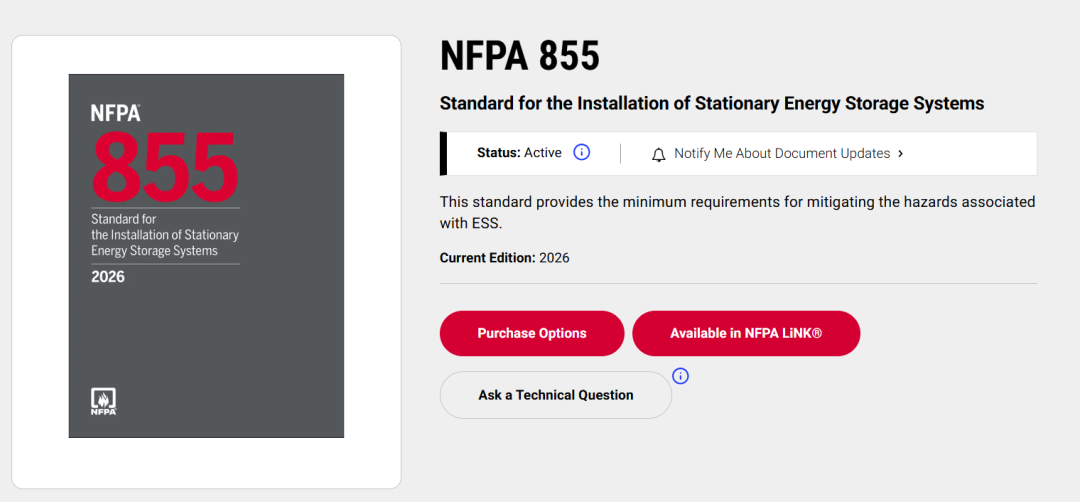
Meanwhile, industry standards are still catching up. Internationally, the 2026 edition of NFPA 855 now explicitly takes large-scale fire testing into account; in China, the relevant standards are not yet mandatory.
It was in this gap, with standards not yet in place but demand already pressing, that the leading companies moved first. Since 2024, Sungrow, BYD, Trina, Huawei Digital Power, Canadian Solar, Hithium and others have run LSFTs on real units to verify that their energy storage containers meet the coming regulatory requirements.
Publishing these tests has not only drawn a great deal of attention in the industry; it is also quietly changing how the market chooses. Buyers now prefer to work with companies that have large-scale fire test data, even at a somewhat higher cost, because it lowers safety risk later on.
But there is no ignoring the fact that the tests are very expensive. One engineer explained that a complete large-scale fire test not only burns an energy storage container worth several hundred thousand yuan, along with the batteries, PCS and other equipment inside it, but also involves third-party test fees and more, so the total cost of a single test is generally around RMB 1 million. Multiple rounds of optimisation and retesting multiply the cost. At a time when profits in energy storage are returning to more modest levels, this kind of investment is clearly not simply a matter of following the crowd.
Why companies are willing to "burn money"
Answering safety anxiety: building market trust with data
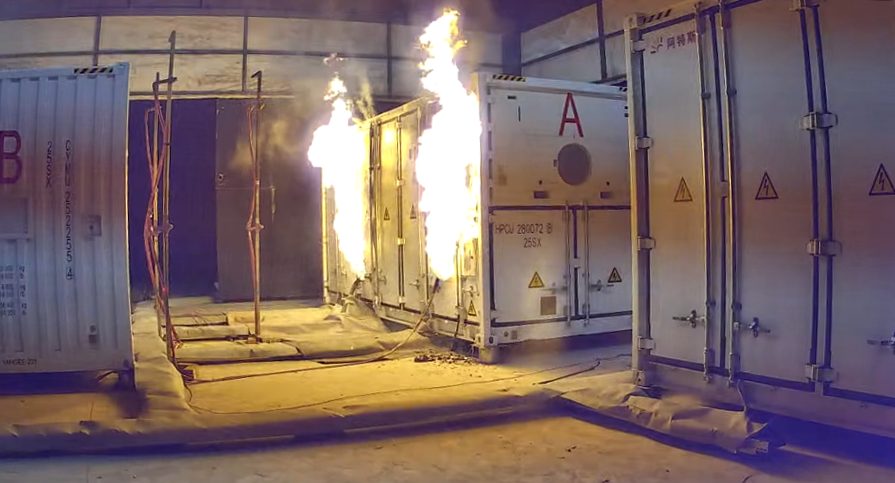
For the energy storage industry, safety is never an abstract idea; it is a hard capability that has to be proven with data. In the past, manufacturers relied mostly on small-scale tests (such as burning single cells or modules) to demonstrate safety, but these limited tests differ considerably from a fire in a real energy storage container. In a real fire, thermal runaway spreads within an enclosed space and can set off a chain of further effects, such as pressure relief and structural deformation, which small-scale tests cannot fully simulate.
Large-scale fire testing fills exactly this gap. By burning a complete energy storage unit, a company can show the market that its product can still contain the risk in a near-real fire scenario (for example, by preventing deflagration and limiting fire spread). Data like this is more persuasive than any marketing line.
Pressure from standards: UL 9540A + NFPA 855
If escalating risk is the internal driver, the explicit requirements of industry standards are the external hard constraint pushing companies to burn containers. Together, UL 9540A and NFPA 855 make large-scale fire testing a red line for energy storage safety.
NFPA 855 is the North American installation standard for energy storage and is widely recognised in that market; most US authorities use it as the basis for acceptance and inspection of energy storage systems. In September 2025, the 2026 edition of NFPA 855 was published on the NFPA website. Building on Annex G of the 2023 edition, the new edition adds Annex sections G.8, G.9 and G.11. Section G.11 for the first time raises large-scale fire testing to the status of a core test guide. This change marks the shift of large-scale fire testing from "optional" to "mandatory", with much greater scientific rigour.
UL 9540A, published by UL Standards & Engagement, is currently the most widely used standard for evaluating the fire safety of energy storage systems. It sets out a systematic sequence of "deflagration → pressure relief → ventilation → full fire involvement", and is the core test standard referenced by NFPA 855; the two form a complementary system.
More importantly, these requirements are spreading worldwide. Projects in the United States, Australia and Europe all refer to NFPA 855 in requiring UL 9540A reports as a condition of market access.
What insurers and fire services want
The value of large-scale fire testing is not only technical; it has also caught the attention of the insurance industry and fire services. For insurers, the claims risk from energy storage station fires is huge, and they urgently need real fire data to assess their exposure and set reasonable premiums.
If manufacturers can provide safety performance data verified by authoritative testing, insurers will be more confident in providing cover, and may even offer lower premiums. Conversely, for projects without test data, insurers may raise premiums or refuse cover.
Likewise, fire authorities rely on these test results to draw up practical emergency plans and firefighting measures. Key information in the test report on the rate of fire development, flame height, toxic gas emissions and the risk of structural collapse can guide fire services, for example in choosing suitable extinguishing agents, equipping firefighting resources and planning evacuation.
In short, large-scale fire test reports have a direct bearing on a project's insurance premiums, approvals and emergency plans. In some regions, project approval and insurance due diligence already treat "a coherent body of empirical safety data" as a default requirement. Without one, companies often have to commission additional tests themselves and use auditable test plans and reports to convince regulators and customers.
From a commercial point of view, then, large-scale fire testing is also about meeting the requirements of market access and risk control. Only products that have been "burned" can reassure customers and regulators and stand out in a fiercely competitive market.
Improving product design
A large-scale fire test is not just a proof; it is a practical exercise. In a fully developed fire, every weak point in a product's design is exposed, showing the company where to improve. Testing can reveal, for example, whether the ventilation and pressure relief design is adequate, and companies can use the results to optimise their battery management strategy and the integration of fire protection.
Every LSFT is a stress test of a product's safety performance at its limit, and the lessons learned feed directly into the next iteration. This return on investment, where each burn brings a big step forward, is entirely worthwhile for companies seeking long-term safety and reliability. Especially in a highly competitive industry with fast technical change, refining products through LSFT builds a higher safety barrier and a competitive edge.
In summary, although large-scale fire testing is costly, it provides irreplaceable verification of energy storage system safety: it fills gaps in the standards, verifies safety at system level, wins trust with data, and guides the optimisation of product and fire protection design. For companies and test laboratories committed to outstanding safety performance, the investment is entirely worthwhile.
Looking ahead, large-scale fire testing is moving from a voluntary practice towards standardisation and mandatory requirements. The UL 9540A test method referenced by NFPA 855 (2026 edition) is also due to update its large-scale fire test provisions accordingly. This means that soon, in 2026, large-scale fire testing will become a necessary condition for energy storage project compliance. Once the standards are mandatory, test methods and procedures will be more uniform and consistent, and results from different manufacturers will be more comparable.
As technology advances and standards mature, the cost of LSFT can be expected to fall gradually and its efficiency to improve, but its importance for energy storage safety will only grow. As an energy storage test laboratory, we are witnessing and taking part in this historic process: from "being told to burn" to "wanting to burn" to "having to burn", large-scale fire testing will become the new normal for the safe development of the energy storage industry.

First published on our WeChat channel: read the original