

Background
The global energy transition has brought explosive growth to the energy storage industry. China's installed new-type energy storage capacity has grown by more than 60 % a year for two years running, with new installations in 2024 exceeding 30 GW / 77 GWh.
At the same time, commercial and industrial (C&I) energy storage has taken off: 625 new projects in 2024, totalling 1.9 GW / 4.87 GWh, and 1.09 GW / 2.64 GWh installed in the first five months of 2025, with a marked increase in projects of 100 MWh and above.
But behind the boom lies a hidden danger. C&I storage is dominated by lithium battery systems, and the risk of thermal runaway in lithium batteries under certain conditions is amplified by the nature of C&I storage: dense deployment close to people. C&I systems are mostly installed in factories, shopping centres, data centres and other places where many people gather, so their safety risks are of particular concern.
Repeated risks are forcing the industry to act. Where compliance certification cannot meet real safety needs, the cabin burn test, as a new means of verification, is spreading from utility-scale storage to C&I storage. By simulating extreme scenarios such as thermal runaway and external fire, it tests a system's fire endurance from every angle. It has become a way for companies to identify hazards and improve their technology, and a "visible proof" by which the market judges product safety.
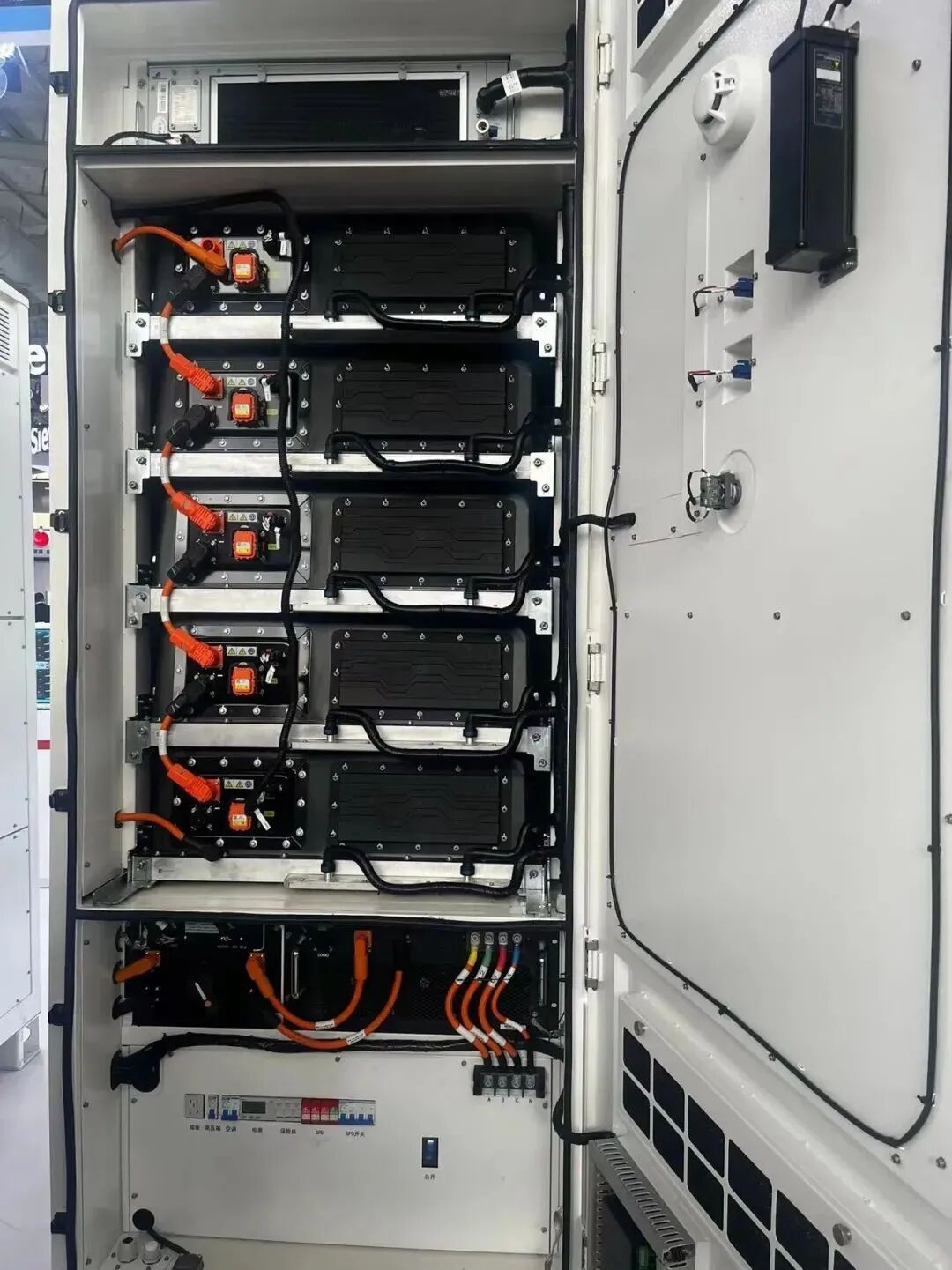
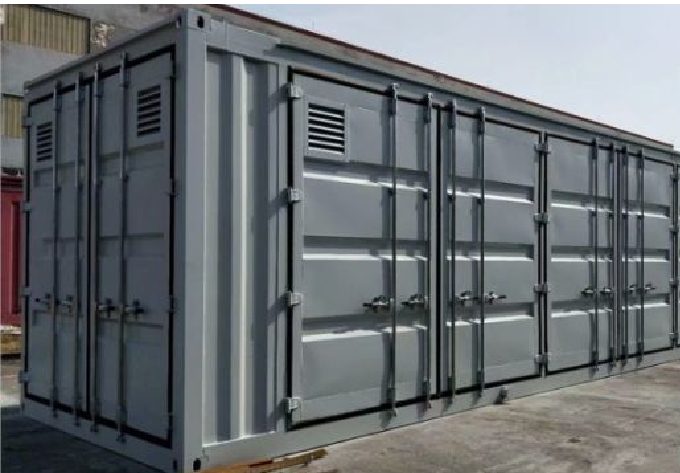
Policy drivers
Meanwhile, changes in the market environment in China and abroad are strongly pushing energy storage fire testing from the background into the spotlight.
In China, the issue of Document No. 136 and Document No. 394 (national policy documents) marks the start of a period of deep adjustment in which the energy storage industry is driven by "value". Safety performance has become a core element of asset value and the first hurdle in the industry's "knockout round". In this context, the cabin burn test, because it rigorously verifies the safety limits of energy storage products, has quickly become the industry's recognised high-level "touchstone".
Overseas, technical codes such as the 2024 update of NFPA 855 by the US National Fire Protection Association (NFPA) and the updated TS-800 from the Canadian Standards Association (CSA) have turned large-scale fire testing from an option into a mandatory requirement. It has become an indispensable ticket of entry, and a compliance threshold that must be crossed, for Chinese energy storage companies entering overseas markets.
Even in other overseas markets such as Europe and Australia, and in China itself, where there is as yet no national mandatory requirement, whether a product has passed a cabin burn test has become a key unwritten screening criterion and a significant advantage in actual tendering and product selection. This reflects how widely the market values, and requires up front, verification of product safety.
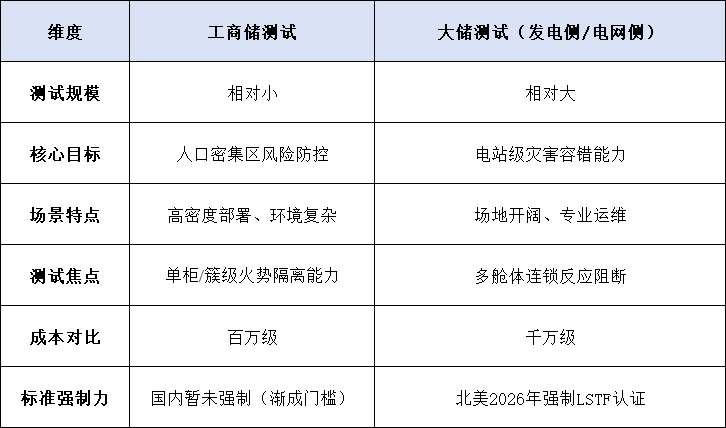
C&I vs utility-scale storage: differences in fire testing
Test cases
Large-scale fire testing of utility-scale storage is now established, but C&I units are smaller and more densely installed, and are generally still verified case by case.
On 3 July, State Grid Zhejiang Integrated Energy Services Co., Ltd. successfully completed the first extreme burn test of its standardised energy storage unit.
The State Grid Zhejiang Integrated Energy test focused on "fire control in a compact layout". It used a small 220 kWh cabinet, with an ultra-compact spacing of 15 cm to simulate a real layout, ignited with "zero intervention". The result showed that even with peak flame temperatures of 1,380 °C, the fire was contained within a single cabinet and isolated in all directions. This filled a gap in real-world thermal runaway testing of small energy storage units, showed that safety can be controlled in dense deployments, and gave the industry a safety reference for small-capacity, high-density applications.
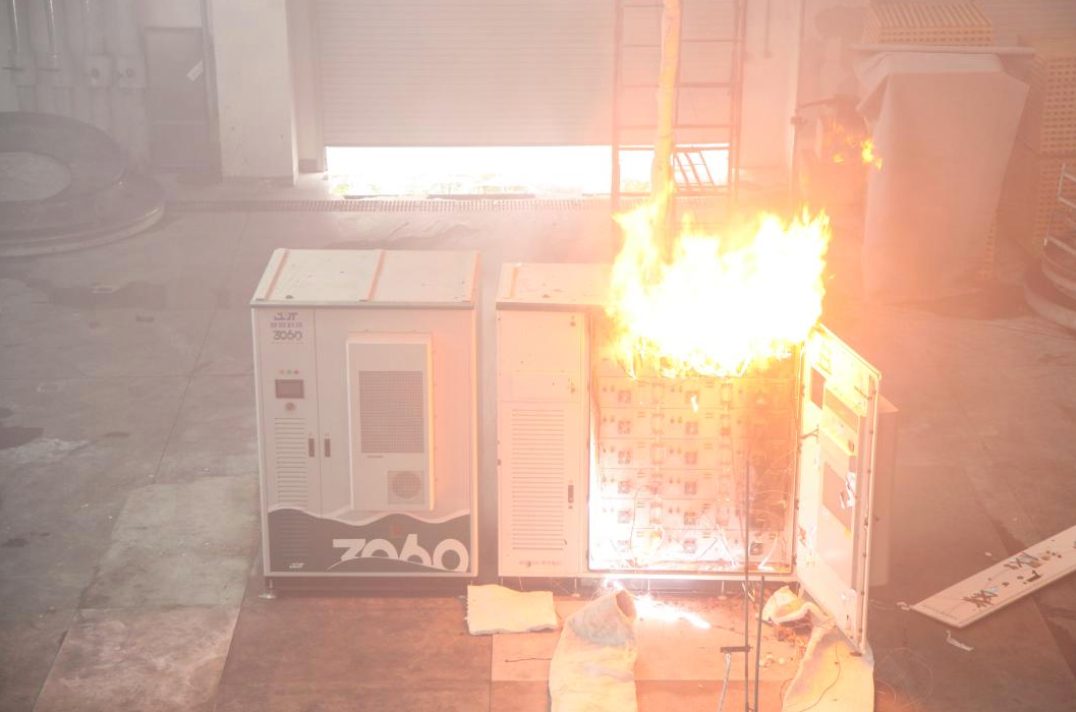
Sigenergy arranged its test strictly at the minimum standard installation distances for real C&I sites. All active protection, including the fire suppression module and temperature monitoring, was removed, with 20 cm between the clusters in front and behind and 30 cm to the left and right. The fire was contained within a single battery pack and did not spread to the adjacent equipment. It stayed strictly inside the one pack (containing just 12 cells): the target cells peaked above 300 °C, while the neighbouring cluster stayed below 31 °C. After 30 minutes the fire died down, with no secondary risks such as short circuits or structural damage. This result validated the effectiveness of its "passive protection design" and offered a safety solution for "no active intervention" scenarios.
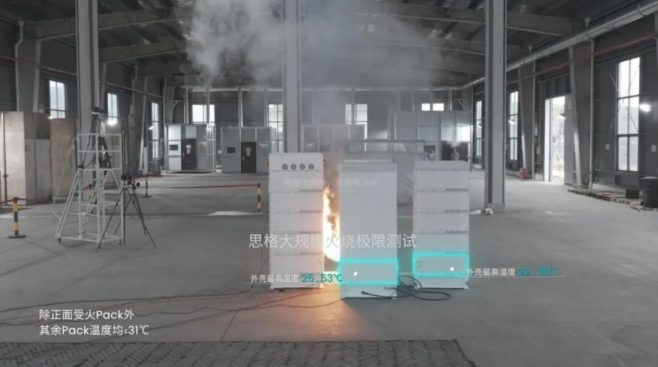
Although the two tests had different emphases, both centred on "staying close to real conditions", reproducing the real characteristics of C&I storage: limited space, dense deployment and complex operating conditions.
Burn tests for C&I storage are now a trend
Fire testing of C&I storage has become a focus of the industry, mainly because the explosive growth in scale in China is forcing safety upgrades, and manufacturers run these tests to prove their products are safe and win market trust.
For C&I manufacturers, test requirements should be built into product design from the start. The core value of a burn test lies not only in verification after the fact but in optimisation beforehand: manufacturers need to anticipate, in their product design, the risk points that tests commonly reveal (such as thermal runaway propagation and loss of thermal insulation in dense layouts).
For the test itself, there is still no national standard for C&I storage, so manufacturers should work with an experienced test laboratory to develop a tailored plan based on the product's application and target markets. Only then can test results be turned into a competitive advantage. They should also keep track of updates to industry test standards (such as Chinese association standards and mandatory international requirements) and adjust their test plans promptly, so that their products always meet the latest market access requirements.
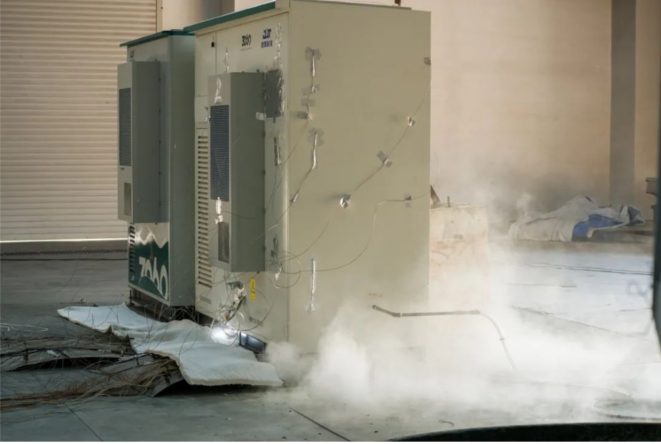
In short, burn tests for C&I storage are steadily becoming a question the industry must answer rather than an optional extra. Only by using testing to guide technical improvement, planning tests around real applications and using the results as proof to win market share can manufacturers hold their ground in a competitive industry.

First published on our WeChat channel: read the original