
Introduction
We have recently had a number of enquiries about testing and certification of energy storage products and components, and found that many energy storage manufacturers, especially newcomers and small and medium-sized companies, share the same questions when entering new markets:
Each country or region (Europe's CE, North America's UL, China's GB/T) has its own self-contained system of certification standards, covering many dimensions at once: electrical safety, EMC, chemical compliance, grid connection performance and more. Manufacturers find it hard to pin down the core market access requirements quickly.
An energy storage system is made up of many components, such as battery packs, the BMS and the PCS, each with different certification requirements. Manufacturers can easily confuse "component certification" with "system-level certification", leading to repeated tests or missed key steps.
A lack of understanding of the certification process (test duration, samples, the requirements of local certification bodies) can delay a project.
Let's sort it out.
First, some basic concepts.
What an energy storage system is and what it is made of
Energy storage
In the broad sense, energy storage is a cyclic process in which energy in one form is stored, by means of a medium or a device, either in the same form or converted into another, and released in a particular form when needed in the future.
In the narrow sense, energy storage refers specifically to storing electrical energy: the set of technologies and measures that use chemical or physical methods to store energy and release it when needed. Here we focus on electrochemical energy storage systems.
Energy storage systems
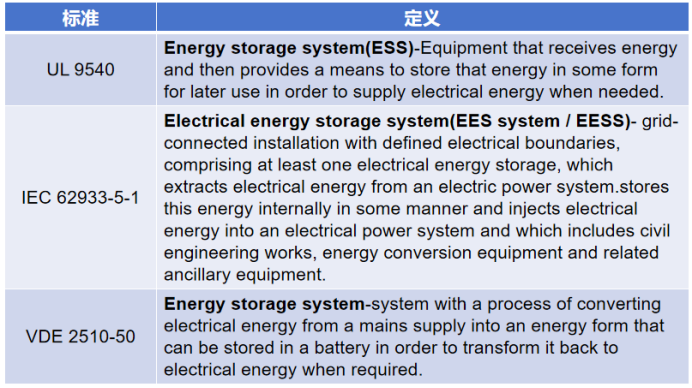
An energy storage system (ESS) is a device or system that can store electrical energy and release it when needed. ESS are widely used for peak shaving, integrating renewable energy, improving grid stability and other purposes. The definitions of energy storage in different standards are shown below.
Components
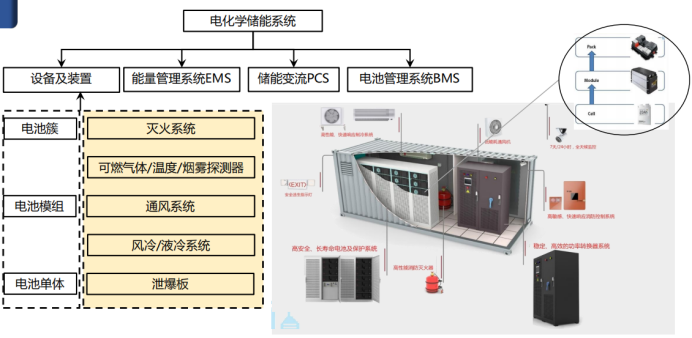
A complete electrochemical energy storage system consists mainly of battery packs, a battery management system (BMS), an energy management system (EMS), a power conversion system (PCS) and other electrical equipment.
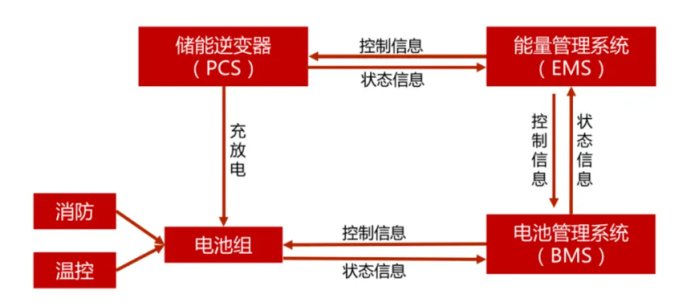
In the system, the battery packs report their status to the BMS, which shares it with the EMS and the PCS. Based on its optimisation and dispatch decisions, the EMS sends control information to the PCS and BMS, which control the cells and battery packs as they charge and discharge.
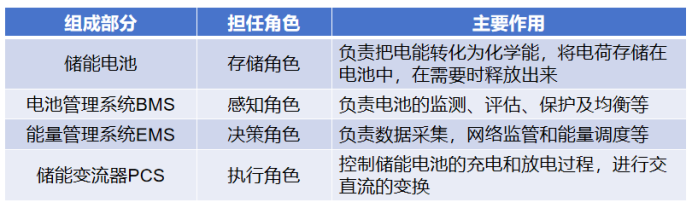
Energy storage batteries: energy storage units made up of many cells (such as lithium-ion cells) connected in series and parallel. They are the core energy carrier of the system, converting between electrical and chemical energy as they charge and discharge, and provide the system's basic capacity and energy output.
The battery management system (BMS), sometimes called the battery's "housekeeper" or "nanny", is the link between the cells and the energy storage system or power station. It manages and maintains each battery unit intelligently and is mainly responsible for monitoring, assessing and protecting battery health, keeping the cells operating in safer, more comfortable conditions, dynamically maintaining cell consistency and controlling ambient temperature precisely.
The energy management system (EMS) accounts for only a small share of the whole energy storage system, but it is an indispensable core component, providing system monitoring and system coordination and optimisation. The EMS is the upper-level "command" system above the individual BESS: upwards, it can connect to a larger, higher-level EMS and receive operating instructions and parameter settings from it; downwards, it dispatches the local energy storage controllers to manage energy scheduling and power control. The EMS is the system's decision-making centre, its "brain". Energy management systems include grid-level and microgrid-level systems; the EMS in an energy storage system is generally microgrid-level.
The power conversion system (PCS), also called a bidirectional inverter, is the core component that allows electrical energy to flow in both directions between the energy storage system and the grid. It consists of a bidirectional DC/AC converter, a control unit and other parts. Depending on the sign and size of the power command, it controls the converter to charge or discharge the batteries, regulating active and reactive power on the grid, and it can supply AC loads directly when there is no grid.
Other electrical equipment: distribution cabinets, cables, circuit breakers, fuses and so on, which form the system's electrical network for transmitting and distributing power and for safety protection.
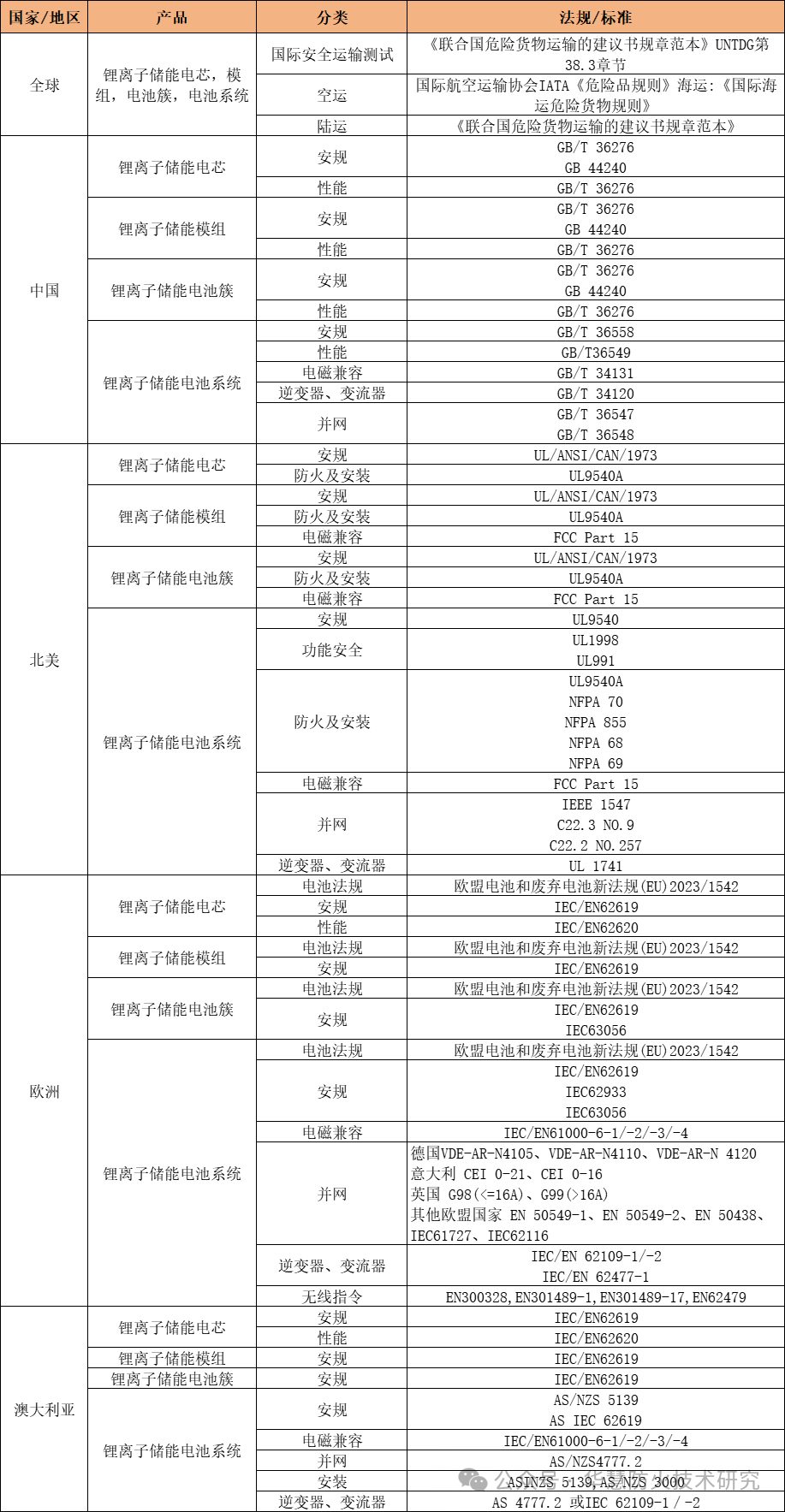
Energy storage certification requirements in the main markets
Global certification
Core standards: the IEC (International Electrotechnical Commission) series.
Cells: IEC 62619 (safety) and UN 38.3 (transport safety).
Modules and battery systems: IEC 62619 + IEC 60730 (functional safety) and UN 38.3.
Energy storage systems: IEC 62933 series (system-level safety and performance).
Inverters: IEC 62477-1 (safety of power converters) and IEC 62040 (UPS functions).
Europe
Energy storage battery safety: IEC/EN 62619, IEC/EN 63056
Energy storage battery performance: IEC/EN 62620
Energy storage system safety: IEC/EN 62619, IEC 62933, IEC 63056
Energy storage system safety risk assessment: IEC/EN 62933-5-2
Inverters and converters: IEC/EN 62109-1/-2, IEC/EN 62477-1
Grid connection: EN 50438 and others (grid connection standards for distributed generation).
North America
UL 1973: safety of cells, modules and battery systems.
UL 9540/9540A: overall safety of energy storage systems and thermal runaway assessment.
UL 1741: inverter safety (must be compatible with the IEEE 1547 grid connection standard).
EMC: FCC Part 15 (control of radio interference).
China
Lithium-ion battery safety: GB/T 36276, GB 44240
Energy storage system safety: GB/T 36558, GB/T 34131.
GB/T 34120: safety of power conversion systems for energy storage.
Grid connection: GB/T 36547, GB/T 36548 (grid connection performance of energy storage systems).
Transport: UN 38.3, the dangerous goods packaging certificate, and CCS (China Classification Society) certification.
Australia
Safety certification: AS/NZS 5139 (energy storage system safety) and AS IEC 62619 (battery safety).
EMC: IEC/EN 61000-6-1 to -4 (electromagnetic compatibility).
Grid connection: AS/NZS 4777.2 (grid connection requirements for distributed generation).
Key regional differences
Europe: CE marking is central, with several directives applying in parallel. Safety requirements are localised versions of IEC standards (EN 62619 = IEC 62619, for example) with EU directives layered on top. Germany, France and other countries also require local certification (such as VDE in Germany and NF in France), so products must still meet regional safety rules even after CE marking. In addition, the new Batteries Regulation requires a battery carbon footprint declaration and traceability of raw materials such as cobalt and lithium (for example, conflict-mineral certification for the Democratic Republic of the Congo); non-compliant products are barred from the EU market.
North America: the core is UL/CAN standards (UL in the United States plus CSA in Canada). Note that the UL 9540A thermal runaway test (which simulates a battery fire) is demanding, and California, New York and other states make functional safety certification (UL 991 + UL 1998) mandatory.
China: national standards centre on GB/T, with an emphasis on energy efficiency and coordination with the grid. Transport requires UN 38.3 plus the dangerous goods packaging certificate; all lithium battery modules and systems exported must have it, and the certificate must be issued by a body designated by China Customs.
Australia: AS/NZS standards, close to IEC but with an emphasis on local conditions. The core standards are AS IEC 62619 (identical to IEC) and AS/NZS 5139 (energy storage system safety).
Strategy
Focus by region and secure the core markets first. If you are targeting residential energy storage in Europe, plan early for CE-EMC (residential environment) + VDE-AR-E 2510-50 (safety of home energy storage) and so on. If you are targeting North America, concentrate on UL 9540A (thermal runaway testing), large-scale fire testing and the like.
Optimise compliance costs: use mutual recognition schemes such as CB certification to reduce repeat testing and avoid paying twice.
Global competition in energy storage is at heart a contest of both "compliance capability" and "technical strength". We hope this overview of certification requirements helps manufacturers break through information barriers and ease the pressure of market access, so that early-stage R&D, supply chain management and marketing can be matched precisely to the needs of the target market, ultimately turning compliance into a competitive advantage.
For more on tailoring a certification route, the order of certifications, sample preparation and other details, get in touch and we will be glad to help.
Contact us: +86 21 6991 3579, [email protected], or send a test request on this website.

First published on our WeChat channel: read the original