

Origins
In the 2010s the global energy storage industry entered a period of rapid growth, but frequent fires caused by thermal runaway in storage systems exposed a gap: technology was developing faster than standards. The US, an early mover in the storage market, was the first to face the regulatory challenge.
In 2015 UL published UL 9540, the safety standard for energy storage systems and equipment. It set out, for the first time, requirements for the electrical safety, mechanical safety and thermal runaway protection of storage systems, but did not specify a test method for the spread of fire from thermal runaway.
NFPA 855 grew out of the resistance storage projects met when deployed in communities. Public protests over fire hazards in places such as California pushed regulators to introduce stricter installation rules, and in 2016 the National Fire Protection Association (NFPA) began developing NFPA 855, with the aim of establishing an installation standard for stationary energy storage systems. Early drafts drew on NFPA 1 (Fire Code) and NFPA 70 (National Electrical Code), but lacked a quantitative basis for the fire risk of battery thermal runaway.
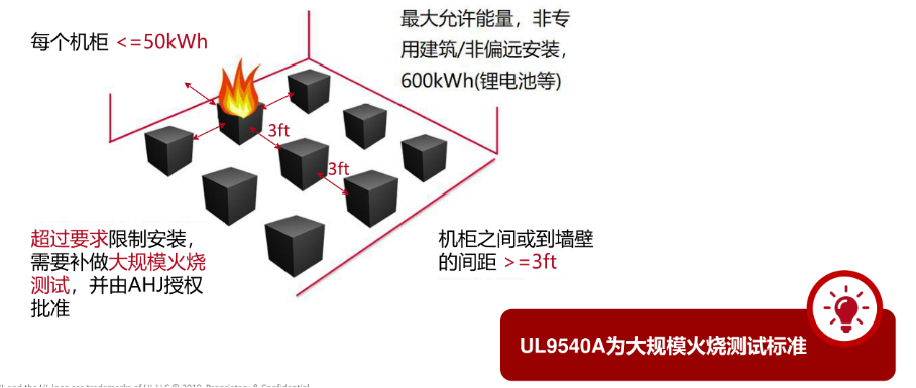
At the time, fire departments and building code bodies across the US found that traditional one-size-fits-all capacity limits (such as no more than 50 kWh per system indoors) and spacing requirements (at least 3 feet) seriously undermined the economics of storage projects. The industry urgently needed a technical route that demonstrated safety through testing, rather than relying purely on conservative limits.
The birth of UL 9540A
The first edition of UL 9540A was published in 2017, providing a scientific framework for assessing the thermal runaway risk of storage systems. UL 9540A set up a tiered test regime with four levels — cell, module, unit and installation — verifying at each level the conditions that trigger thermal runaway, the characteristics of the gas released and the way it propagates. It simulates battery thermal runaway behaviour under extreme conditions, quantifies the risk of fire spread and provides data to support design optimisation. For example:
Cell-level testing measures the lower flammability limit (LFL), maximum explosion pressure (Pmax) and burning velocity (with reference to ASTM E918);
Module-level testing adds assessment of smoke release and the rate of heat propagation;
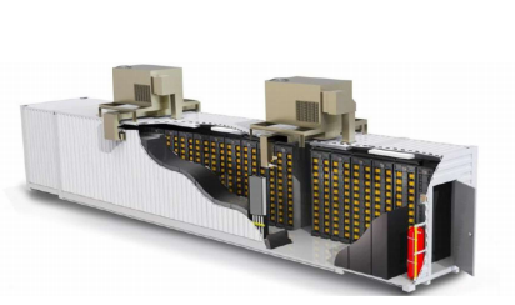
Installation-level testing simulates the fire chain reaction in a container or building-scale system.
UL 9540A thus became the scientific tool for assessing thermal runaway fire propagation for NFPA 855.
NFPA 855 states explicitly that if a storage system passes UL 9540A testing, its capacity and spacing limits can be exceeded. For example:
NFPA 855-2021 required no more than 50 kWh per system indoors and at least 3 feet between units;
With test data, and with the approval of the authority having jurisdiction, projects can go beyond these capacity and spacing limits.
How NFPA 855 has evolved
UL 9540A is the test tool; NFPA 855 is the compliance guide. Each revision of NFPA 855 has been linked to revisions of UL 9540A, and the two have formed a symbiotic relationship: code requirement and test method.
NFPA 855 introduced a "test-based installation approval" mechanism, allowing authorities to relax capacity and spacing limits on the basis of a UL 9540A report. It also makes clear that the fire protection design of a storage system must take account of UL 9540A data on explosion pressure and smoke toxicity, for example by requiring gaseous suppression systems and explosion venting devices.
This works in favour of storage products. For instance, after companies such as CATL passed UL 9540A testing, the barriers to entering the North American market for their storage products fell considerably.
What deserves our attention:
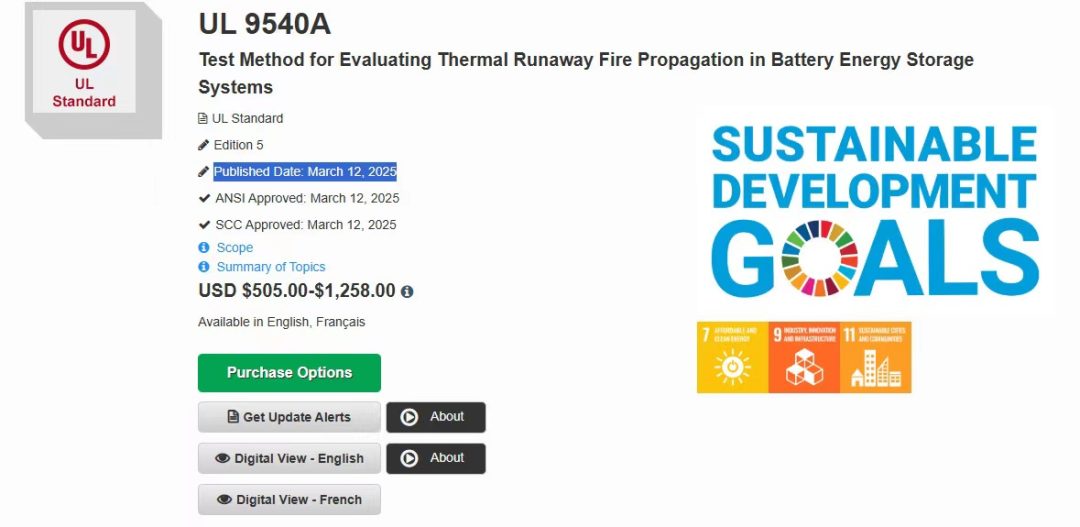
As the world's first dedicated safety standard for thermal runaway propagation in energy storage systems, UL 9540A reached its fifth edition on 12 March 2025, after 16 months of work and 27 rounds of intercontinental technical consultation and balloting. The new edition marks a strategic shift in storage safety standards from "passive fire protection" to "active early warning". It is not only a mandatory national standard in the US and Canada, but has also been written into storage installation regulations in major international markets such as Singapore, Malaysia and the Australian state of Victoria. Covering key markets in the US, Canada, Australia and South-East Asia, it gives companies going overseas a single technical framework.
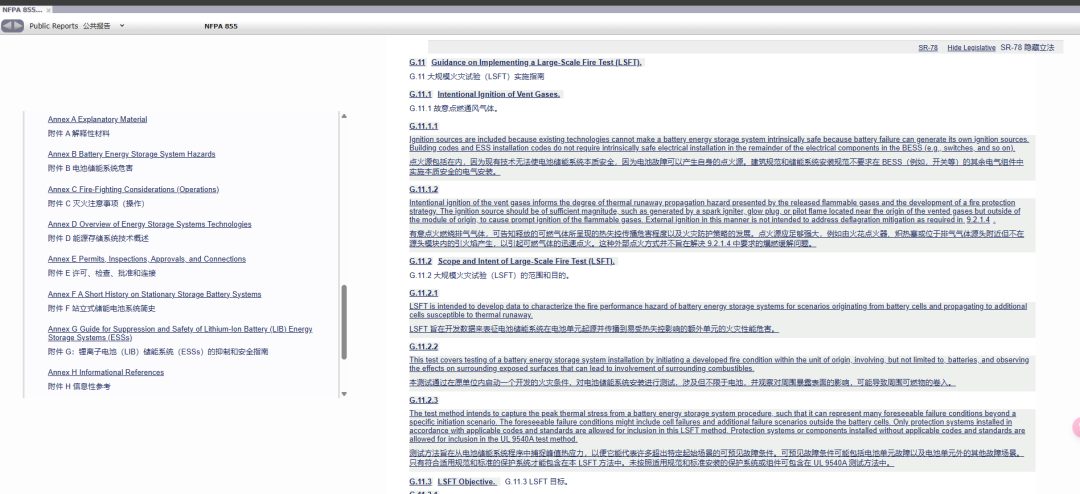
NFPA 855-2026, published in 2025, adds a requirement for large-scale fire testing on top of UL 9540A testing (section 9.2). The edition of UL 9540A it references is still the 2019 edition, not the fifth edition.
A model of cooperation
The way UL 9540A and NFPA 855 work together has been adopted in several countries.
In the US, the International Fire Code (IFC), the California Fire Code and other local regulations adopt the combined requirements of NFPA 855 and UL 9540A directly;
Singapore and Australia reference the installation requirements of NFPA 855 directly and require a UL 9540A test report;
The EU has not adopted them wholesale, but the thermal runaway test methods required by the Batteries Regulation are very similar to UL 9540A; in future, mutual recognition of test data will be needed to reduce compliance costs for companies.
At heart, the relationship between UL 9540A and NFPA 855 is a close coupling of a technical standard and a regulatory standard. The first quantifies risk through testing; the second turns the data into enforceable installation rules. As technology advances and standards converge worldwide, this "golden pairing" will continue to lead the storage industry towards greater safety and efficiency.
The fifth edition of UL 9540A will also become the technical foundation for the revision of NFPA 855. Its impact lies not only in the update to the standard itself but in reshaping the design logic of storage systems — from "conservatively limiting capacity" to "proving safety through testing" — and so speeding up the delivery of large storage projects. Companies need to pay particular attention to compliance with large-scale fire testing to meet market access requirements in North America and worldwide.

First published on our WeChat channel: read the original