

On 12 March 2025, UL published ANSI/CAN/UL 9540A-2025, the test method for thermal runaway fire propagation in battery energy storage systems.
The world's first dedicated safety standard for thermal runaway propagation in energy storage systems, it has now reached its fifth edition, after a 16-month revision involving 27 rounds of technical consultation and votes across continents.
UL 9540A is not only a mandatory national standard recognised in the United States and Canada; it is also widely adopted internationally, and is cited by the energy storage installation regulations of Singapore, Malaysia and the Australian state of Victoria for specific installation scenarios.
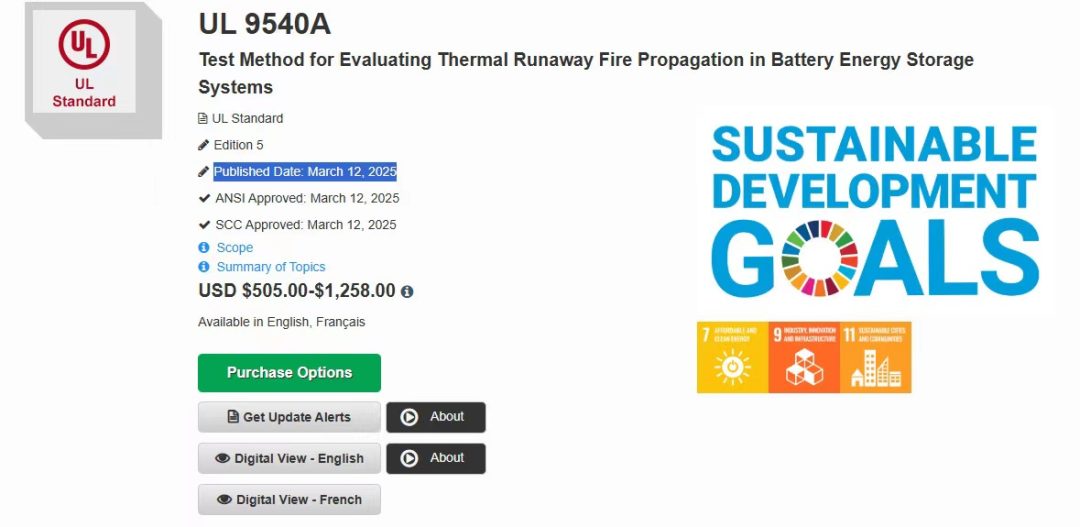
Here is an early look at the summary of key changes in the fifth edition of ANSI/CAN/UL 9540A (12 March 2025).
1. Updated test methods and measurements
FTIR and hydrogen measurement: FTIR (Fourier-transform infrared spectroscopy) measurement is now optional, and hydrogen measurement is newly required in unit-level tests (clauses 8.2.14–10.3.13).
Continuous heating option: a new method of initiating thermal runaway by continuous heating has been added (7.3.1.5).
Heat flux gauges and sampling rates: Gardon gauges are permitted, and the sampling rates for heat flux and wall temperature have been revised (6.3, 9.2.15–10.3.10).
Heat flux criteria for egress paths: the heat flux measurement requirements for non-residential outdoor wall-mounted systems have been updated (9.5.1, 9.5.5).
2. Changes to test configuration and equipment
Residential unit tests: a "test wall" replaces the NFPA 286 test room (9.1.2, Figure 9.3).
Thermocouple locations: the placement of thermocouples in cell tests has been revised (7.3.1.2, 7.3.1.7–10).
Exception for ground-mounted systems: a new exception has been added for residential systems (9.2.19–10.3.10).
3. Clarified definitions and procedures
Sample rest time: the rest time for samples after conditioning and charging has been clarified (7.2.2, 8.1.2, 9.1.9).
Cell charging method: the cell charging procedure has been set out in more detail (7.2.1, 7.2.4).
Test report requirements: the reporting requirements where a battery system is used as the BESS unit have been clarified (7.7.1).
Failure criteria: the terminology for cell, module and unit failure has been revised (7.3.1.2, 8.2.8–9.1.8).
Definitions: "thermal runaway propagation" has been added and the definition of "thermal runaway" revised (4.16, 4.19).
Residential and non-residential: the distinction between the two uses has been clarified, which affects test configuration and reporting (8.4.1, 10.7.1).
4. New test methods
More battery types: test methods have been added for lead-acid and nickel-cadmium batteries (7.3.3.1–7.10.4), along with a test procedure for high-temperature batteries (7.3.4.1–10.11.3).
Flow batteries: the requirements for flow batteries have been updated (5.4.3, 7.1.1–9.11.1).
5. Revised performance criteria
Module-level performance: the acceptance criteria for module tests have been revised (8.5.1).
Module surface temperature range: the measurement range has been adjusted (9.7.3, Table 9.1, 10.5.2).
6. Updated referenced standards
NFPA 855 added as an applicable code (1.2, 3.2).
UL 1685 replaced by UL 2556 as the cable standard reference (3.2, 10.2.2).
7. Safety and construction requirements
Non-combustible construction exception removed: the rules for outdoor flame spread have been clarified (4.16, 9.1.1–9.7.1).
Deflagration hazard: a deflagration analysis requirement has been added in Annex A (A3.3.1).
8. Other important updates
Alignment with residential use: code requirements related to residential use have been revised (1.2, 10.1.1–A2.3.2).
Residential installation restriction deleted: the statement prohibiting installation in dwelling units has been removed.
Expanded test reports: the content of module-, unit- and installation-level test reports has been expanded (8.4.1, 10.4.1).
Impact in brief
More flexibility: optional FTIR and the heating method give more flexibility in testing.
Wider scope: tests for lead-acid, nickel-cadmium and high-temperature batteries cover more technologies.
Stronger safety: the revised flame spread rules and the new deflagration analysis reduce the risk of fire spread.
Simpler testing: the move to a test wall for residential tests may make testing less complex.
This edition puts the emphasis on clarity, safety and technological inclusiveness, keeping pace with developments in battery technology and in regulation.
Summary
UL 9540A evaluates the safety of an energy storage system after thermal runaway propagates through its batteries. It is the reference standard for the large-scale fire testing mentioned in NFPA 855, and the only consensus standard recognised in NFPA 855.
The publication of UL 9540A-2025 marks a strategic shift in energy storage safety from "passive fire protection" to "active early warning". We will continue to offer a one-stop service covering standard interpretation, test planning and cross-border certification. For the full text of the standard or technical support, please get in touch.
Contact us: +86 21 6991 3579, [email protected], or send a test request on this website.

First published on our WeChat channel: read the original