

As the energy storage battery industry booms, safety has become the top priority. UL 1973, a key standard for energy storage battery safety, attracts attention worldwide.
What is UL 1973?
UL 1973 (the Standard for Batteries for Use in Stationary, Vehicle Auxiliary Power and Light Electric Rail (LER) Applications) is a safety standard for energy storage battery systems and equipment published by Underwriters Laboratories.
UL 1973 was first published in 2008 to provide safety requirements for the design, installation and use of energy storage battery systems and equipment, so that these systems are safe and reliable across their applications. It has since been revised and updated several times to keep pace with developing storage technology and market needs. The latest edition is UL 1973-2022.
Scope of UL 1973
Battery types: the standard covers battery systems used for stationary storage, solar PV, wind, backup power, telecom base stations, vehicle auxiliary power, LER and similar applications, and includes construction evaluation and test evaluation of energy storage systems. It is purely a safety standard, however, and does not assess performance or reliability.
-
Batteries and components for light electric rail (LER) or stationary installations.
-
Stationary and/or motive storage batteries and components.
-
Batteries for stationary energy storage (PV systems, wind farms, home storage, etc.).
-
Batteries for vehicle auxiliary power (excluding traction batteries).
-
No restriction on chemistry: all kinds of batteries, supercapacitors, and hybrid battery/electrochemical capacitor systems are included, for example sodium-beta batteries and flow batteries.
Applications: energy storage battery systems and equipment used in residential, commercial, industrial and utility settings, for example batteries in home solar systems, backup power systems in data centres, storage at EV charging stations, and grid-scale energy storage stations.
What UL 1973 tests
UL 1973 testing is very comprehensive, covering electrical, electromagnetic, mechanical and environmental tests as well as materials tests.
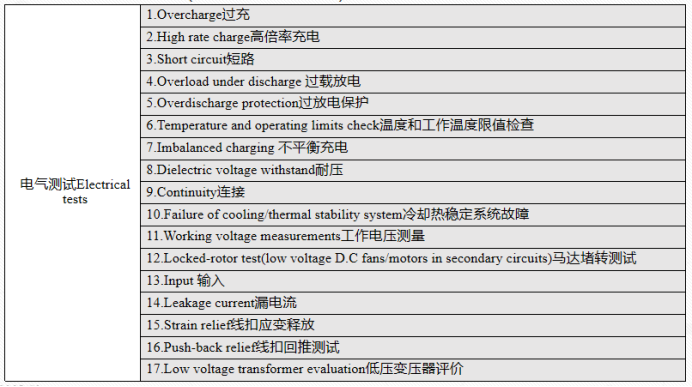
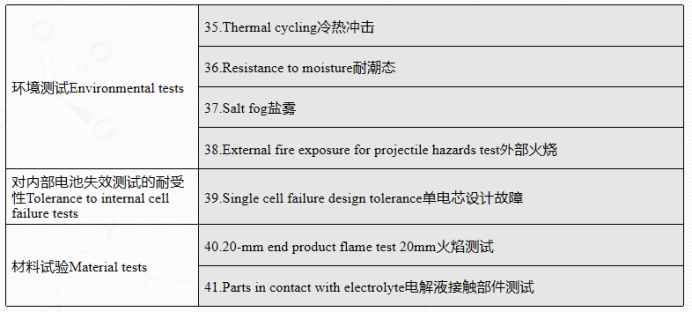
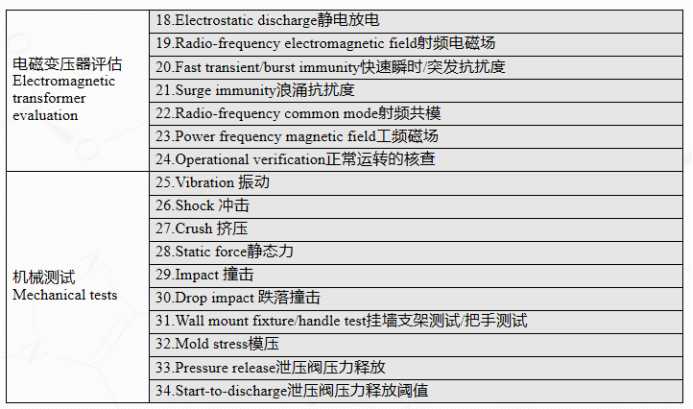
It is worth noting that, while attention has long focused on the thermal runaway testing in UL 9540A, the safety tests in UL 1973 are an effective way of preventing cells, modules and systems from going into thermal runaway, catching fire or exploding under abnormal conditions. To assess whether a product will propagate fire or explode, UL 1973 in fact also requires two fire exposure tests: an external fire exposure test and an internal fire exposure test.
The external fire test is intended to show that the ESS will not explode when exposed to a hydrocarbon pool fire or brush fire. A fully charged ESS is exposed for 20 minutes to a heptane pool fire or a similar hydrocarbon pool fire. The fuel is held in a pan 24 inches below the ESS, sized (in diameter) to cover the footprint of the ESS. After the 20-minute exposure, the ESS is subjected to the hose stream test of UL 263 (the standard for fire tests of building construction and materials) to assess how the system behaves under water impact during a fire.
The internal fire test is intended to demonstrate how the ESS prevents a single-cell failure inside the battery system from causing fire and/or explosion. A fully charged product is heated until one internal cell at the centre of the ESS goes into thermal runaway. Once thermal runaway starts, the means used to initiate it is switched off or stopped, and the ESS is observed for one hour. During this period, flames must not spread or cause an explosion.
These tests show that UL 1973 sets detailed requirements for every aspect of a lithium battery, from design and manufacture to performance.
On electrical safety, it requires the electrical connections of the battery system to be secure and the insulation to meet a defined level, to prevent electric shock in use; earthing must also meet strict rules so that electrical short circuits do not cause fires or other hazards.
On thermal management, since lithium batteries generate heat when charging and discharging, the standard requires the battery system to have an effective cooling design that monitors and controls temperature in real time, keeping the batteries within a suitable temperature range and preventing overheating that would degrade performance, shorten life or even cause a safety incident.
On mechanical construction, the standard requires the enclosure and internal structure of the battery to be strong and stable enough to withstand the vibration, shock and other mechanical stresses it may meet during transport, installation and use.
With the 2022 edition of UL 1973, these requirements on manufacturers become correspondingly stricter. Energy storage products intended for sale in the US should take the requirements of the third edition of UL 1973 into account at the design stage, to avoid later rework or redesign.
UL 1973 and regulatory requirements
UL 1973 is the North American safety standard for energy storage battery systems and is recognised as a national standard in both the US (ANSI) and Canada (SCC). It is also recognised in other regions, such as by Australia's CEC, and is highly regarded in the energy storage sector. Products certified to it can enter the North American and Australian markets, and indeed markets worldwide, more easily, and gain credibility for their brand.
The IFC (International Fire Code) is the model fire code used in the US. Its Section 1207, Electrical Energy Storage Systems, refers to UL 1973 for thermal runaway protection and battery system safety requirements.
NFPA (National Fire Protection Association) standards are published by the US fire protection association. NFPA 70 is the National Electrical Code (NEC), adopted in all 50 US states as the benchmark for safe electrical design, installation and inspection to protect people and property from electrical hazards. Its Article 706, Energy Storage Systems, also requires battery system thermal runaway protection and safety to comply with UL 1973.
NFPA 855, the Standard for the Installation of Stationary Energy Storage Systems, is also published by the NFPA. Its Chapter 9, Electrochemical Energy Storage Systems, requires battery systems, modules, capacitor systems and modules, and thermal runaway protection to comply with UL 1973.
UL 1973 is also among the standards recognised by OSHA, part of the US Department of Labor.
In other words, many countries and regions around the world treat UL 1973 certification as a prerequisite for importing and installing lithium batteries. Energy storage products entering the US and Canadian markets generally need to pass UL 1973 testing and obtain certification, or risk seizure, fines or even exclusion from the market.
For lithium battery exporters, UL 1973 certification is an important way to become more competitive. In international markets, consumers and buyers pay increasing attention to product safety and compliance. A UL 1973 certification mark is in effect a trusted safety label on a battery product, giving customers more confidence to choose and use it. This helps companies expand overseas and win more international orders, and strengthens their brand image and reputation. In a fiercely competitive energy storage market, UL 1973 certification is one of the key factors that make a company stand out.

First published on our WeChat channel: read the original