

Gas burning velocity
Thermal runaway in a lithium-ion cell is a chain of exothermic reactions inside the cell triggered by a short circuit, overcharge or mechanical damage. It is accompanied by decomposition of the electrolyte, melting of the separator and violent reactions of the cathode and anode materials, releasing large amounts of heat and flammable gases (such as H₂, CO, CH₄ and HF).
The burning velocity of lithium battery thermal runaway gas is the speed at which a flame propagates through the flammable gas mixture released by the battery during thermal runaway, under specified conditions. It is usually expressed in centimetres per second (cm/s). It directly reflects how violently the gas burns and how fast it releases energy, and it is a key parameter in assessing the explosion risk in battery enclosures and the hazard of thermal propagation.
Why the test is needed
As a lithium battery performance property, gas burning velocity is one of the properties measured in the UL 9540A cell-level test.
In practice, however, many battery manufacturers focus on performance indicators such as cell energy density and cycle life, and invest too little in understanding the mechanisms behind vent gas burning velocity and in optimising its testing. This blind spot creates many obstacles to both R&D and compliance.
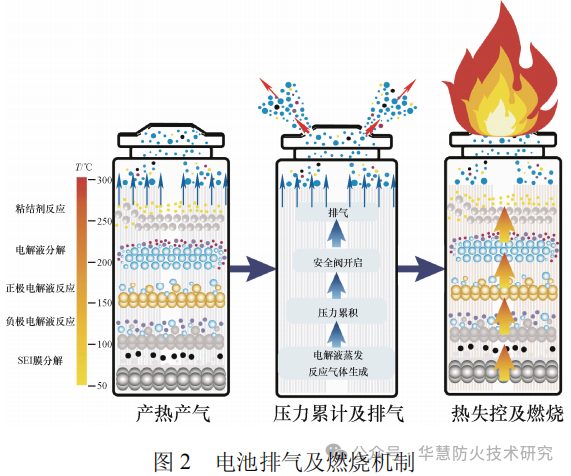
Gas burning velocity is a key indicator for assessing the fire and explosion risk of thermal runaway gas. The data can be used to judge accurately how dangerous a battery is in thermal runaway and provide a direct basis for assessing the fire and explosion risk of its vent gas.
Testing burning velocity gives R&D staff and companies a clear understanding of a battery's potential risks in extreme conditions, so that they can take appropriate safety measures in battery design and system integration and reduce the likelihood of fire and explosion incidents.
It is also key input data for calculation and simulation. It directly affects the design of pressure relief devices and the fire strategy for energy storage systems, and provides key parameters for explosion protection and venting design, ensuring that vent sizes match the burning velocity and helping products meet the relevant standards and codes.
For burning velocity testing of lithium battery thermal runaway gas, accuracy of the data matters above all. Accurate data is an important foundation for subsequent battery design and development.
For product certification, accurate test data is a prerequisite for passing the relevant certifications.
A UL 9540A test report is a precondition for insurance and grid connection of energy storage projects in North America and more than 50 countries worldwide, and so directly affects market access; and UL 9540A is explicitly linked to burning velocity data. If the test data are inaccurate, the product may fail the additional verification (such as deflagration testing) that overseas regulators or insurers require, stalling projects, delaying market entry and causing financial losses.
Measuring burning velocity under UL 9540A
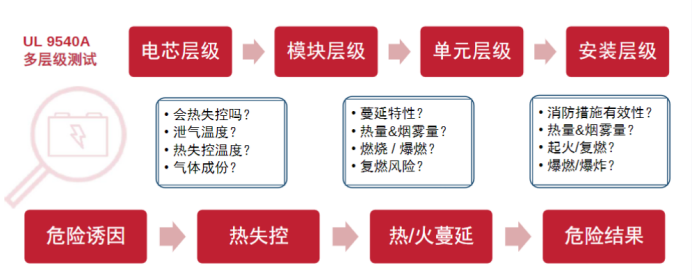
UL 9540A is currently the widely accepted and cited safety test method for evaluating thermal runaway fire propagation in battery energy storage systems. It comprises cell-level, module-level, unit-level and installation-level tests, and it explicitly places the burning velocity test of battery vent gas within the cell-level safety tests.
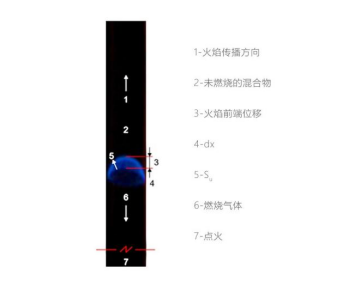
In UL 9540A, the burning velocity is defined as the speed at which the flame front in a flammable gas mixture propagates vertically along the combustion tube under specified conditions. It is the core parameter for quantifying the fire and explosion risk of thermal runaway gas.
Typically, the cell is driven into thermal runaway in a pressure vessel and the vent gas is produced and collected there. Gas chromatography (GC) is used to identify and quantify the components of the vent gas, and the burning velocity is then measured on a synthesised replica gas mixture.
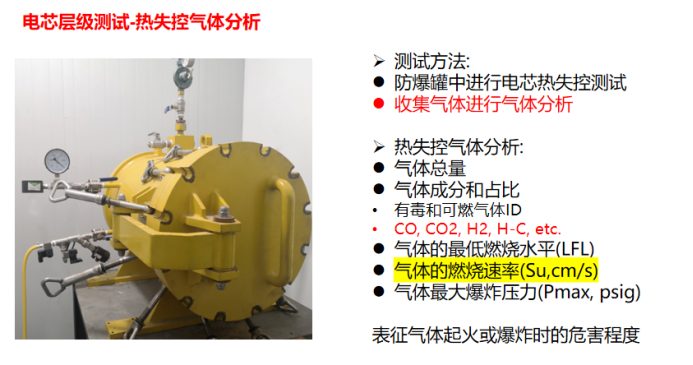
In UL 9540A, the burning velocity of the flammable gas is determined in accordance with ISO 817 (Refrigerants — Designation and safety classification), Annex C (test method for measuring the burning velocity of flammable gases).
The basic principle is as follows. A homogeneous mixture of the flammable gas under test and air is ignited in a long, narrow vertical tube that is open at the bottom (ignition) end, and the flame propagates upwards towards the closed end. During the stable propagation phase, a camera records the flame in real time, and image processing algorithms extract the flame shape to calculate the surface area of the flame front and the burning velocity.
Limitations
In practice, however, and particularly for the complex gas mixtures produced by battery thermal runaway (such as hydrogen-rich, fast-burning gases), the ISO 817 Annex C method has certain limitations.
The choice of tube inner diameter has to balance quenching of the flame at the wall against stability of flame propagation. The larger the diameter, the less readily the flame is quenched, but the less stable its shape.
ISO 817 uses a tube with a 40 mm inner diameter, designed for refrigerant gases with low burning velocities (typically < 40 cm/s). Slow flames are easy to capture, and measurement accuracy is high.
For mixtures with high burning velocities, such as those containing hydrogen, the propagating flame is easily affected by turbulence and buoyancy. The flame front becomes distorted and unsteady, and may even split or extinguish and re-ignite. When the diameter is too large (such as 40 mm), wall quenching is weaker, and the turbulent boundary layer formed by the fast flow in the tube disrupts the laminar structure of the flame front. This increases the error in calculating the flame front surface area and makes the measured burning velocities widely scattered.
Besides the diameter, fast-burning gases propagate the flame front in a very short time, and the camera frame rate may be too low to capture key transient features. The flame is also bright, with a wide dynamic range, which easily causes overexposure or blurred edges and reduces the accuracy of shape recognition.
Furthermore, battery thermal runaway gas has a complex composition (H₂ can exceed 40 %, together with CO, CH₄, C₂H₄ and others). The components differ widely in diffusion coefficient and burning velocity, which easily leads to uneven distribution of the mixture in the tube. The flame front then advances irregularly, forming "finger-like" or "cellular" flame shapes, so that the overall measurement departs from the true mean.
Improving test accuracy
Building on its capability to test at every level of UL 9540A, the Huahui laboratory has accumulated extensive experience in testing thermal runaway gas from lithium batteries of many types and specifications.
To keep pace with the testing needs that come with continually evolving lithium battery products, and to take responsibility for test accuracy, these challenges call for in-depth study of the ISO 817 Annex C vertical tube method. By optimising the test method, improving on the standard and introducing coordinated multi-parameter analysis, test accuracy can be greatly improved and the differences in precision caused by the limitations of the method avoided, achieving the following test results:
In short, accurate measurement of the burning velocity of battery thermal runaway gas is key to safe battery design, product certification and market access. Drawing on advanced test equipment and our capability across every level of UL 9540A, our laboratory will continue to work professionally and rigorously, making full use of its strengths to provide the industry with more accurate and reliable test data and support the safe, healthy development of the energy storage industry.
First published on our WeChat channel: read the original