

Growing workloads from artificial intelligence, cloud computing and streaming are creating enormous demand for data centre computing capacity. Operators are racing to meet it, and to do so they must find ways to extend the life of their data centres and make them more flexible.
The modular data centre (MDC) has emerged as a revolutionary way of building, and has quickly moved from edge applications to centre stage, carrying core business. The global MDC market is expected to grow from USD 29.3 billion in 2025 to USD 128 billion in 2035, a compound annual growth rate of 15.8%.
This rapid growth, however, brings an urgent need for standardisation. When prefabricated modules have to be assembled and expanded quickly around the world like Lego bricks, a widely recognised set of safety and performance standards is essential. It is against this background that UL 2755 originated in the North American market and has evolved into the compliance standard for MDCs worldwide.
What is a modular data centre (MDC)?
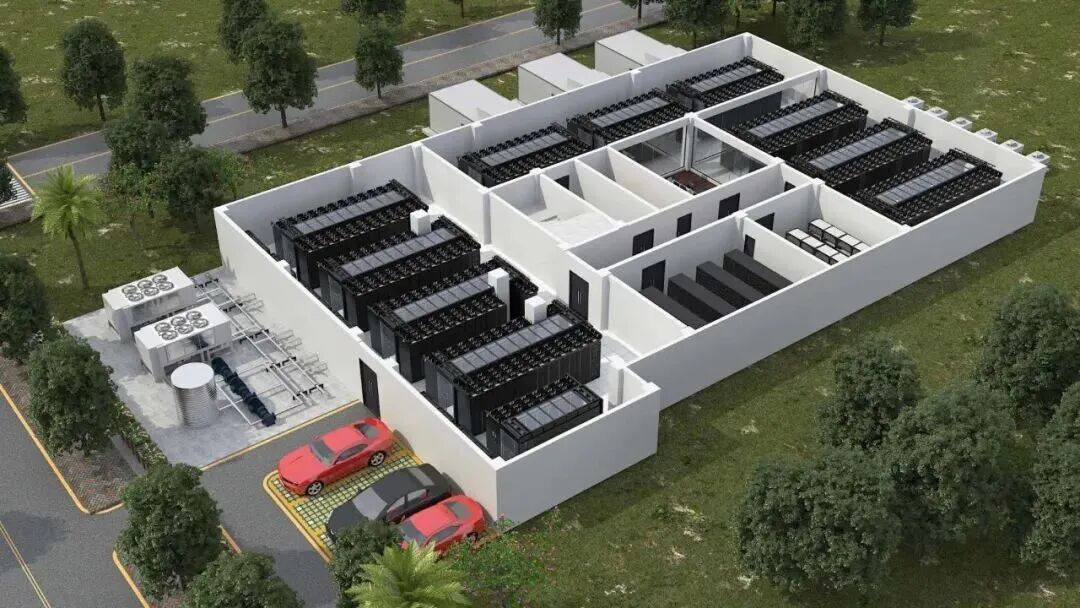
A modular data centre is a data centre solution based on prefabricated, standardised design: the key infrastructure components of the data centre (power distribution, cooling, racks, fire protection, monitoring and so on) are integrated in the factory into self-contained functional modules, which are then shipped to site for rapid assembly and deployment. The core idea is to "turn complex site engineering into efficient factory manufacturing".
The main forms are:
Containerised MDC: a complete data centre integrated into a standard ISO container, ready to plug and play.
Prefabricated power and cooling modules: complex power distribution units (PDUs), uninterruptible power supplies (UPS) or cooling plant (such as chillers or indirect evaporative cooling) prefabricated as self-contained modules.
Micro-modules (MDC pods): a number of racks with their associated power distribution, cooling and aisle containment integrated into a unit that can operate on its own, the typical way of adding capacity on demand.

Challenges for MDCs and the need for standards
The rapid growth of MDCs has also exposed a number of challenges:
High system integration complexity: an MDC involves tight coupling of electrical, mechanical, thermal, network and control systems, and any interface or compatibility problem can cause a system-wide failure.
Unclear safety responsibility: when the power, cooling and IT modules come from different suppliers, it is hard to establish responsibility after an incident, which exposes operators and owners to great risk.
Barriers to global market access: countries and regions have different electrical safety and building code requirements, so MDCs face complex compliance reviews.
UL 2755
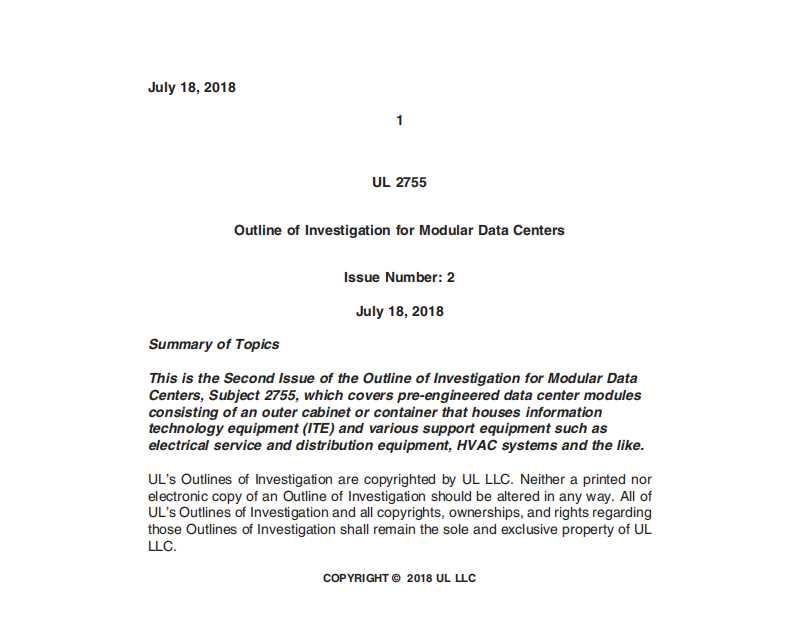
UL 2755 is the dedicated evaluation framework for prefabricated modular data centres (MDCs). Although it currently takes the form of an Outline of Investigation for Modular Data Centers, it has become the recognised benchmark for MDC safety certification in the US market.
It was developed by UL Solutions together with equipment manufacturers, regulators and end users. First published in 2018, it underwent a key revision in 2025 (UL 2755:2025). Its core aim is to address the system-level safety risks that come with the integrated, prefabricated nature of modular data centres.
Unlike traditional equipment standards, UL 2755 takes a system-level approach to evaluation, treating the MDC as a complete integrated system rather than a collection of separate components. Its scope covers three core dimensions: the external enclosure (container, metal housing, etc.); the key internal components (IT equipment, power distribution, HVAC, UPS, fire protection equipment, etc.); and safety across the whole life cycle (factory prefabrication and integration, protection in transport, site installation, and operation and maintenance). Together these form a safety framework covering the whole chain from design to disposal.
UL 2755 sets strict requirements for MDCs in several areas to ensure safe and reliable operation:
Structural integrity: modules must withstand the mechanical stresses of transport, lifting and operation and meet the requirements for wind resistance, seismic resistance and environmental protection rating. The fire performance of materials must comply with NFPA standards to slow the spread of fire.
Electrical safety: including wiring practice, protection of the power distribution system, earthing design and arc flash protection. All electrical components must comply with the NEC, and equipment such as UPS and PDUs must pass short-circuit and overload protection tests.
Cooling performance: for high power density applications, liquid cooling, including cold plate and immersion cooling, can be evaluated. The stability of the cooling system under extreme load must be verified to prevent overheating.
Fire and personnel safety: fast-response fire detection and suppression equipment suited to a modular environment (such as gaseous extinguishing systems) must be installed. Enough working space and emergency exits must be provided to keep operating and maintenance staff safe.
Note in particular that even after an MDC is certified to UL 2755, its internal components must still meet their own UL standards (such as UL 508A for industrial control panels, UL 1778 for UPS and UL 294 for access control systems), giving a dual compliance system of "system certification + component certification".
UL 2755: the threshold for the US market
Section 646.4 of the US National Electrical Code (NEC) explicitly names UL 2755 as a reference for MDC compliance certification, and the authority having jurisdiction (AHJ) treats UL 2755 certification as the core evidence of compliance during site inspections. MDC products without this certification not only cannot obtain an installation permit but may also face legal liability.
US states and local governments generally adopt the NEC as their electrical safety code, and many insurers require data centre equipment to be UL certified to reduce insurance risk and premiums. Large US companies and government agencies usually write UL certification into their contracts as a basic requirement when buying data centre equipment. UL 2755 certification is therefore not only a matter of technical compliance but a necessary condition for meeting US legal and commercial requirements.

As a comprehensive safety standard for modular data centres, UL 2755 not only defines technical requirements for products but also shapes the design philosophy and direction of the whole industry. By setting comprehensive requirements for structural, electrical, mechanical, fire and personnel safety, UL 2755 ensures that modular data centres deliver flexibility and efficiency without sacrificing safety and reliability.
For modular data centre manufacturers that want to enter the US market, UL 2755 certification is indispensable. It is not only the legal compliance prerequisite for meeting NEC Article 646 and AHJ requirements but also a strategic tool for winning customer trust and becoming more competitive. With rapid technical change and ever fiercer competition, UL 2755 certification has become a company's passport for demonstrating its technical strength and entering high-end markets.
As AI, edge computing and other technologies develop further, UL 2755 will continue to evolve. Manufacturers should treat UL 2755 compliance as a continuous process rather than a one-off certification task, meeting the standard's requirements while driving modular data centre technology forward through continuous innovation and improvement.

First published on our WeChat channel: read the original