

GB/T 44026
GB/T 44026-2024, the technical specification for prefabricated-cabin lithium-ion battery energy storage systems, is China's first national technical specification for this type of system. Its core breakthrough is that, for the first time, it sets out systematic requirements for protection against cell thermal runaway propagation in a national standard, and it sets unprecedentedly strict requirements for cabin protection, fire-resistant materials and test methods.
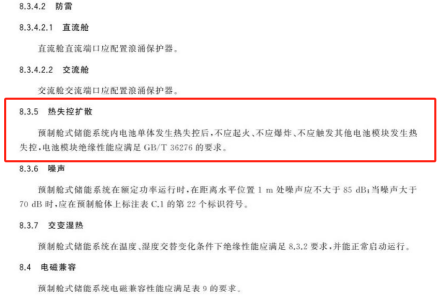
It establishes a systematic technical framework for protection against thermal runaway propagation. The standard explicitly requires that, after a cell in a prefabricated-cabin energy storage system goes into thermal runaway, the system meets the "three nos": no fire, no explosion, and no thermal runaway triggered in other battery modules.
Test procedure
Sample preparation: one battery cluster is placed in the middle of the prefabricated cabin; the trigger target is the cell at the centre of the cluster.
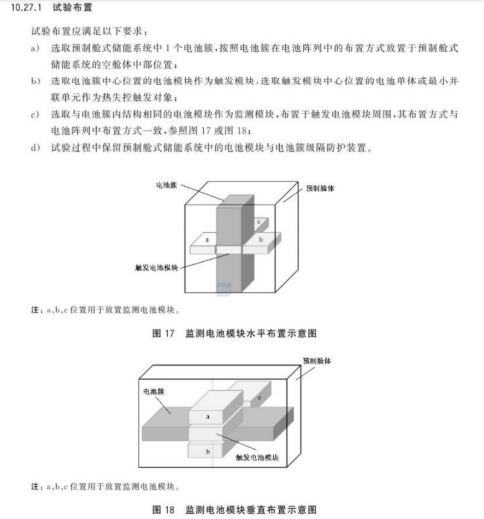
Conditioning: the state of charge (SOC) of the trigger target is adjusted to 95 % of rated charge energy, simulating the high-energy state of real operation.
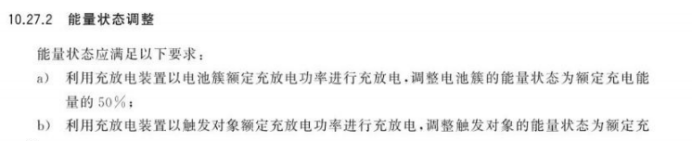

Trigger: thermal runaway is triggered by constant-current charging. Charging stops and the observation phase begins when the highest temperature in the module reaches 300 ℃, when the test time reaches 4 hours, or when any cell shows signs of thermal runaway such as a sudden voltage drop or temperature jump.
Assessment: the voltage, temperature and rate of temperature rise of the trigger module and the monitored modules are recorded, together with what is observed, including swelling, leakage, smoke, fire, explosion and the location of any casing rupture. System-level protection must ensure that thermal runaway is fully contained.
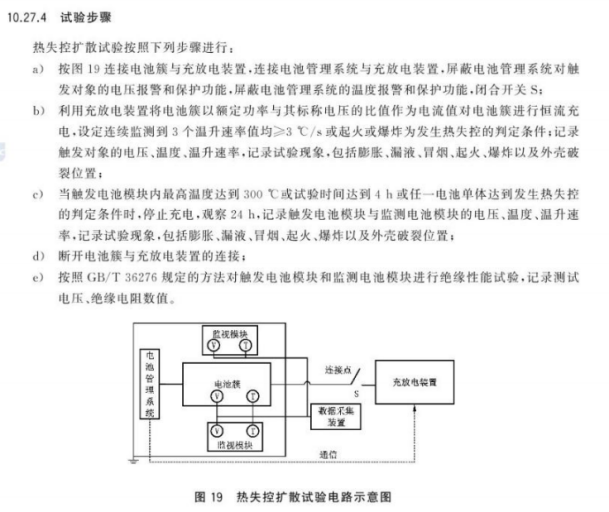
By simulating the propagation path of thermal runaway under extreme conditions, this test method verifies the system's ability to stop thermal runaway.
Why thermal runaway propagation testing is needed
Thermal runaway in lithium-ion battery energy storage systems has a pronounced "domino effect". In the fire at a 20 MWh energy storage station in Wuwei, Gansu, thermal runaway started by a single overcharged module spread through the whole battery cabin within 3 minutes, and 2,000 cubic metres of firefighting water were eventually needed to bring it under control.
GB/T 44026-2024 triggers thermal runaway by charging the battery cluster at constant current, with the trigger cell at the centre of the cluster; charging stops when the highest temperature in the trigger module reaches 300 ℃, after 4 hours, or when thermal runaway is detected, followed by 24 hours of observation. It requires prefabricated-cabin energy storage systems to meet the "three nos" after thermal runaway in a single battery cluster ("no fire, no explosion, no runaway triggered in other modules"), cutting off the path of thermal propagation at its root. For example, in testing of Eaton's xEnergyCubo system, even with the trigger cell held at an extreme 300 ℃ for 24 hours, thermal runaway was stopped at multiple levels from cell to cabinet, showing that the standard is achievable in practice.
Before this, in the absence of a unified standard, some companies in the energy storage industry simplified their designs, leading to inconsistent product performance. GB/T 44026-2024 sets explicit requirements for thermal runaway propagation, explicitly requires the fire resistance of the cabin and the reaction to fire of the insulation materials to meet class A, and makes a thermal runaway propagation type test compulsory. This effectively raises the barrier to entry to the industry and forces companies to retire outdated technology.
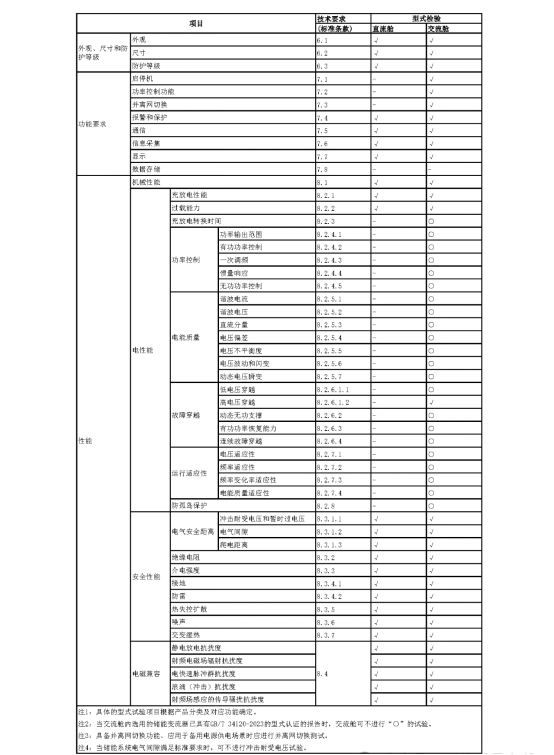
The test data also provide key parameters for system design:
Material selection: analysis of gas volume and composition (such as CO and CH₄ concentrations) helps optimise flame-retardant materials and select cabin protection materials that meet the test requirements, satisfying the standard's compliance requirements for the materials of prefabricated cabins, such as reaction to fire and fire resistance.
Structural design: temperature gradient data are used to adjust the spacing between battery clusters and the ventilation paths, optimising product design and improving safety.
In lithium-ion battery energy storage systems, thermal runaway propagation between battery clusters is a critical issue. Once one battery goes into thermal runaway, it may quickly spread to its neighbours and cause a serious accident.
The implementation of GB/T 44026-2024 marks a new, "system-level protection" stage in China's safety standards for energy storage systems. By establishing a multi-level system for stopping thermal runaway from cell to cabin, the standard not only gives the industry a unified technical specification but, through close alignment with international standards, also helps Chinese energy storage technology compete globally.
In future, as new technologies such as solid-state batteries and intelligent fire protection systems are adopted, thermal runaway propagation testing will keep evolving towards "accurate prediction and active prevention and control", and the related test methods and standards will continue to be refined and updated. We all need to keep following and learning about them.

First published on our WeChat channel: read the original