

At this critical stage of the energy transition, energy storage, as a core means of balancing electricity supply and demand and keeping the power system stable, is enjoying unprecedented opportunities for growth. As installed storage capacity in China keeps rising and safety incidents at energy storage stations continue to occur, the construction quality of these stations matters more than ever.
To meet this challenge, in May 2022 China's National Energy Administration issued a Notice on Strengthening the Safety Management of Electrochemical Energy Storage Stations. The notice is comprehensive and detailed. It sets systematic safety management requirements across 7 main areas and 18 specific topics: control at source through planning and design, careful equipment selection, rigorous completion and grid-connection acceptance, whole-life tracking of operation and maintenance, and emergency and fire preparedness. It lays a solid policy foundation for the sound development of the storage industry.
Energy storage stations play a vital role in the power system as a tool for peak shaving and valley filling. When demand peaks, they release stored energy promptly to relieve the strain on supply; when demand is low, they store surplus electricity so it is not wasted.
The battery pack is the core component of a storage station, its "heart", continuously supplying the station with power. Its performance and safety directly determine how well the whole station runs. If the batteries perform inconsistently or carry hidden hazards, the station may fail or even catch fire at any time, and there are many examples of such station fires. That is why sample testing of storage station batteries is so important.
Properly conducted sample testing can reveal potential problems in time and keep the station running safely and stably. Analysis of the test data can also guide targeted improvements in battery performance, extending service life and reducing later operation and maintenance costs. From the wider perspective of the industry, rigorous battery sampling is an important safeguard for the healthy, sustainable development of energy storage, helping speed China's transition to a greener, more efficient energy mix.
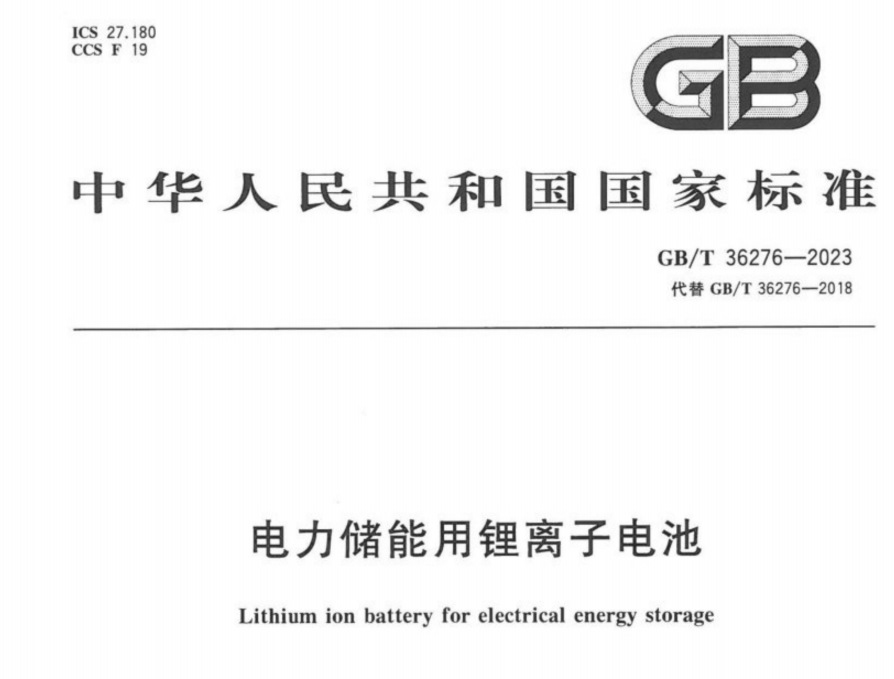
Sample testing of storage station batteries is not done at random; it follows strict standards. GB/T 36276-2023, Lithium-ion batteries for electrical energy storage, published in 2023 by China's State Administration for Market Regulation together with the Standardization Administration of China, provides the basis for battery sample testing.
When sample testing is required
a) To verify that the key performance of the products actually installed in a project is consistent with that of the corresponding type-tested product;
b) To verify that the key performance of a production batch is consistent with that of the corresponding type-tested product;
c) To verify that the key performance of replacement products is consistent with that of the corresponding type-tested product;
d) Where required by contract.
Sampling rules
Sample testing shall be carried out in order and comply with the following:
a) Module sampling is completed before battery cluster sampling, and cell sampling is completed before module sampling;
b) Each product model is sampled separately;
c) The routine sampling items and sample sizes are the mandatory items and minimum sample sizes; items and sample sizes may be increased where needed, for example for arbitration;
d) Where the total rated energy of a battery batch does not exceed 100 MWh, the batch is taken as one sampling unit;
e) Where the total rated energy of a battery batch exceeds 100 MWh, each 100 MWh is one sampling unit, any remainder below 100 MWh is counted as 100 MWh, and sampling is carried out in separate lots.
Test items
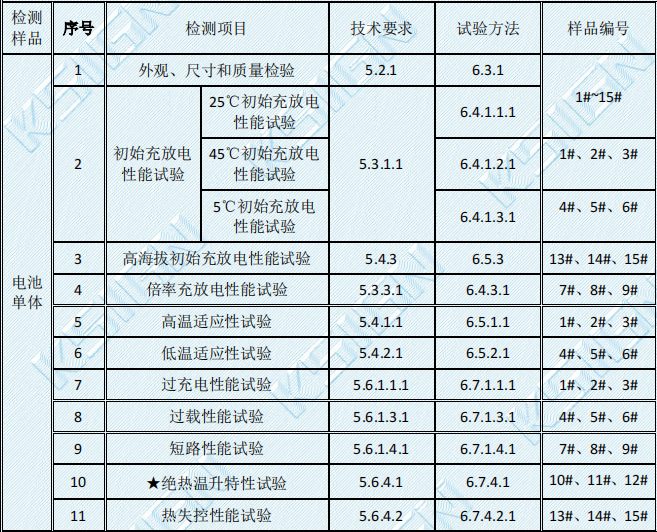
Battery cells
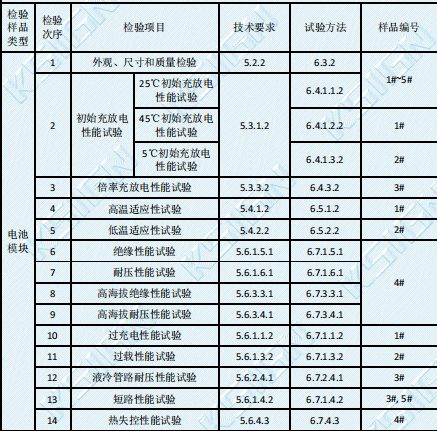
Battery modules
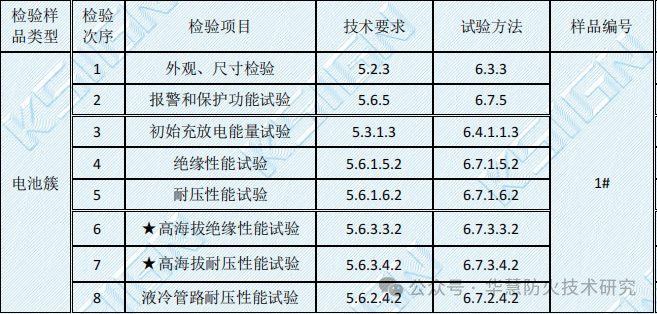
Battery clusters
Pass/fail criteria
The sample test is passed when every sample meets the requirements for every item tested; if any sample fails any test, the sample test is failed.
Common problems in sample testing
Withstand voltage test of modules/clusters: Under the new standard, the test must be carried out under both DC and AC conditions. The AC test is more severe: the distribution and variation of electrical stress are more complex and breakdown is more likely, so pass rates are relatively low. This shows that some products fall short in withstanding high AC voltage.
Module overcharge test: When a module is overcharged to 1.5 times the cut-off voltage, violent electrochemical changes occur inside the cells: large amounts of lithium ions accumulate at the anode and the cathode is fully delithiated, causing the module temperature to rise sharply. This readily causes cell swelling and, in severe cases, venting, making the test difficult to pass.
Module thermal runaway propagation test: A cell driven into thermal runaway by heating or overcharge transfers energy (thermal, electrical and mechanical) to the surrounding cells, and ignition of the ejected material often leads to propagation. If the module has not been developed with good heat-transfer design, it will often struggle to pass this test.
Adiabatic temperature rise test: In the new standard, the adiabatic temperature rise test places higher demands on the heating environment of the sample. Where structural components have poor flame-retardant, cooling or oxygen-excluding properties, heat conduction may lead to a risk of runaway battery temperature.
How sample testing differs from type testing
For cells sampled at a station, the tests are: appearance, dimensions and mass; initial charge and discharge performance; rate charge and discharge performance; high and low temperature adaptability; overcharge and over-discharge; short circuit; and thermal runaway.
Type testing covers more items. Compared with type testing, sample testing concentrates on cells' environmental adaptability and their safety under electrical and thermal abuse, and does not cover cycling, storage or mechanical abuse.
For sampled battery modules, a withstand voltage test is added to the appearance, dimensions and mass, initial charge and discharge, rate charge and discharge, high and low temperature adaptability, overcharge and over-discharge, short circuit and thermal runaway tests. Again, compared with type testing, the mechanical abuse tests are not required.
Sample testing is a key part of keeping an energy storage station running safely and stably, and it must follow a uniform, standardised procedure. Every step must be done right: the proper selection of samples, accurate marking and detailed registration, careful calibration and acceptance of test equipment, and the subsequent testing and thorough recording. The specialist and complex nature of this work places very high demands on the testing body. It is essential to choose a laboratory with extensive experience and strong technical capability for the task, so that sample test results are accurate and reliable and the safe operation of the station rests on a firm foundation.

First published on our WeChat channel: read the original