
With the rapid growth of the battery energy storage market in recent years, lithium-ion batteries, with their clear advantages of high energy density, long cycle life and low self-discharge, have been widely used in energy storage stations, electric vehicles and the emerging low-altitude economy, among other fields.
As energy storage stations keep growing in scale and their applications become more complex, however, the demands on the performance and safety of lithium-ion batteries have become far stricter. To regulate and guide the production and use of lithium-ion batteries for electrical energy storage, China issued and implemented GB/T 36276-2018, Lithium-ion batteries for electrical energy storage, on 1 January 2019. The standard set out detailed provisions for battery cells, modules and clusters, covering specifications, technical requirements, test methods and inspection rules, and provided an important basis for the design, manufacture, testing, operation, maintenance and repair of lithium-ion batteries for electrical energy storage.
Although GB/T 36276-2018 strengthened the safety oversight of energy storage to some extent, accidents still occurred from time to time. With the rapid growth of the storage battery market and continual technical progress, the old standard increasingly failed to match current needs in some respects, especially in the key areas of safety, durability and environmental adaptability.
Against this background, the Standardization Administration of China issued the new GB/T 36276-2023, Lithium-ion batteries for electrical energy storage, on 28 December 2023, and the new edition came into force on 1 July 2024. Compared with the 2018 edition, the overall structure is essentially unchanged, but the technical conditions are stricter and the test requirements more complete. The new standard adds six safety tests, including overload, vibration, and high-altitude insulation and withstand voltage, and removes the test methods and technical requirements for several tests.
Compared with GB/T 36276-2018, the new national standard GB/T 36276-2023 changes the following:
Wider scope
2023 edition: specifies requirements for lithium-ion batteries for electrical energy storage ("lithium-ion batteries") covering appearance, dimensions and mass, electrical performance, environmental adaptability, durability and safety performance; describes the corresponding test methods; and specifies classification and coding, normal operating conditions, inspection rules, marking, packaging, transport and storage. It applies to the design, manufacture, testing, inspection, operation, maintenance and repair of lithium-ion batteries for electrical energy storage.
2018 edition: specified the specifications, technical requirements, test methods and inspection rules for lithium-ion batteries for electrical energy storage, and applied to lithium-ion batteries for electrical energy storage.
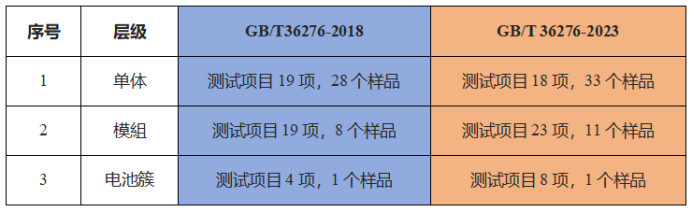
Differences in sample quantities
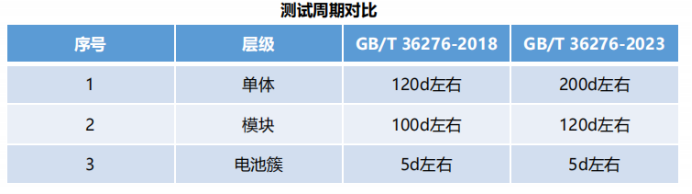
Differences in test duration
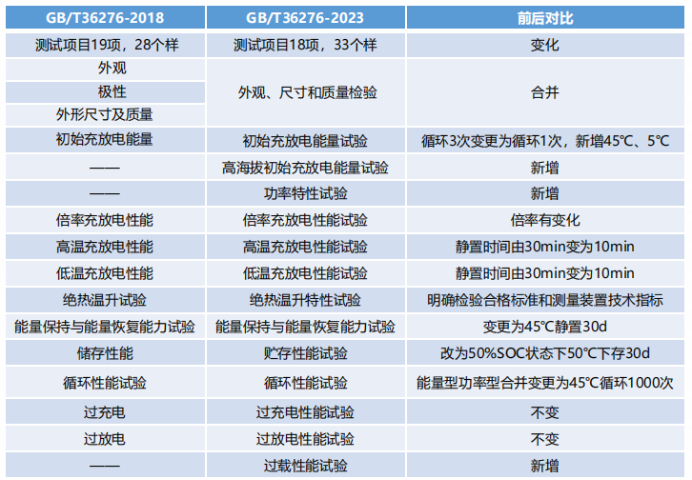
Differences in test items
GB/T 36276-2023 covers the key operating parameters and the performance and safety of the battery from cell and module up to cluster level, setting clear requirements at every level.
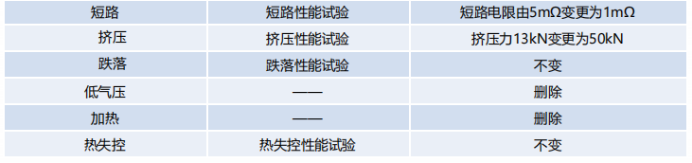
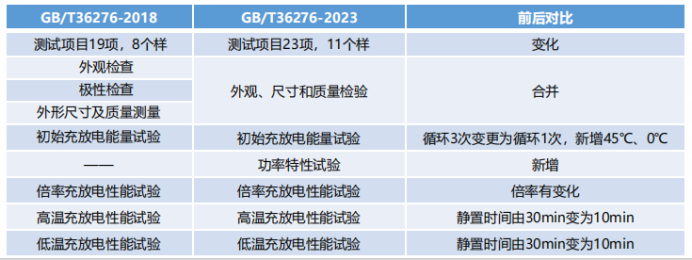
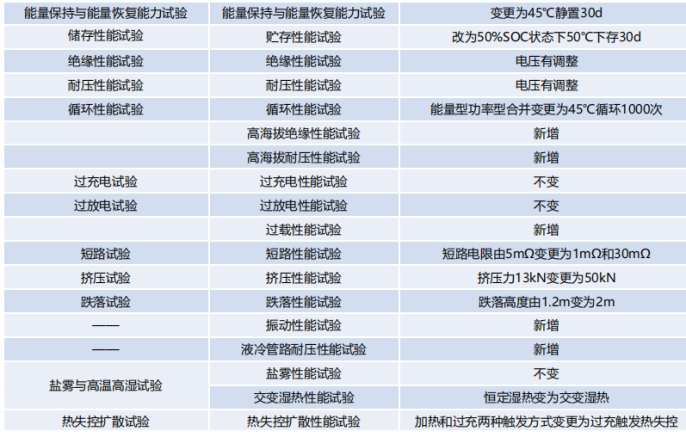
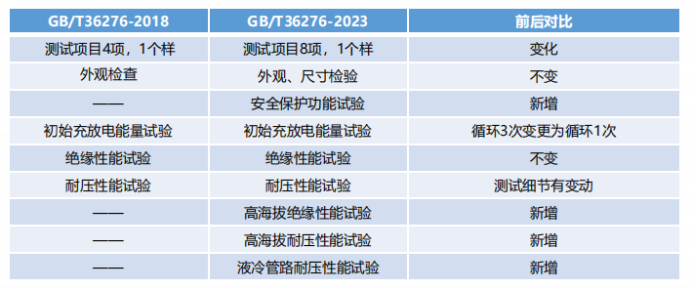
Compared with GB/T 36276-2018, GB/T 36276-2023 adds, for cells: requirements for power characteristics, high- and low-temperature adaptability, initial charge and discharge energy at high altitude, and overload performance; for modules: power characteristics, high- and low-temperature adaptability, overload performance, vibration, a pressure test of the liquid-cooling pipework, insulation and withstand voltage performance, a high-altitude insulation test and a high-altitude withstand voltage test; and for clusters: a pressure test of the liquid-cooling pipework, a high-altitude insulation test and a high-altitude withstand voltage test. Requirements for dimensions, energy efficiency and so on have been raised for cells, modules and clusters alike.
Here is a detailed comparison of the two editions, level by level:
Cells
Modules
Clusters
Overall, the new GB/T 36276 brings a good many changes. It has been updated at cell, module and cluster level, and in particular it raises the test requirements for electrical performance at high and low temperatures, rate capability, storage performance, energy retention and thermal runaway.
These stricter test requirements pose a considerable challenge for manufacturers, who need to keep up with the new requirements and make targeted design changes to their products to be sure of passing the tests.

First published on our WeChat channel: read the original