

Fire doors play a vital role in protecting life and property. They are usually located at emergency exits, where they separate a fire for a set period, stop it spreading and so allow people to evacuate. In the US, NFPA 252, UL 10B and UL 10C are all important standards for evaluating the fire performance of fire doors, chiefly through a fire resistance test and a hose stream test.

Last time we covered UL 10B certification for fire doors. There is another fire door certification test standard that is very similar to UL 10B: UL 10C. This time we look at UL 10C certification.
US building codes and fire safety standards require fire doors to pass the UL 10C test, especially in buildings that demand high safety standards, such as commercial buildings, high-rise buildings, hospitals and schools. Once a fire door passes the UL 10C test, it is certified by UL and can carry a certification label. This certification shows that the door has superior fire performance and meets US fire safety standards.
UL 10C positive pressure fire tests of door assemblies
UL 10C UL Standard for Safety Positive Pressure Fire Tests of Door Assemblies
UL 10C is the positive pressure fire test for fire doors. It evaluates the performance of a fire door, and in particular its ability to remain securely assembled during the test.
The UL 10C test applies to door systems, including doors with transoms and frames, made of all kinds of materials and constructions and installed in wall openings to stop the spread of fire. It does not apply to lift entrance doors or to doors forming part of a larger assembly.
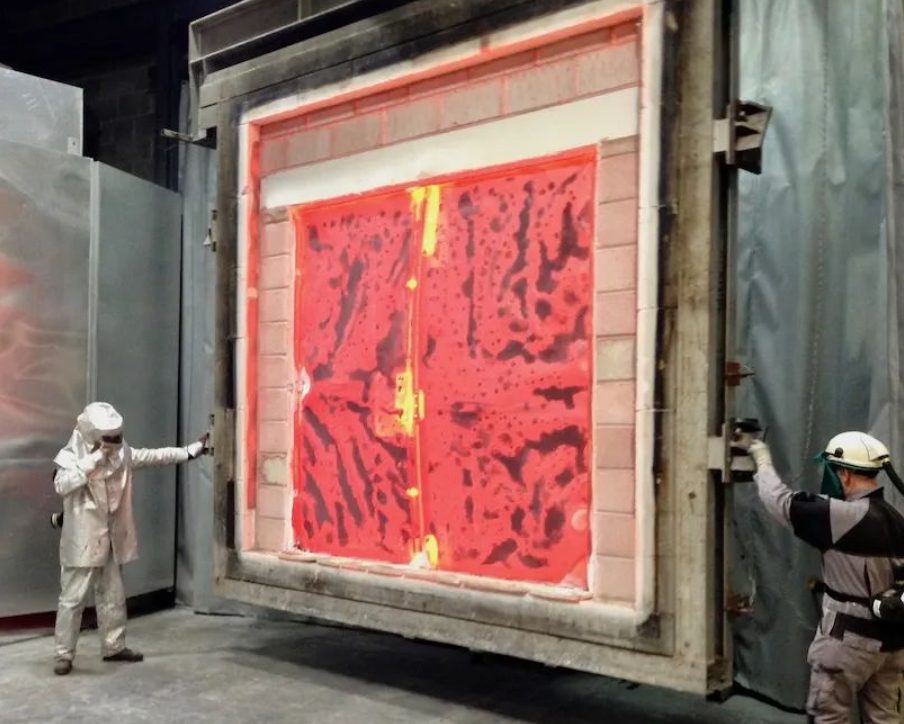
What the UL 10C test involves
As with UL 10B certification for fire doors, the hardest part of UL 10C certification is passing the test. The UL 10C test is as follows:
Positive pressure:
The UL 10C test is designed to reproduce accurately the particular conditions of a fire. When a fire breaks out, hot gases laden with dense smoke rise rapidly and create positive pressure. The fire door has to withstand the strong air pressure generated by the fire and still act as an effective barrier, holding back flames, smoke and heat.
The neutral pressure plane is set 40 inches above the bottom of the test specimen. Below the neutral plane the furnace is at negative pressure, like a zone of suction; above it the furnace is at positive pressure, pushing outwards. In the negative pressure zone, ambient air from outside is drawn continuously into the furnace through the gaps between door and frame and through other parts of the assembly. In the positive pressure zone, furnace gases are driven hard outwards through the door-to-frame joints and the assembly's components, increasing the risk that the specimen splits or breaks.
Fire resistance:
The fire resistance period of the door is the key test indicator. UL 10C requires the door to maintain integrity and insulation for a set time in a fire, typically 30, 60, 90 or 120 minutes, depending on the door's rating.
The test specimen (the door assembly) is installed in a test wall assembly, usually of masonry, or of drywall on studs. The whole test assembly is mounted on the test furnace and exposed to specified temperatures for the specified time. Furnace temperature is measured by nine thermocouples distributed evenly in the furnace and controlled to the prescribed time-temperature curve. Furnace pressure must be established within 5 minutes of the start of the test and maintained throughout the fire resistance test.
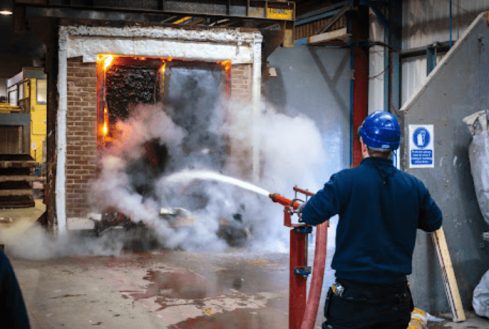
Hose stream test:
The hose stream test is carried out immediately after the fire resistance test. Within 3 minutes, the test assembly is subjected to the impact, erosion and cooling effects of the water stream. The stream is directed first at the bottom centre and then over all exposed surfaces. It should be applied smoothly and steadily so that every part of the test assembly is hit by the stream. For a fire resistance test of 1 hour and an exposed area of 2.4 m², the water pressure at the base of the nozzle should be 207 kPa and the stream should be applied for 24 seconds.
UL 10C acceptance criteria
The fire door undergoes the fire resistance test for the specified time (60 min/90 min), followed by the hose stream test.
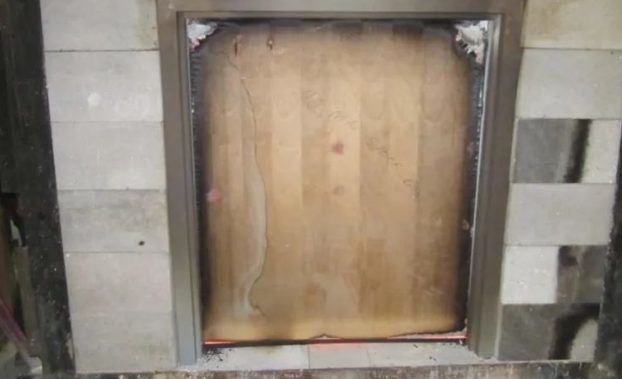
At the end of the fire test, the specimen as a whole remains in the door opening;
no through-openings have formed in the fire door specimen;
movement of the leaf edges does not exceed the limits in the standard;
separation between the lock position and the frame does not exceed the limits in the standard;
no through-openings have formed between frame and leaf or between frame and wall.
After the hose stream test, the specimen as a whole remains in the door opening.
During the test, no through-openings form on the unexposed face of the specimen, and movement of the leaf edges does not exceed the limits in the standard.
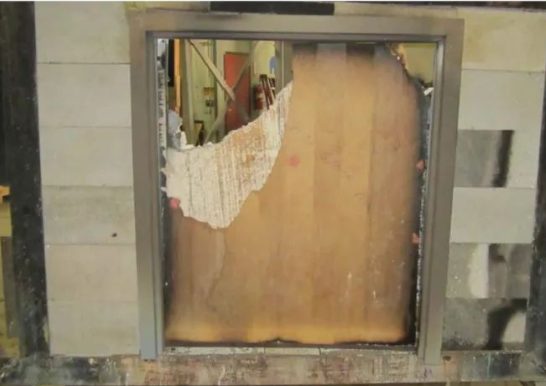
Why UL 10C is hard to pass
Withstanding heat and pressure: the fire door is exposed to the standard time–temperature curve (about 927 °C at 1 hour and 1052 °C at 3 hours) and has to withstand the positive pressure generated by the fire. Its materials and construction must therefore be carefully designed so that it does not deform, fracture or fail.
Insulation: there must be no flaming on the unexposed side and no hot gases able to ignite a cotton pad. For doors with a temperature-rise rating, the maximum temperature rise on the unexposed side at 30 minutes also counts; US building codes, for example, limit doors to interior exit stairways to 450 °F (250 °C). This stops the fire spreading to other parts of the building. Good insulation depends not only on the properties of the materials but also on the design and thickness of the door.
Integrity: the door must not crack, drop parts or suffer other damage in the fire, so that it keeps working as a barrier. This tests not only the door leaf itself but also its installation, its hardware, and how it works together with the frame.
Sealing: the fire door has to prevent smoke and flame penetrating, which means the joints between door and frame, the seals, the leaf materials and the hardware (such as locks and hinges) all need high fire performance.
UL 10C certification testing is genuinely demanding, because it places strict requirements on every aspect of a fire door, including its materials, design, construction and sealing.
To avoid failing the formal test and paying high certification fees and time costs, a pre-test can help manufacturers check how their fire door will perform in the UL 10C test. A well-planned pre-test helps the door perform better in the UL 10C test and avoids wasting resources.

First published on our WeChat channel: read the original