

With pressure mounting in the domestic market and global trade ever more closely linked, many Chinese fire door manufacturers want to go abroad in search of new opportunities. The US market, with its large consumer base and mature construction industry, has caught the attention of many of them. To open the door to that market, however, one key "entry ticket" is essential: UL 10B certification.
Quite a few of the manufacturers we work with have recently asked us about UL 10B certification, so here is an overview.

Why is UL 10B certification needed?
The first driver is US building regulation.
Just as China has CCC certification, the US has its own certification system in UL. UL (Underwriters Laboratories) is a globally recognised safety science company whose expertise and credibility in developing product safety standards and in testing and evaluation are acknowledged worldwide. US consumers and regulators place great trust in the UL mark, and a fire door carrying a UL label comes with a built-in reputation for reliable quality.
US building regulations are highly detailed and strict. Chapter 7 of the International Building Code (IBC) sets strict fire separation requirements for different building types and areas. For example, in high-rise commercial buildings, fire doors with a high level of fire performance must be fitted between escape stairs, lift lobbies and the rest of each floor, to stop fire and smoke spreading quickly into the vertical circulation cores and trapping people trying to escape. Such fire doors are required to pass an authoritative certification such as UL 10B, which assures a minimum duration of fire and smoke resistance and structural stability. The fire rating required depends on factors such as building height and occupant density, and ranges from 1 hour to 3 hours.
The standards published by the National Fire Protection Association (NFPA), such as NFPA 101 Life Safety Code, also require compliant fire doors at key fire compartment boundaries. UL 10B certification has become a common way for manufacturers to show that their products comply.
The second driver is commercial insurance.
Insurance is pervasive in the US, and to control their claims risk, commercial insurers impose firm requirements on the fire protection of the buildings they cover. A business that installs UL 10B-certified fire doors can obtain better premiums; non-compliant fire doors, by contrast, can leave a business facing soaring premiums or even refusal of cover. As a result, owners and contractors give preference to certified fire door products.
Manufacturers therefore have to consider whether UL 10B certification is necessary for them.
What is UL 10B certification?
ANSI/UL 10B:2015 (R2020) Fire Tests of Door Assemblies is a fire test standard for door assemblies, used to evaluate the fire performance of doors.
The standard sets out a series of test procedures and evaluation methods to determine the performance and fire resistance of door assemblies under fire conditions.
Its main purpose is to ensure that door assemblies can effectively stop the spread of fire in a fire event, protecting life and property.
Scope of UL 10B certification: door assemblies of all materials and types installed in wall openings, including swinging doors, sliding or rolling doors, horizontal sliding lift doors, access doors, chute doors, dumbwaiter doors and service counter doors, together with door and frame hardware.
How do you apply for UL 10B certification?
Many manufacturers are more interested in how to apply.
Preparation: the manufacturer first carries out a thorough self-assessment of the product to make sure the design, raw materials and production process meet the basic requirements of UL 10B. It compiles complete technical documentation, covering product specifications, raw material lists and production flow charts, much as a student prepares revision notes before an exam, ready for review. Some manufacturers may not prepare this part well enough; a certification body or consultancy can help.
Application: submit the application form to the certification body, with product samples and technical documentation. Once the application is accepted, the certification body makes an initial judgement, based on the documents, of whether the product is ready for testing. If documents are missing or non-compliant, the application is returned for completion; this stage tests how rigorously the company has organised its documentation.
Product testing: once the application is approved, the product is sent to a specialist laboratory recognised by the certification company. The fire door is tested to the requirements of UL 10B to evaluate the fire resistance of the door assembly: it is exposed to extreme temperatures above 1000 °F for up to 90 minutes, simulating a real fire, to make sure the door keeps its structural integrity and stops fire and smoke from spreading.
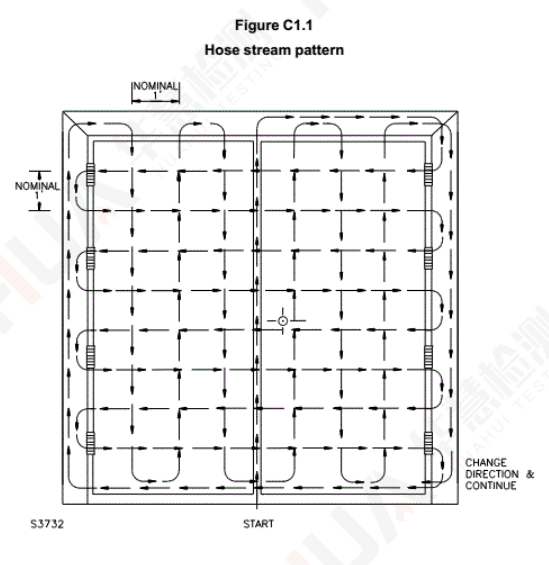
After the fire resistance part of the test, the assembly also undergoes a hose stream test: having been exposed to fire, the door is hit with water from a fire hose at 30 to 120 psi. This assesses the door's resilience to thermal shock and mechanical stress, reflecting firefighting operations.
The laboratory issues a detailed test report, and the product must pass the tests to meet the certification requirements.
Factory inspection: an inspector carries out an on-site audit of the manufacturer's factory.
Certification and surveillance: the certification body issues a certificate to manufacturers that meet the requirements and carries out follow-up surveillance after certification.
What the UL 10B test involves
Product testing is the critical "checkpoint" in the whole certification process, and many manufacturers fail here. Here is what the UL 10B test involves.
-
Fire resistance test: assesses the door's performance at high temperature. The door is mounted on a burning furnace and continuously exposed to high-temperature flames to determine its fire resistance performance, such as resistance to smoke penetration, insulation and integrity.
-
Hose stream test: after heating, the door assembly is hit by a high-pressure water stream, typically at 30 to 120 psi. This step simulates the impact and stress experienced in real firefighting operations and verifies the door's ability to withstand thermal and mechanical stress.
Why UL 10B is hard to pass
The test does not look complicated, yet many manufacturers' certification stalls at this stage. From our laboratory's experience, the reasons are as follows:
Genuinely poor materials: little needs to be said here. Low-quality door leaf infill burns and decomposes rapidly at high temperature and simply cannot achieve the required fire resistance period.
Weak connections and frames: the frame and leaf are connected by hardware. If the frame is not adequately supported, or the hinges and locks are of poor quality, then under the hot gas flow and the pressure of the hose stream the frame twists and lets fire through, fittings loosen and deform, the door becomes hard to open and close or even falls out, and the integrity of the fire door as a barrier is completely lost.
Poorly designed seals: the door core panel is of good quality, but the sealing arrangement fails, letting flames pass through.
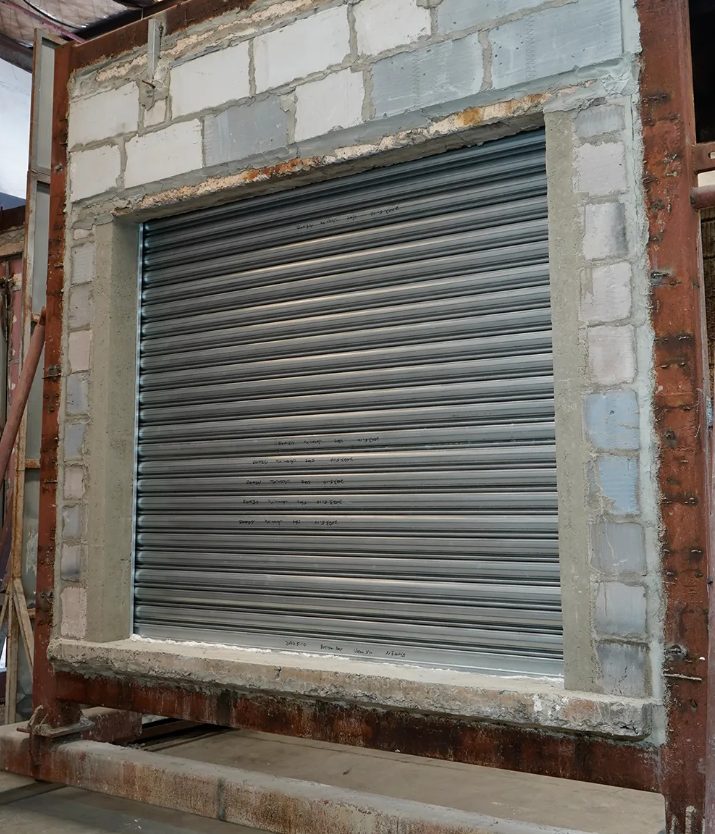
Because the UL 10B test simulates a real and harsh fire scenario, any small product defect is magnified and can cause the manufacturer to fail at the last hurdle. We therefore recommend that manufacturers run a pre-test before certification.
A fire door is a complex construction in which the leaf, infill, hardware and seals all depend on one another. In routine production testing, manufacturers mostly focus on standard performance indicators and find it hard to recreate a fire scenario as extreme as the UL 10B test. A pre-test helps find and fix weaknesses, and avoids the high cost of a failed certification test followed by the cost of remedial work.

First published on our WeChat channel: read the original