

Fire-resistant insulation materials play a vital role in construction, aerospace and other fields. Understanding and distinguishing their performance measures correctly is the basis for sound material selection, design optimisation and safety assessment.
Throughout the development, production testing and engineering use of fire-resistant insulation materials, we constantly come across measures such as fire resistance limit, equivalent thermal conductivity, equivalent thermal resistance, insulation efficiency, insulation efficiency deviation and thermal conductivity. These reflect the thermal properties and fire-resistant insulating ability of materials from different angles, but because the concepts are similar and their calculations are linked, they are easily confused in laboratory testing and in manufacturers' production quality control.
Here we look at each measure from the standpoint of materials science and engineering practice, based on the relevant Chinese standards and codes: its definition and engineering significance. This helps clarify the differences and underlying links between them, and their applicability to assessing and predicting the performance of fire-resistant insulation materials in general.
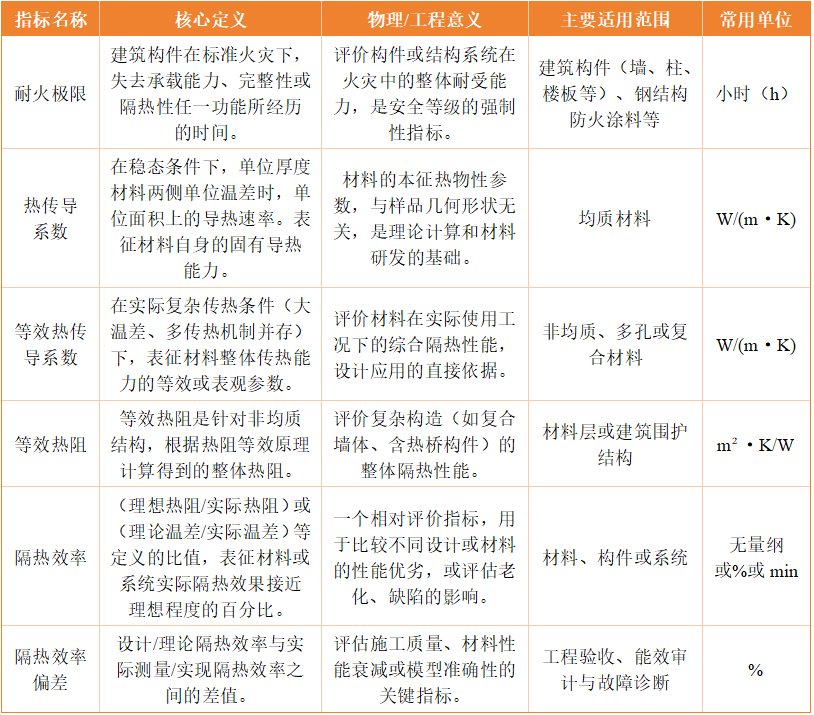
Fire resistance limit
The fire resistance limit is the core measure of how well building elements, materials and structures maintain their performance when exposed to the high temperatures of a fire. It is defined as the time, under standard fire test conditions, from the start of fire exposure until the material or element loses integrity, insulation or load-bearing capacity (for load-bearing elements), expressed in hours (h).
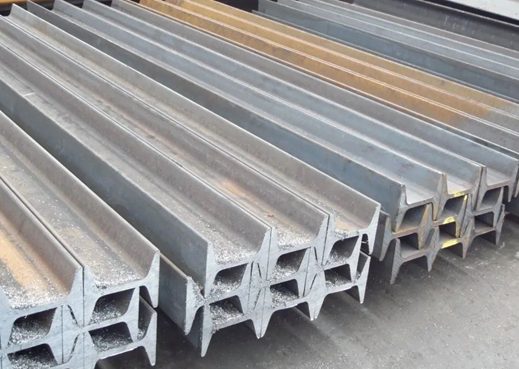
The fire resistance limit is assessed for building elements or structures such as beams, slabs, columns, walls and steel structures protected with fire-resistive coatings. It is not an intrinsic property of a material but the result of many factors acting together, including the material, the form of construction and the way it is exposed to fire. It reflects in combination the material's mechanical performance, dimensional stability and thermal performance at high temperature, and is a system-level, functional assessment result.
The fire resistance limit must be determined by a standard fire resistance test, usually following the standard heating curve of GB/T 9978; its value is set directly by the time at which the test ends.
The fire resistance limit matters greatly in practice. GB 50016 (China's code for fire protection design of buildings) sets out explicit fire resistance requirements for the elements of different building types and fire compartments. For example, in class I high-rise civil buildings, fire walls must have a fire resistance limit of at least 3.00 h and floor slabs at least 1.50 h. This measure directly determines a building's fire resistance rating and is the fundamental basis for fire safety design, fire safety acceptance and risk assessment. Manufacturers also need fire resistance tests to verify their products' performance and provide a compliance basis for marketing them.

Thermal conductivity vs equivalent thermal conductivity
These two concepts are very often confused in practice. The difference comes from the gap between test conditions and real service conditions.
Thermal conductivity is an intrinsic thermal property of a material, defined as the heat flow through unit area of the material per unit time under a unit temperature gradient. It characterises the material's ability to conduct heat.
In Chinese standards, thermal conductivity is commonly measured by the guarded hot plate method (GB/T 10294) or the heat flow meter method (GB/T 10295). These usually require the sample to be at a small temperature difference (for example 20–30 °C) and in a steady state, deliberately suppressing radiative and convective heat transfer. Thermal conductivity is therefore an intrinsic property of the material: for a given homogeneous material it is a relatively fixed value, independent of thickness.
Thermal conductivity is the core basis for selecting fire-resistant insulation materials: the lower the λ value, the better the material insulates.
Equivalent thermal conductivity is a combined heat transfer parameter for inhomogeneous materials and composite constructions. It is defined as the thermal conductivity obtained when a complex heat transfer process (conduction, convection and radiation acting together) under specified conditions is treated as an equivalent single conduction process.
In real engineering, fire-resistant insulation materials are mostly inhomogeneous (such as aerated concrete or fibre composite boards) or composite constructions (such as an insulation layer plus a fire protection layer), with additional heat transfer through convection in pores and radiation at interfaces. Their overall heat transfer cannot be characterised by intrinsic thermal conductivity alone, and that is where equivalent thermal conductivity comes in.
Equivalent thermal conductivity is also an important measure for non-intumescent fire-resistive coatings for steel structures: the lower it is, the better the coating protects and insulates. Heat transfer through a non-intumescent coating follows Fourier's law, so if the coating thickness and the required fire resistance time are known, the equivalent thermal conductivity can be estimated.

Equivalent thermal resistance
Thermal resistance expresses a material's ability to resist the transfer of heat: the higher the thermal resistance, the better the insulation. Equivalent thermal resistance is the overall thermal resistance, obtained by calculation or testing, of a composite construction, an inhomogeneous element or a complex system with thermal bridges.
In steel structures, for example, the equivalent thermal resistance of a steel element measures the insulating performance of a specific steel member (such as a 10 cm deep I-beam). It is the "total insulating capacity" of the whole steel system, such as the combined insulating effect of a steel column plus its insulation layer plus connectors. The higher the equivalent thermal resistance, the more slowly the steel heats up and the longer its fire resistance time. It depends directly on the size of the structure and how it is built.
Insulation efficiency and its deviation
Insulation efficiency is the effectiveness of a material or construction in blocking heat transfer, usually assessed by measuring how much the heat transfer is reduced. The higher the insulation efficiency, the better the material or construction blocks heat. It is generally expressed as a percentage (%).
In GB 14907 (China's standard for fire-resistive coatings for steel structures), "insulation efficiency" refers specifically to the time taken, in a standard fire resistance test, for the average temperature on the unexposed side of a coated steel specimen to rise to 500 °C, and can be measured in a standard fire resistance test.
Insulation efficiency deviation is the difference between the measured insulation efficiency and the theoretical or nominal value. It can arise from many factors, such as inhomogeneity of the material, errors in the measurement method and changes in ambient conditions.
In engineering practice, insulation efficiency deviation is an important quality measure: too large a deviation can mean the insulation falls short, affecting safety and performance in use. For example, the insulation efficiency deviation of fire-resistive coatings for steel structures must be kept within ±15%, so that they protect steel members effectively in a fire.
How the measures relate
These measures do not stand alone. Together they form a complete assessment chain from intrinsic material properties to system-level fire safety, with a clear hierarchy:
Base level: intrinsic material parameters. Thermal conductivity (λ) is the foundation and the starting point of all thermal calculations. It depends mainly on the material's chemical composition, crystal structure and pore characteristics.
Service-condition level: application performance parameters. Under real conditions with large temperature differences and several heat transfer mechanisms, the material's intrinsic λ has to be corrected to an equivalent thermal conductivity, which reflects the material's performance in its real state more faithfully.
Element performance parameters: bringing in thickness turns thermal conduction into thermal resistance. Equivalent thermal resistance is also a scenario-specific combined parameter, depending on the combination of materials, the state of the pores and the modes of heat transfer; the same material has different values in different scenarios.
Functional assessment level: the fire resistance limit is a fire performance measure of an element or material, closely tied to the form of construction, the fire exposure conditions and the criteria applied, and is a system-level measure. Insulation efficiency is a relative performance measure, reflecting how well a material actually insulates. Insulation efficiency deviation is a precision control measure, focused on the consistency of test results and product quality.
Underlying links
Equivalent thermal resistance and fire resistance limit work together. For non-load-bearing fire-resistant insulating elements, insulation is the core criterion for the fire resistance limit, and equivalent thermal resistance directly determines how fast the temperature rises on the unexposed side: the larger Rₑq, the more slowly the unexposed side heats up and the longer the fire resistance limit. For example, increasing the thickness of a fire protection board raises the equivalent thermal resistance and so extends the element's fire resistance limit; the two tend to rise together.
Insulation efficiency is linked to equivalent thermal conductivity and equivalent thermal resistance: under the same conditions, the lower the equivalent thermal conductivity, the higher the equivalent thermal resistance, the more strongly the material suppresses heat flow, and the higher the insulation efficiency.

First published on our WeChat channel: read the original