
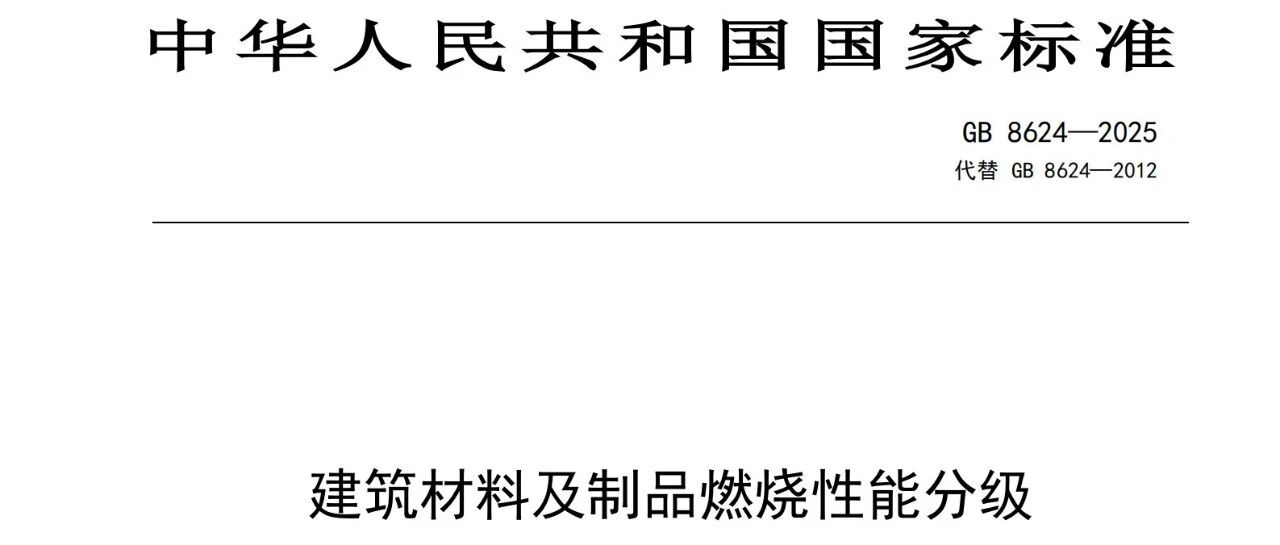
GB 8624
According to an announcement by the Standardization Administration of China, the much-anticipated mandatory national standard GB 8624-2025 (China's classification of building materials and products by reaction to fire) was officially published on 31 December 2025. The standard has a one-year transition period and takes effect on 1 January 2027, when the current 2012 edition, GB 8624-2012, will be withdrawn.
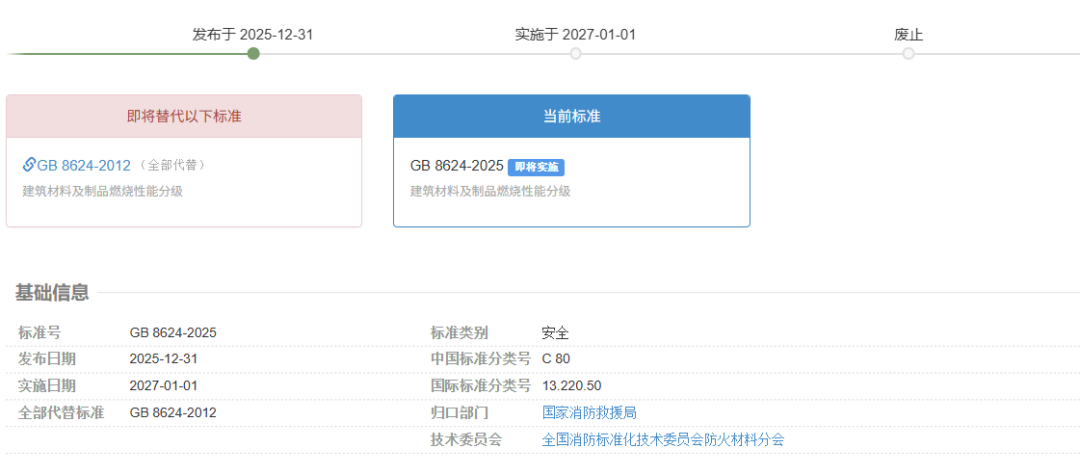
GB 8624 is China's basic, mandatory national standard for the fire performance of building materials. The 2025 edition is a comprehensive upgrade on the 2012 edition: wider in scope, stricter in its technical requirements and more closely matched to real applications. It will have a far-reaching impact across the whole chain, from building material production and construction to fire safety enforcement and laboratories.
Key changes in GB 8624-2025
Compared with the 2012 edition, the new standard keeps the core classification framework of the old one but makes many key revisions and improvements, upgrading it across the board:
Wider scope
One of the most notable changes is the wider scope, with new categories such as photovoltaic modules.
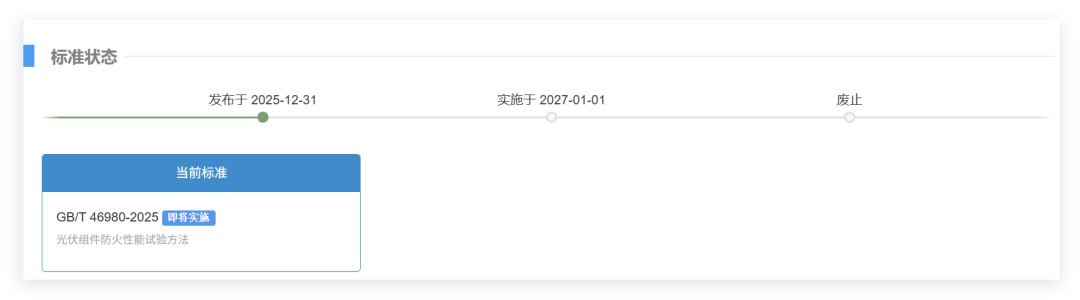
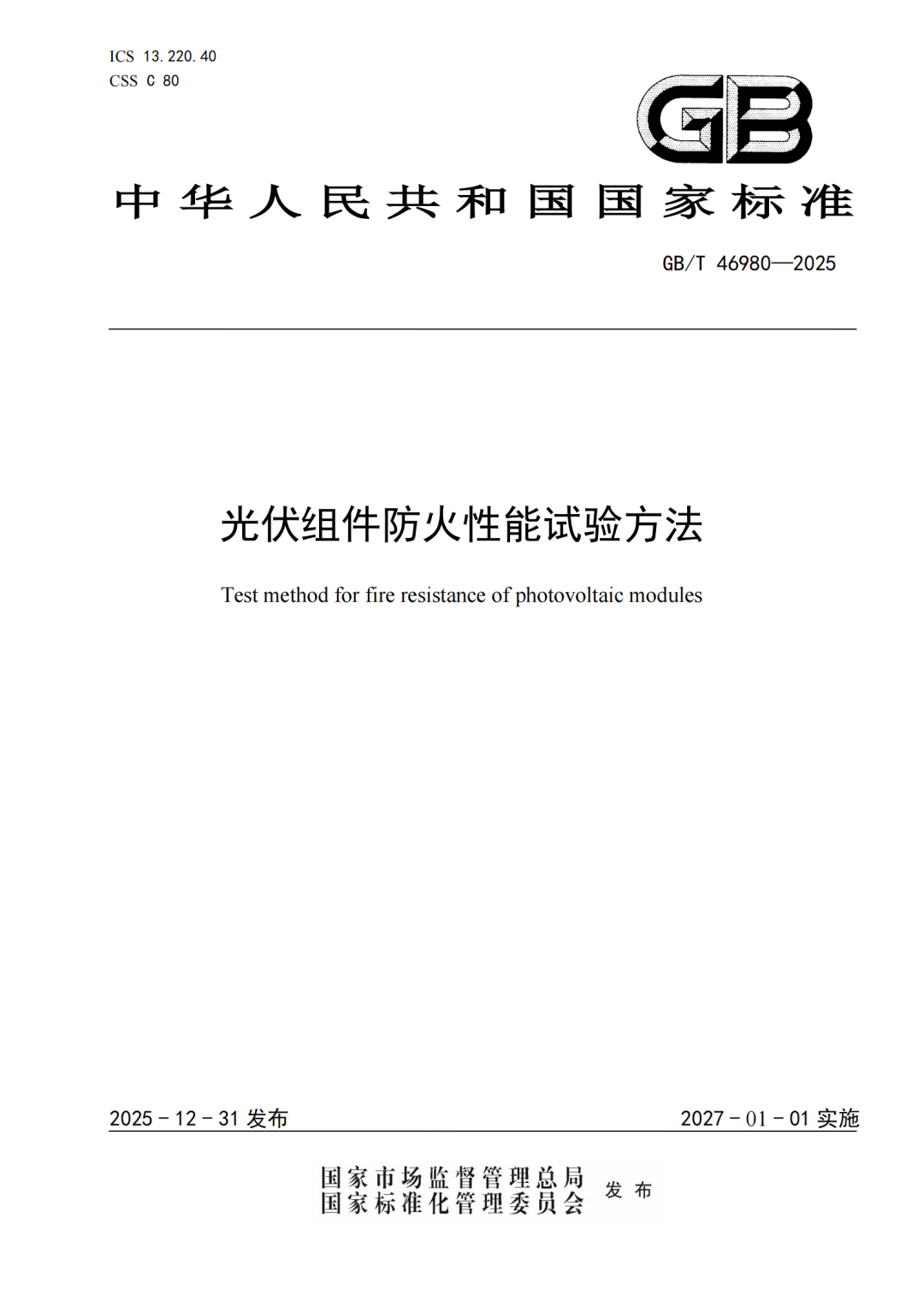
Photovoltaic modules: with China's "dual carbon" goals (carbon peak and carbon neutrality) being pursued, building-integrated photovoltaics (BIPV) and distributed rooftop PV systems are increasingly common. GB 8624-2025 brings the fire performance of PV modules into reaction-to-fire classification for the first time, and GB/T 46980-2025 provides a unified, scientific test method for the fire performance of PV modules. This fills a gap in the standards, solves the problem of assessing the new fire risks brought by the rapid growth of the PV industry, and provides a mandatory basis for the safe use of building PV products.
Decorative and electrical materials and products: the new standard explicitly brings in soft and hard furniture and its components, plastics for electrical use, and foams for electrical equipment and furniture, placing them under a unified reaction-to-fire classification. This will help regulate the market and phase out high-risk products.
Refined classification criteria
GB 8624-2025 systematically refines the logic of reaction-to-fire classification for building materials and further details the criteria for each class. The old edition assessed reaction to fire mainly in terms of "combustion and flame spread"; the new edition adds three criteria, smoke production, flaming droplets/particles and smoke toxicity, drops the term "additional classification", and moves the content of the former annexes into the main text.
New material categories and test standards
The revision fully takes into account the different fire risks of different building materials in real applications.
Building on the old edition, it classifies materials in more detail. Building insulation materials, for example, are no longer lumped together: wall insulation, roof insulation and floor insulation for cold stores each have their own classification criteria. It also sets more targeted test requirements for different classes. A new welding spark test (to GB/T 40237) assesses the ability of foam insulation to resist welding sparks, and reaction-to-fire reports must now include thermal conductivity data (tested to GB/T 10294 or GB/T 10295).
New test methods have also been added, such as GB/T 30735, GB/T 34441, GB/T 40238, GB/T 46980 and GB/T 16172 (heat release rate), making the assessment of building materials' reaction to fire more complete.
Supporting standards
GB 8624-2025 cannot be implemented without a complete, coordinated set of test method standards to support it.
Behind the publication of GB 8624-2025 is the coordinated updating of a whole system of supporting standards. A series of core national test method standards supporting the new classification standard are currently being revised and approved as a batch, and will be published soon.
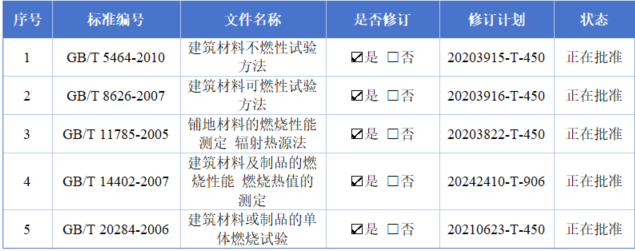
For example, the revision of GB/T 5464 (non-combustibility test method for building materials), the core basis for classifying non-combustible materials (revision project 20203915-T-450), is in the approval process and is expected to take effect 6 months after publication. Also "awaiting approval" are: GB/T 8626 (ignitability test method for building materials), used to assess the ignition behaviour of materials (revision project 20203916-T-450); GB/T 11785 (determination of the burning behaviour of flooring using a radiant heat source), specific to floorings (revision project 20203822-T-450); GB/T 14402 (determination of the gross heat of combustion of building materials and products), used to measure calorific value (revision project 20242410-T-906); and GB/T 20284 (single burning item test for building materials or products), the key test for classes B and C (revision project 20210623-T-450).
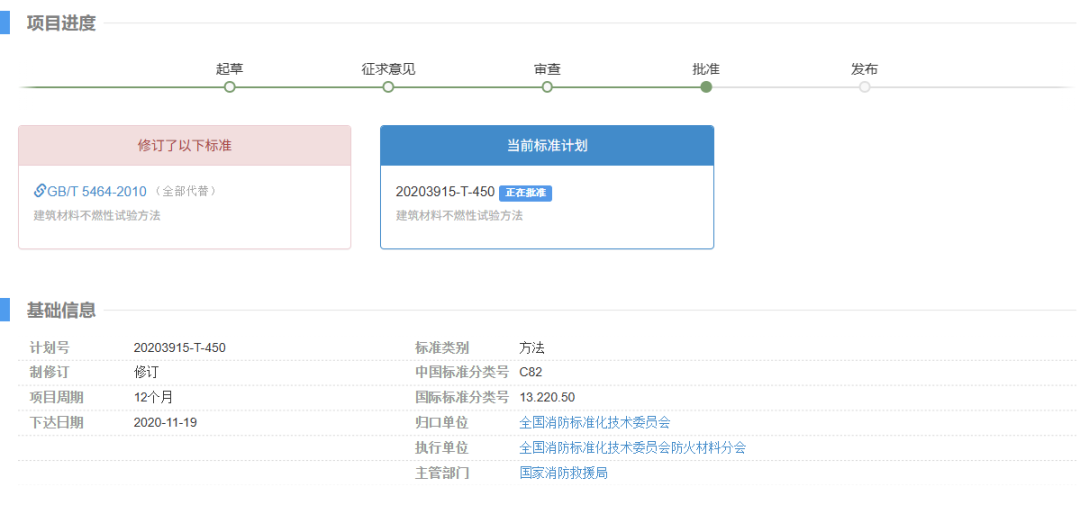
According to the available information, work on updating these supporting standards is in its final stages.
Key point: to support the new classification requirements for PV modules in GB 8624-2025, a completely new national standard, GB/T 46980-2025 (test method for the fire performance of photovoltaic modules), has been drawn up alongside it, providing a unified, scientific test procedure for fire testing of PV modules and filling a gap in Chinese standards in this field. It was published together with GB 8624 on 31 December 2025 and takes effect at the same time, on 1 January 2027.
Updating this series of standards together ensures a seamless link from test methods to classification criteria, laying a solid technical foundation for the smooth implementation of the new standard.
Preparing for the change
The changes in the new standard are particularly far-reaching. There are more test items and more detailed requirements, and the description of material information in test reports must follow stricter rules. This will raise the bar for falsifying test reports and further safeguard the authenticity and authority of test results.
For laboratories, though, adapting quickly to the technical, equipment and capability demands of the upgraded standard is undoubtedly a major challenge. For everyone else in the chain, from production and construction to enforcement, the change is equally a comprehensive test that calls for a proactive response.
The 12-month transition period from publication to entry into force on 1 January 2027 is both a buffer in which companies and institutions can adapt to the new standard and a critical period for meeting the challenge. Once it takes effect, GB 8624-2012 will be withdrawn, and the production, import and use in construction of all relevant materials must meet the new edition. Violations will be dealt with under the Fire Protection Law and the Product Quality Law.
Testing laboratories:
Equipment upgrades and capability verification: the new test methods and stricter criteria require laboratories to upgrade or buy new test equipment and to recalibrate and re-verify existing equipment.
Staff training and technical preparation: laboratory technicians need to study and master the technical details of the new standard and its supporting test method standards, to ensure accurate and consistent results.
Extending scope and updating accreditation: laboratories need to apply promptly to CMA and CNAS (China's laboratory qualification and accreditation bodies) to extend their scope to the new standards, so that they can legally issue test reports to the new edition after the transition period.
Manufacturers:
Re-assessing products: companies need to re-test and re-assess existing products to the new standard. Some products may be downgraded or even fail, and companies will need to invest R&D resources in optimising formulations and improving processes.
Upgrading products: materials need to move towards "flame-retardant, low-smoke, low-toxicity" performance; PV modules and insulation materials, for example, will need to improve their core performance to meet the standard.
Updating product certification: products need to be re-tested and re-certified for reaction to fire to the new standard.
Our recommendations
Companies should study the new standard straight away, map the gaps between their existing products and the new classification criteria, and make sure their products meet the new reaction-to-fire requirements. Rather than waiting until the end of the transition period, they should choose a capable laboratory early for pre-testing of representative products, to provide data for product improvement and market decisions.
Testing laboratories need to speed up equipment upgrades and staff training and complete verification and roll-out of the revised test methods in advance, so that testing is carried out efficiently and accurately.
Building safety is never a small matter. The implementation of the new GB 8624 is an important upgrade in China's building fire safety, both a necessary response to the new situation in fire risk prevention and control and an important step in driving high-quality development of the building materials industry. If you are a building materials company, contractor or fire safety professional, we recommend studying the details of the standard early and preparing technically. As a fire testing laboratory, Huahui Fire will also bring our professionalism and experience to providing a better service.
To find out more about the details of the new GB 8624, get in touch with us at any time.

First published on our WeChat channel: read the original