
As smartphones, laptops, power banks and other portable electronic devices (PEDs) become ubiquitous, lithium-ion batteries are ever more widely used in portable electronics, high-power energy storage systems and aircraft equipment, and the safety risks are rising with them.
This is especially true in aviation. A battery in thermal runaway rapidly releases large amounts of heat, flame, smoke and toxic gas, and if this cannot be controlled in the cabin, the hold or areas accessible to people, the consequences can be serious.
The Federal Aviation Administration (FAA) recorded around 254 in-flight or airport incidents involving lithium and lithium-ion batteries between 1991 and 2019, 56 of them in 2018 alone.
Many airlines already carry so-called "battery fire containment bags" or "thermal runaway battery isolation devices" on board, but there has been no unified, widely accepted standard for the test methods, certification and performance definitions of these products.
To improve the reliability and comparability of such devices and the industry's trust in them, and to regulate the performance of battery fire containment products, UL Solutions led the development of UL 5800, providing a unified set of safety requirements for lithium battery fire prevention and control in aviation.
About the standard
UL 5800, Standard for Safety: Battery Fire Containment Products
The aim of UL 5800 is to provide a quantifiable, repeatable and certifiable framework for testing and assessing the performance of battery fire containment products.
Using standardised test methods and performance criteria, it assesses whether products designed to contain fires from the lithium batteries of portable electronic devices (such as containment bags, boxes and closed containers) can effectively contain the spread of flame, smoke and debris when a portable lithium-ion battery goes into thermal runaway, providing reliable protection in high-risk settings such as aviation.
In other words, the standard is concerned not with "extinguishing" but with "isolation and control": once thermal runaway has happened, how to protect people, structures and surroundings as far as possible.

Scope
According to the standard itself (Edition 1, December 2020, revised up to 6 May 2025), its scope includes:
Thermal runaway scenarios involving lithium-ion batteries used in portable electronic devices (PEDs).
"Battery fire containment products", i.e. devices designed to enclose or isolate such a thermal runaway event, which may be active (containing an extinguishing agent) or passive (enclosure and isolation only).
Use in "inhabited aircraft compartments", i.e. passenger and crew compartments, not cargo holds or ground equipment.
Protection limited to devices with a maximum energy of 300 Wh, which covers the battery capacity of the great majority of consumer portable electronic devices.
Explicit exclusions
Fire protection for fires originating from equipment not powered by batteries is not covered.
Containment products intended specifically for protecting cargo are excluded; the standard focuses only on PED fires in the passenger cabin.
Fire protection products that need additional manual operation, such as devices that must be used with a hand-held extinguisher, are not covered; only active products that need no manual intervention other than releasing the suppressant are recognised.
Requirements apply only to the control of visible smoke; mitigation of toxic and flammable gases is not included.
Products are intended for a single thermal runaway event only; reusability is not required.
In terms of application, then, UL 5800 mainly serves the aviation industry's need to isolate battery thermal runaway (in battery-powered carry-on devices, power banks, laptops, mobile devices and so on in the cabin).
Classes and performance levels
The standard divides containment products by "Class" and "Performance Level".
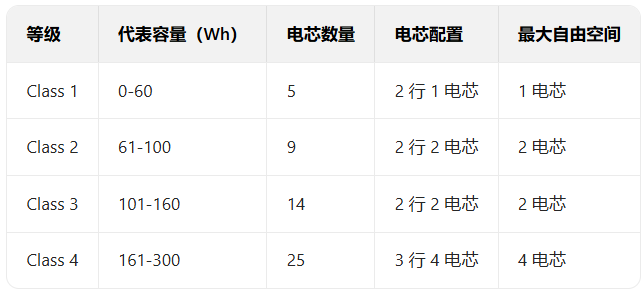
The standard defines two performance levels, and every compliant product must meet the basic safety baseline:
Performance Level 1: all visible smoke must be fully contained within the product, with no leakage;
Performance Level 2: a total smoke release of up to 5 m² is permitted, for certain special applications.
Test procedure
The UL 5800 test regime is rigorous. Section 8 sets out the test equipment, sample preparation and procedure in detail.
-
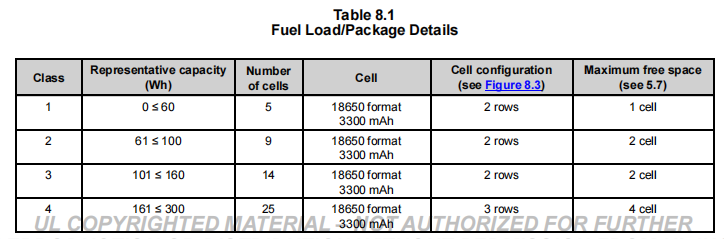
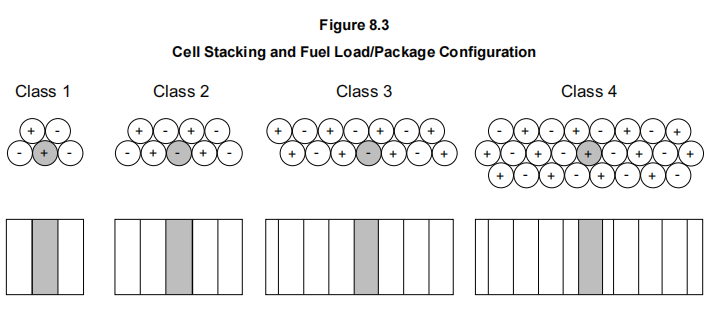
Prepare the fuel load: the fuel load consists of 18650 lithium-ion cells with a capacity of 3400 ± 100 mAh, charged to 100% SOC. The number and arrangement of cells are set according to the product class, with the specified free space left.
-
Place the fuel load inside the containment product under test and close it according to the manufacturer's instructions.
-
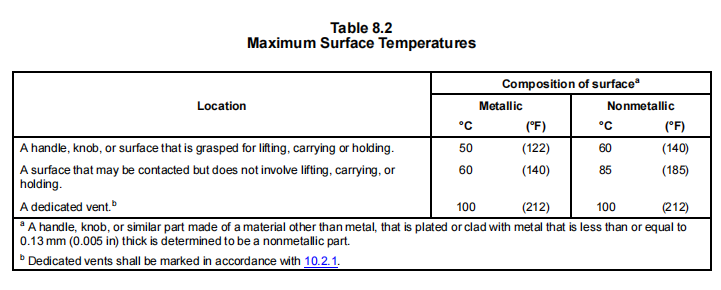
Fit at least one temperature sensor per 36 square inches of the product's outer surface, with one sensor directly above and one directly below the battery position; additional measurement points are required at particular locations such as vents and handles.
-
Place the container under test on a standard test bench (for example, a cork base covered with white paper and a single layer of cheesecloth, under a smoke hood to collect the smoke) to simulate the cabin environment.
-
Heat one central cell in the enclosure until thermal runaway occurs, then monitor for 6 hours, recording temperature, smoke release, flame behaviour and other data.
-
Certification: the product must pass three identical tests in succession; failing any one of them means certification is refused, ensuring that the product's performance is consistent and reliable.
Performance requirements
After the test, the device must meet a set of "Conditions of Acceptance". The main ones are:
Flame must not breach the containment device (for example, the cheesecloth or paper must not glow or ignite).
No debris, sparks or projectiles may escape from the device.
The temperature at any point on the outer surface must not exceed the maximum specified in the standard (see Table 8.2).
All visible smoke must be contained within the device; at the relevant performance level, total smoke release must not exceed the specified limit.
If any test fails to meet these requirements, the product fails and is not certified.
Marking, instructions and packaging
Once certified, a containment product must be marked with its Class and Performance Level, and instructions for use and warnings (such as "Risk: burns, avoid contact") must be given on the packaging or in the instructions.
For manufacturers, UL 5800 is not just a certification target; it is also a systematic guide to which tests and which performance they must meet.
UL 5800 certification gives a product a "passport" to North American and high-end global markets and helps make the brand more competitive.
For regulators, the standard provides a scientific basis for oversight and simplifies product safety assessment; for consumers, a containment product that complies with UL 5800 means more reliable protection and more peace of mind when using portable electronic devices.
UL 5800 has already become the main basis for North American airlines' procurement of lithium battery fire containment products, and more and more international airlines make UL 5800 certification a condition of acceptance. As the global aviation industry pays ever more attention to lithium battery safety, the standard's influence is extending to more countries and regions.
For companies, UL 5800 is more than a certification mark: it directly affects a product's access to high-risk settings such as aviation, its safety credentials and the credibility of the brand. As a specialist third-party testing laboratory, we have a comprehensive thermal runaway test platform and can help companies move quickly through a one-stop process from development testing to formal certification.

First published on our WeChat channel: read the original