

In modern life we rely more and more on the power bank, that palm-sized box of energy. It keeps us going on business trips, recharges our cameras on holiday, and even on the commute we reach for it now and then to check it still has charge. On a flight, it is all the more indispensable.
Yet few people realise that this small, everyday item can, in the flight environment, become a "hidden bomb" right beside them.
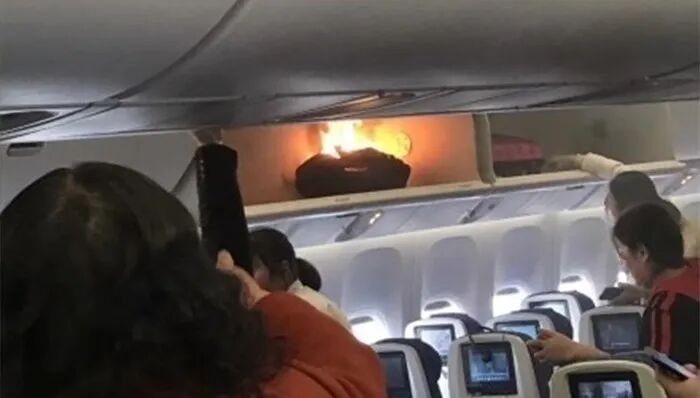
In the first half of 2025 there were 15 incidents of power banks catching fire or smoking on Chinese civil aviation flights. In some, a power bank suddenly started smoking in an overhead locker, its hot casing burning through a canvas bag; in others, one sprayed electrolyte from a backpack on a passenger's lap, sending the neighbouring passenger leaping out of their seat. In the most serious case, hot gas ignited the seat fabric, turning a crowded cabin that is hard to evacuate into a high-risk scene.
The civil aviation authorities and airlines have taken a series of measures, such as banning power banks from checked baggage, limiting the rated energy that may be carried and requiring products to have CCC certification. These rules have raised the bar to some extent and eliminated some poor-quality products. They cannot, however, eliminate thermal runaway at its root: the risk of power bank thermal runaway remains and continues to threaten airlines, passengers and flight safety.
To close this gap in the safety system, what we really need is a solution that steps in as soon as an incident begins.
Why is thermal runaway so hard to guard against?
The spread of lithium batteries has made the power bank a travel essential, but most people's understanding of its risks goes no further than "avoid crushing and knocks". What they don't realise is that the particular conditions of flight amplify the damage this risk can do.
The low pressure and low temperature in the cabin can accelerate unstable reactions of the chemicals inside lithium batteries and increase the likelihood of thermal runaway. More importantly, the cabin is enclosed and full of combustibles: once thermal runaway occurs, hot ejecta can quickly ignite seats, luggage and other items, while the narrow aisles make evacuation extremely difficult. Cabin crew are professionally trained, but faced with a fire that breaks out in moments, their means of fighting it are very limited, and they are often left reacting.
The civil aviation authorities recognised the risk long ago and have introduced rules banning power banks from checked baggage, limiting rated energy and requiring CCC certification. These measures have indeed raised the bar for products and eliminated a number of non-compliant, poor-quality ones, but they offer no effective answer to unexpected faults in compliant products. Even a genuine product you have chosen carefully may, because of the nature of the product, become a "hidden bomb" in flight.
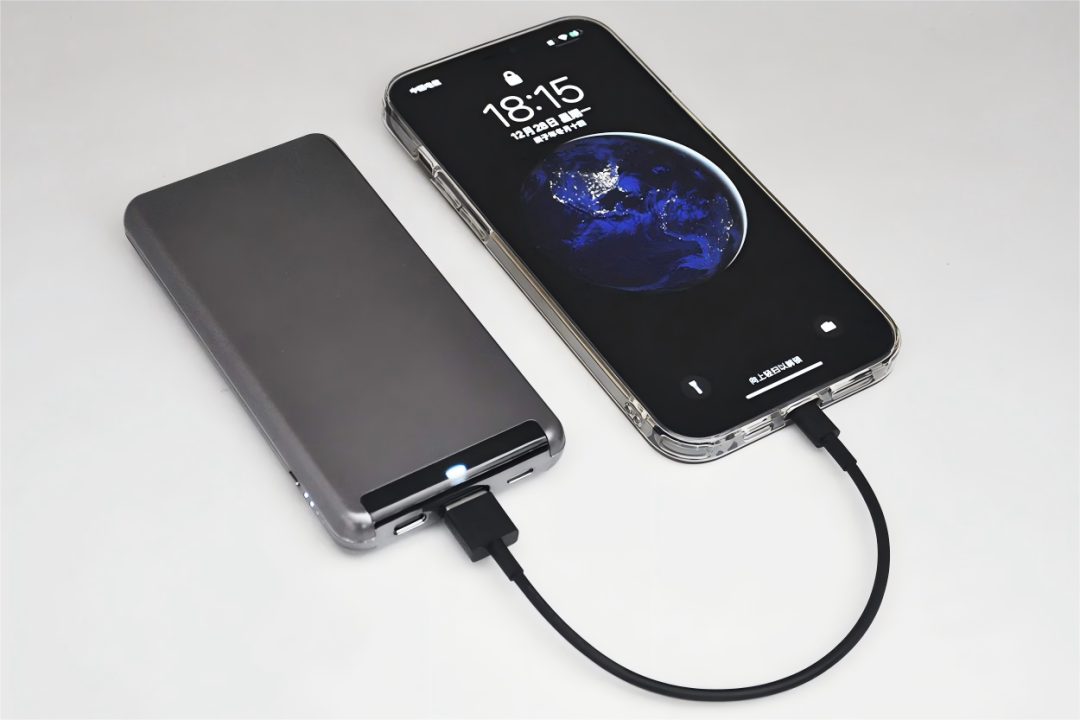
For passengers the risk is even harder to guard against. Who can guarantee that a power bank won't be slightly crushed in their bag? Who can foresee the ageing of a battery after long use? And who can react in time at the moment thermal runaway happens? These unanswerable questions are the most hidden safety pain points of air travel.
A "fire and blast suit" for lithium batteries
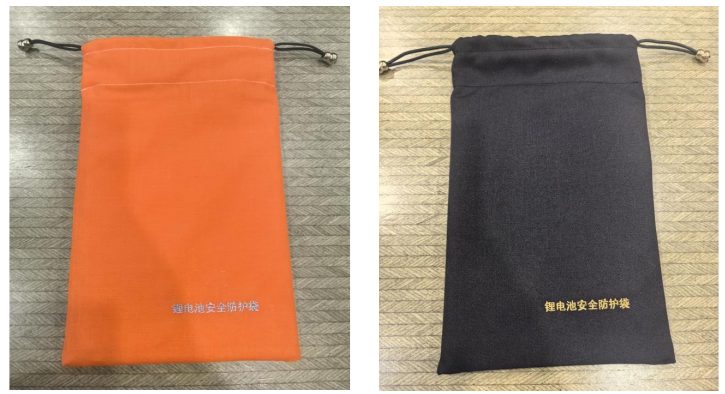
To address the pain points of lithium battery safety in air transport, a lithium battery safety bag designed specifically for flight has been developed. Instead of the "passive blocking" approach of traditional protective products, its core design idea is "layered suppression": three composite layers work together to build a line of defence across the whole course of a thermal runaway event.
Outer layer: 400 °C flame-retardant fabric
The outer layer of the bag is a high-quality fire-resistant, flame-retardant fabric that withstands temperatures of 400 °C and fully meets GB 8624 (China's classification standard for the burning behaviour of building materials and products) and other national flame-retardancy standards.
If thermal runaway leads to fire outside the bag, this layer quickly retards the flames, stopping them spreading outwards and igniting nearby luggage, seats and other combustibles. Its high mechanical strength and abrasion resistance both resist external physical impact and contain the expansion and deformation forces of a power bank in thermal runaway, preventing the bag from rupturing and letting the incident spread. For frequent travellers, this tough outer layer means the bag can stand up to the knocks and bumps of travel without fear of accidental damage.
Middle layer: PCM phase-change composite
The middle layer is the core technology of the bag: a PCM (phase-change material) composite.
It combines the latent heat storage of phase-change materials with the physical structure of a porous matrix, and changes phase in a temperature range of 80–120 °C.
When a power bank goes into thermal runaway, the composite rapidly vaporises and absorbs heat, carrying away a large amount of thermal energy at constant temperature and fundamentally checking the temperature rise. The porous structure left after vaporisation further blocks heat transfer and limits the rate at which oxygen reaches the fire inside, slowing its spread and even smothering it in the early stages, buying cabin crew valuable time to deal with the incident.
This dual action of "active heat absorption plus passive insulation" overcomes the limitation of traditional protective products, which can only block passively.
Inner layer: 1300 °C ultra-high-temperature fire-resistant fabric
The inner layer is an ultra-high-temperature fire-resistant fabric rated to 1300 °C, designed specifically for the hot material ejected by a power bank in thermal runaway.
The molten metal and hot electrolyte ejected by a battery in thermal runaway often exceed 1000 °C, and ordinary materials burn through in an instant. This fabric not only withstands the heat directly but also cushions the impact of the power bank swelling and bursting, preventing hot fragments and flammable gases from bursting out and protecting nearby passengers from burns and toxic gases. For families travelling with elderly relatives or children, this reliable inner layer gives extra peace of mind.

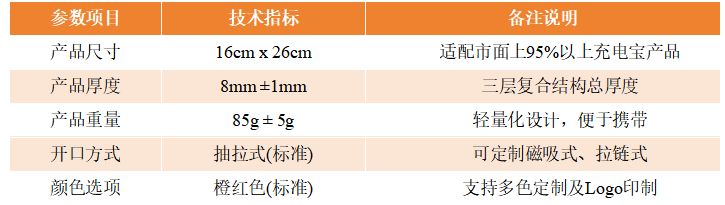
The practical design also takes passengers' needs fully into account. The standard size fits more than 95% of power banks on the market, and at around 85 g the bag is light enough to carry without adding to the load. The standard drawstring opening is easy to use, and magnetic or zip openings can be made to order to suit different users.
Not just for flying
The value of this lithium battery safety bag goes well beyond air travel.
As lithium batteries become ubiquitous in daily life, the risks from power banks, drone batteries, laptop batteries and other devices are becoming more apparent. If a power bank charging unattended at home goes into thermal runaway, it may well start a house fire; on a long road trip, a power bank left in a car baking in the sun can easily become a hazard; and batteries stored unused for long periods can also fail because of environmental conditions.
The bag's suitability for many scenarios addresses exactly these problems. Used throughout a flight, it guards against incidents in the cabin; used while charging at home, it helps prevent house fires; used for long-term storage, it reduces the risk from idle batteries. Outdoor enthusiasts travelling with drones can keep the batteries in the bag to cope with rough conditions, and companies can issue the bags to staff to improve electrical safety in the office.
For airlines in particular, supplying the bags to passengers in bulk, or requiring their use, can reduce at source the risk of lithium battery fires spreading on board, avoiding large hidden costs for a very small outlay and significantly reducing operating costs over the long term. And as the Civil Aviation Administration tightens its oversight of lithium battery safety, deploying the bags at scale can anticipate possible higher safety standards in future and set a benchmark for compliance in the industry.
In an age that depends on batteries, safety protection is never a wasted investment; it is a necessary step in taking responsibility for ourselves and others. A single, seemingly chance thermal runaway event can ruin a journey or a family, or cause irreparable loss.
With safety, "good enough" is not enough; it has to be foolproof. Choosing a lithium battery safety bag is not about preparing for a very unlikely accident, but about having the confidence to respond calmly when the risk does arise.
To find out more, contact us for a tailored solution.

First published on our WeChat channel: read the original