
On 2 September 2025, UL formally published ANSI/UL 263-2025, Fire Tests of Building Construction and Materials.
This is the 14th edition of UL 263, consolidating all revisions issued since the 2011 edition, and it marks a new stage in the evaluation of the fire resistance of building elements.
How UL 263 has evolved
The first edition of UL 263 was published in 1929, in response to the pressing need at the time for a standardised, scientific evaluation of the fire resistance of building elements. It was followed by the second edition (1934), the third (1939) and so on up to the 14th (2011). The revisions of the 1970s introduced the key concepts of "restrained" and "unrestrained" assemblies, which profoundly influenced structural design, and later editions progressively refined the test requirements for different materials (such as steel, concrete and timber) and different elements (such as beams, columns, floors and walls).
ANSI/UL 263-2025 is a revision and reaffirmation of the 14th edition (2011). It consolidates and confirms the technical updates issued as revision pages over the past decade or more, and adds new content, making it the most comprehensive and authoritative version to date. Its designation as an American National Standard further reinforces its foundational role in building codes, engineering design and product certification in North America and worldwide.
Main changes in the 2025 edition
This revision of ANSI/UL 263 (2 September 2025) includes the following changes to requirements:
Pressure measurement probes: the requirements for the furnace pressure probes have been revised in clause 3.4.4 and Figure 3.2. Furnace pressure is a key factor in heat transfer from flames and hot gases to the specimen, and more precise pressure control and measurement improve the repeatability and comparability of test results.
Hose stream nozzle distance and angle: clauses 5.4.5 and 5.4.6, on the distance and angle between the nozzle and the specimen surface in the hose stream test, have been revised. The hose stream test simulates the impact of firefighting hoses on damaged elements after a fire, and clearer rules keep the test severe and consistent.
Alternative test for structural steel column protection: Chapter 9 adds an alternative test method for fire protection systems for structural steel columns, with an accompanying figure (Figure 9.1). The method applies where the protection material carries no structural load, giving a more flexible and targeted route for evaluating such products.
Small-scale test procedure for recessed light fixtures: the new Appendix E is a major highlight. It provides a small-scale test method, as an alternative to full-scale testing, for recessed light fixtures installed in fire-rated floor-ceiling assemblies. Traditionally, any product penetrating a fire-rated element has needed an expensive full-scale test. Appendix E specifies a representative small-scale assembly (about 48 in × 48 in) and assesses the fixture's effect on the fire performance of the whole assembly by comparing the temperature rise in a cavity with a fixture installed against one without, under fire exposure. This greatly reduces the cost and time for fixture manufacturers to obtain certification while keeping the safety assessment valid.
Classification procedure for non-load-bearing steel columns: clause 9.7.1 now explicitly refers to Appendix A of UL 1709 as the procedure for classifying fire protection coatings on non-load-bearing steel columns. This gives clearer, more systematic guidance for classifying protective coatings across a range of shapes, sections, fire resistance periods and temperature requirements.
UL 263 in detail
Scope:
Assemblies of masonry units and composite assemblies of structural materials for buildings, such as load-bearing and non-load-bearing walls, columns, beams, floors, and composite slab-and-beam assemblies for floors and roofs.
Test principle:
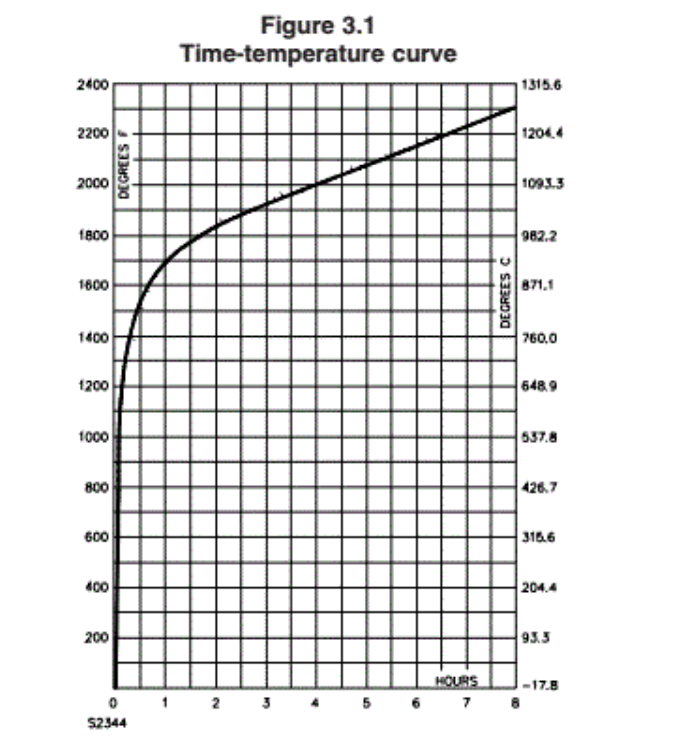
The test simulates a "standard fire exposure": the specimen is heated following the "standard time-temperature curve" specified in Chapter 3. The curve defines the average furnace temperature to be reached at each point in time, for example 538 °C at 5 minutes, 843 °C at 30 minutes, 927 °C at 1 hour and 1010 °C at 2 hours. The test assesses the element's ability to resist heat transmission and structural collapse while carrying its design load (if it is a load-bearing element).
Performance criteria:
An element's fire resistance rating (such as 1 hour or 2 hours) is set by the time at which it first reaches any of the following "failure" conditions:
Loss of integrity: the element can no longer stop flames and hot gases passing through. This is usually checked with the cotton waste test (see clause 5.4A); if the cotton waste ignites, integrity has failed.
Loss of insulation: the average temperature on the unexposed face of the element (the side not exposed to fire) rises more than 139 °C (250 °F) above its initial temperature, or the temperature at any single point rises by more than 181 °C (325 °F). This shows that the element can no longer effectively block heat.
Loss of load-bearing capacity: for load-bearing elements, the element loses its ability to support its load in the fire. This shows as collapse or as excessive deformation or rate of deformation (for beams there are specific formulas; see clause 12.4.1).
UL 263 appendices
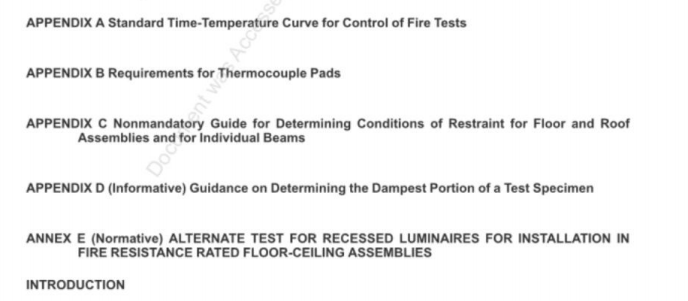
Appendix A: gives the detailed data table for the standard time-temperature curve, the core reference for controlling the furnace.
Appendix B: specifies the exact construction of the thermocouple pads used to measure unexposed-face temperatures, ensuring consistent temperature readings.
Appendix C: non-mandatory guidance to help engineers decide whether a floor or beam in a real building is "restrained" or "unrestrained", so that the right fire resistance rating is used.
Appendix D: an informative appendix with illustrations of how to find the dampest part of a specimen, since the specimen's moisture content significantly affects its fire resistance (especially the risk of spalling in concrete).
Appendix E: provides a small-scale test method, as an alternative to full-scale testing, for recessed light fixtures installed in fire-rated floor-ceiling assemblies.

First published on our WeChat channel: read the original