

During the 14th Five-Year Plan period, the photovoltaic industry was named as one of the key levers for meeting China's "dual carbon" goals (peak carbon emissions and carbon neutrality). As central and western provinces build PV industrial parks, rooftop PV on commercial and industrial buildings, centralised ground-mounted plants, floating PV and other forms are growing fast, and installed capacity keeps rising. The International Energy Agency (IEA) forecasts that by 2030 PV's share of the global electricity mix will jump to 37.1%, with installed capacity expected to grow nearly threefold.
But the industry's breakneck growth has come with a string of safety incidents, in particular modules blown off, mounting structures collapsing and equipment flooded because of inadequate wind and flood design, seriously affecting the safe operation and economics of PV plants.
Frequent incidents
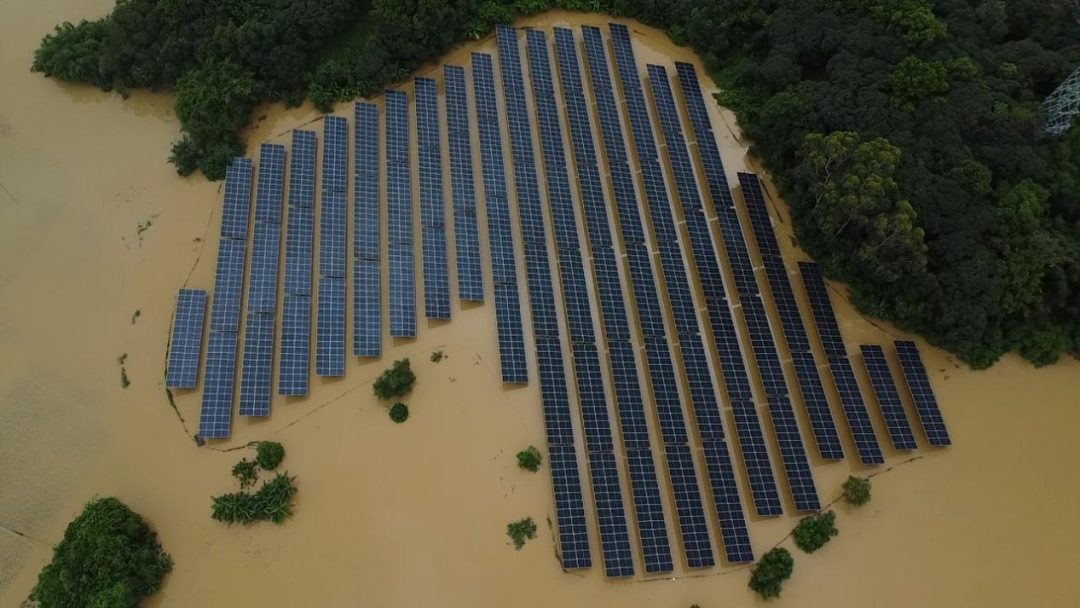
In June 2025, heavy rain caused severe flooding in Maoming, Guangdong. Drone footage showed a PV plant's site largely under water: the neatly arranged panels were now mostly submerged in yellowish floodwater, with only parts of them showing. The flood also knocked over some of the mounting structures.
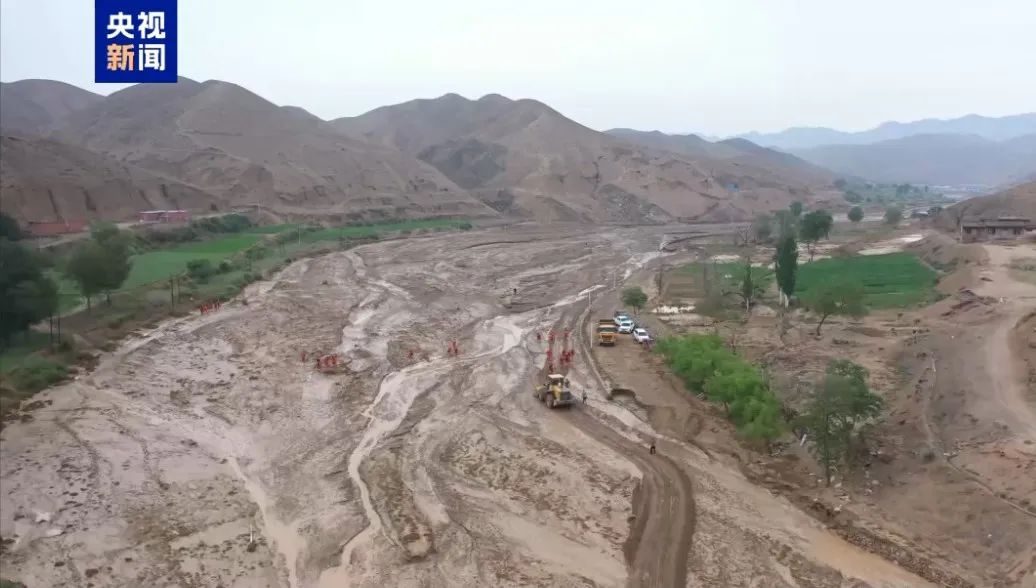
At around 6 pm on 23 June 2025, a flash flood struck Xinquangou in Xinquan Village, Yongxin Township, Jingyuan County, and construction workers at a nearby PV project went missing.
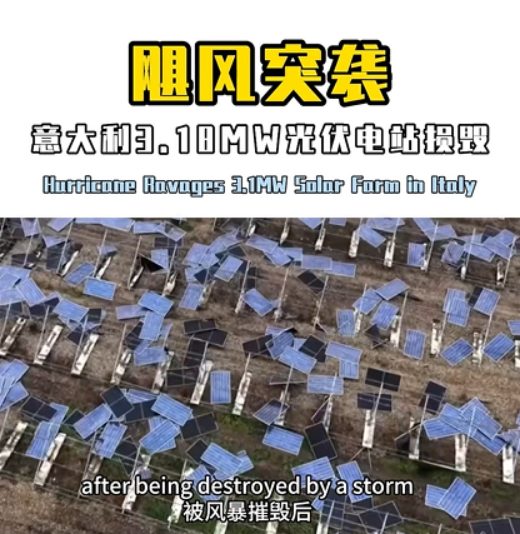
In 2025, a severe storm destroyed a 3.18 MW ground-mounted PV plant in Veneto, Italy, leaving local residents without power for several hours until utility crews restored supply with backup generation.
Extreme weather events driven by global climate change are becoming more frequent and are reshaping the risk landscape of the PV industry. In recent years, China has been hit by severe typhoons, exceptional rainstorms and other disasters markedly more often. When the "dual carbon" goals meet extreme weather as the new normal, these tragedies sound a warning: the grand blueprint for green infrastructure must rest on a firm foundation of respect for the laws of nature.
Current national standards, such as GB 50797-2012 (China's design standard for PV power stations) and GB/T 51368-2019 (China's technical standard for the application of building PV systems), set basic requirements for structural safety design against floods and wind. But with extreme weather now so frequent, any "once in a century" event could become an annual one. Whether these standards still provide enough resilience against disasters is a question the industry must face.
Design provisions in current PV standards
As the guiding document for PV plant design, GB 50797-2012 applies to new, extended or rebuilt grid-connected PV plants and to off-grid PV plants of 100 kWp and above, and gives comprehensive technical requirements for planning, design and site selection.
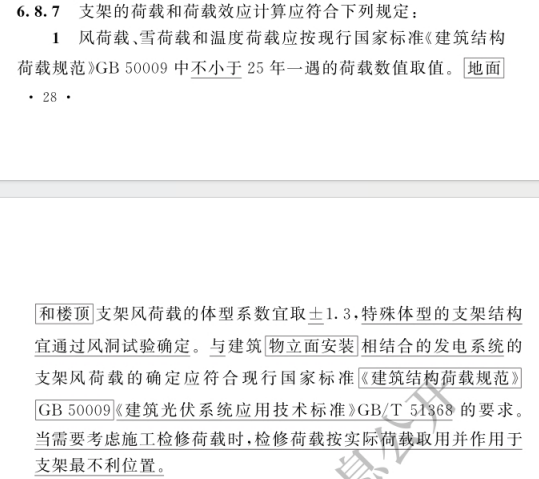
On structural safety, it sets out the basic principles of load calculation, of which the wind load and flood protection standards relate to extreme weather. It requires a design working life of not less than 25 years for PV mounting structures. The basic wind load, snow load and seismic action for the design of mounting structures and their foundations are taken at a 25-year return period, while flood protection works use water levels up to a 50-year return period.
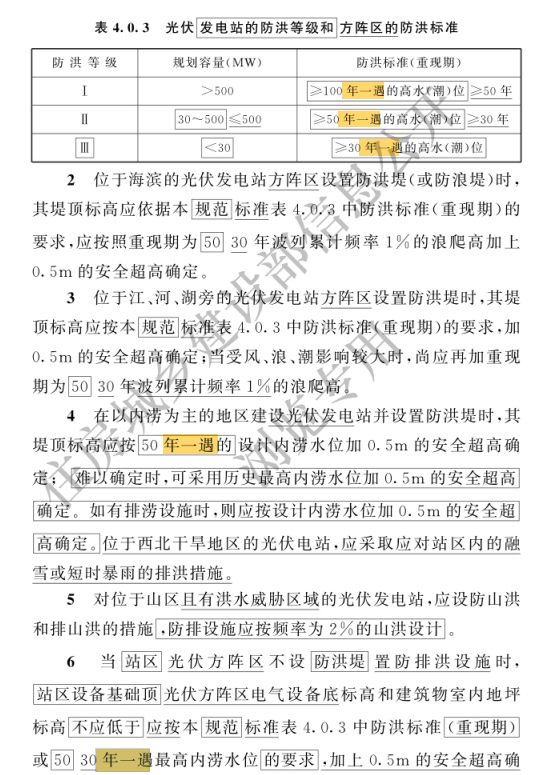
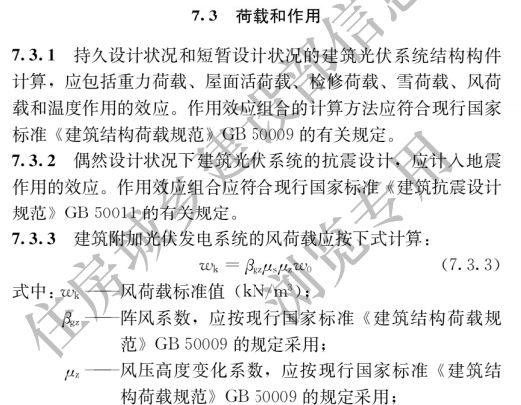
GB/T 51368-2019 focuses on building-integrated PV. On structural loads, section 7.3 "Loads and actions" requires the structural design of building PV systems to consider permanent loads, wind loads, snow loads, seismic action and so on. As in GB 50797, load values follow GB 50009 (China's load code for the design of building structures) directly, again with a 25-year return period for design wind pressure. The standard also requires a structural reliability appraisal of building PV systems; wind load calculations must take account of the building's shape coefficient and gust factor; and the connections between the mounting structure and the main structure must be checked for load capacity.
A "once in XX years" event does not mean it happens exactly every XX years. A "50-year" flood, for example, has a probability of 1/50, or 2%, of occurring in any given year. Likewise, a "25-year" windstorm has an annual probability of 4%.
The rationale and limits of the standards
It must be acknowledged that when these standards were drafted, they were scientifically justified on the basis of the historical meteorological data, understanding of risk and economic and technical conditions available at the time, and they were well founded in their historical context. Over the past decade they have provided a solid basis for the standardised, large-scale development of China's PV industry.
But with global climate change now accelerating sharply, "once in a century" rainstorms, typhoons, extreme winds and other weather events are becoming ever more frequent. Many plants designed for a 25-year wind load have, within a few years of completion, been hit by winds far above the design value, leading to twisted mounting structures, detached modules and even complete overturning. A series of major losses at PV plants caused by extreme weather has shown beyond dispute that we face an entirely new risk environment: a "new climate normal" that models based on historical data can no longer predict accurately.
Designing to the current, lower return-period standards is in essence a "reactive" model of risk management.
Its implicit logic is that extreme disasters are low-probability events, so to keep the initial investment down we can accept the risk and repair or claim on insurance after an incident. That may have been reasonable when the climate was stable, but today it has become a high-stakes gamble. Lose the bet and the consequences are catastrophic: not only the direct economic loss, but long interruptions to generation, complex insurance claims, and secondary disasters such as fires caused by falling modules or electrical faults, which threaten public safety. These losses are uncontrollable, unpredictable and hugely destructive.
The standards need upgrading
"Once in a century" is becoming normal. Research reports from the World Meteorological Organization (WMO) and other authoritative bodies have repeatedly pointed out that global warming has stored more energy in the atmosphere and oceans, markedly increasing the frequency and intensity of extreme rainfall, super typhoons and other events. Under the new climate, "once in a century" events once thought improbable may now have return periods of 30 or 20 years, or even less.
PV plants usually have a design life of 25 years or more, during which climate risk will increase significantly. Designing for wind, snow and water loads with longer return periods is a necessary response to an uncertain climate.
Raising the corresponding design requirements, taking the effects of climate change into account in load calculations and updating the methods for determining load values marks a shift to the modern risk management principle of "active defence".
By increasing design redundancy, we can reduce the probability of catastrophic structural failure. This not only greatly protects the plant as an asset but, more importantly, protects people and the public and ensures a continuous, stable energy supply. For a long-term infrastructure asset with a design life of 25 years or more, this added certainty is invaluable.
At the same time, stricter, differentiated standards could be applied in high-risk areas, such as coastal areas, wind corridors and areas prone to flooding.
As we develop clean energy at pace, we must take the impact of extreme weather on energy infrastructure very seriously and keep strengthening our capacity for disaster prevention and mitigation, to build a solid line of defence for energy security. Raising the structural safety standards for PV is not over-design; it is a responsibility to the future. We must move from "minimum compliance" to "maximum resilience", and through technical upgrades, higher standards and smart management build PV energy systems that are truly safe, reliable and sustainable, safeguarding the energy transition in China and around the world.

First published on our WeChat channel: read the original