

Background to the low-altitude economy
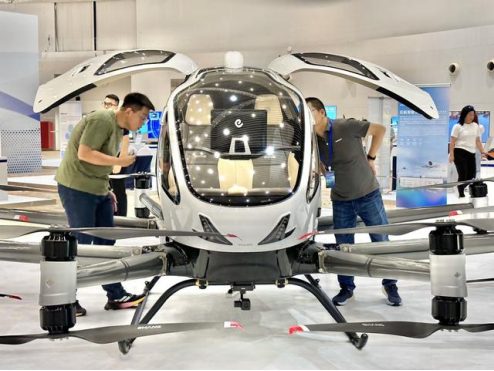
The low-altitude economy generally refers to economic activity in airspace below 3,000 metres, covering applications such as electric vertical take-off and landing aircraft (eVTOL), drone logistics and urban air mobility. As urbanisation accelerates worldwide and technology advances, the low-altitude economy is entering a period of explosive growth as an emerging industry.
In China, the much-discussed concept of the low-altitude economy was written into the Government Work Report for the first time at the 2024 National People's Congress and CPPCC sessions, as an emerging and future industry to be developed into a new driver of economic growth. At the end of March 2024, four ministries — the Ministry of Industry and Information Technology, the Ministry of Science and Technology, the Ministry of Finance and the Civil Aviation Administration of China — jointly issued the Implementation Plan for Innovative Application of General Aviation Equipment (2024–2030). It states that by 2027 aviation emergency rescue and logistics delivery will be in large-scale use and urban air mobility in commercial operation, and that by 2030 general aviation equipment will be fully integrated into every area of production and daily life, forming a market worth trillions of yuan.
The 2025 Government Work Report again called for the safe and healthy development of emerging industries such as the low-altitude economy.
In its report "New opportunities in China: the low-altitude economy, a 'new track' for new quality productive forces", CCTV News stated that the low-altitude economy's overall contribution to the national economy would reach RMB 3 trillion to 5 trillion in 2025.
Lithium batteries: the core power source
Low-altitude aircraft depend on efficient, reliable power systems, and the battery, as the energy carrier, directly determines an aircraft's endurance, payload and safety. An eVTOL, for example, must complete vertical take-off within 3 minutes and transition to cruise, which places stringent demands on the battery's high-rate discharge capability, energy density and cycle life.
Lithium battery technology is currently more mature and stable than hydrogen fuel cell technology and has better rate performance. Solid-state batteries are also expected to break through the energy density limits of today's lithium-ion batteries, and in future solid-state lithium batteries will become the mainstream technology for eVTOL battery systems.
Beijing, Shanghai, Chongqing and other cities have issued action plans for the high-quality development of the low-altitude economy. Under strengthening innovation in key core technologies and improving advanced power systems, all of them include plans for lithium battery R&D and application.
Encouraged by these favourable policies, the major battery companies have stepped up research and investment in eVTOL batteries since last year.
China's main information and communications companies, as well as traction battery and electric motor companies, are actively positioning themselves in the low-altitude economy. CATL, a leading lithium battery company, had already moved into aviation: in April 2023 it launched its condensed-matter battery, with a cell energy density of up to 500 Wh/kg, and it is developing a civil electric passenger aircraft project. Other leading traction battery makers, including EVE Energy, Gotion High-Tech and Farasis Energy, have also launched batteries for low-altitude flight.
Lithium battery safety performance
Besides stringent requirements for energy density and charge–discharge rate, low-altitude batteries must meet extremely high reliability and safety requirements, which is a major challenge for the companies involved.
Although lithium battery technology is mature, its safety faces a tougher test in low-altitude applications. Aircraft operate in complex environments, and high temperature, vibration and high-rate charging and discharging can easily trigger thermal runaway, leading to overheating, swelling or even fire. In 2025, for example, a ceremonial drone at a low-altitude demonstration base fell into a champagne tower because of battery ageing, exposing inadequate monitoring of battery ageing. In crewed applications such as eVTOLs, a battery failure could have catastrophic consequences.
In eVTOL airworthiness certification, battery thermal runaway is a key item of the safety assessment and a technical challenge that cannot be avoided.
Safety standard RTCA DO-311A-2017
In the low-altitude sector, lithium battery technology as the core component of the propulsion system is still relatively new. On the one hand, safety requirements are higher and applications more complex; on the other, most existing test methods for aviation lithium batteries were developed for earlier uses such as standby and starting power, and do not apply directly to propulsion batteries.
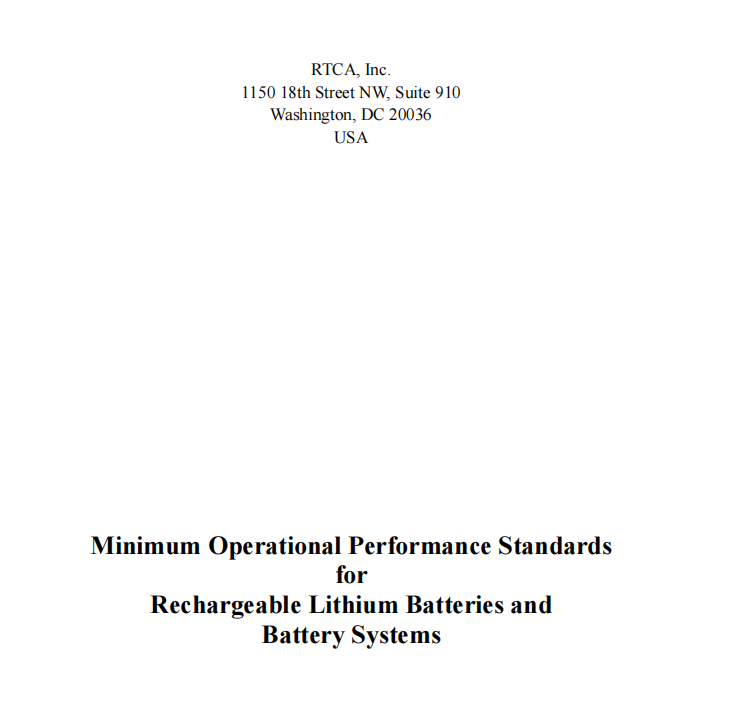
To ensure the safe use of lithium batteries in aviation, a number of targeted standards have been issued in China and internationally. The most widely used is DO-311A-2017, Minimum Operational Performance Standards for Rechargeable Lithium Batteries and Battery Systems, published by RTCA (the Radio Technical Commission for Aeronautics) in December 2017. It applies broadly to lithium batteries and their associated systems permanently installed in all types of aircraft. RTCA DO-311A is also an important reference standard for airworthiness certification by the major aviation authorities worldwide (such as the FAA and EASA).
The standard covers a wide range of battery products and is comprehensive and detailed. DO-311A introduces a full set of test requirements and verification methods for assessing the safety and reliability of lithium battery systems, including:
cell-to-cell failure propagation verification (propagation testing);
short circuit, overcharge and reverse polarity protection verification;
vibration, shock, damp heat, free drop and salt spray corrosion tests;
EMI/EMC performance verification (used together with RTCA DO-160);
thermal runaway tests: 2.4.5.4 single-cell thermal runaway test and 2.4.5.5 battery thermal runaway test.
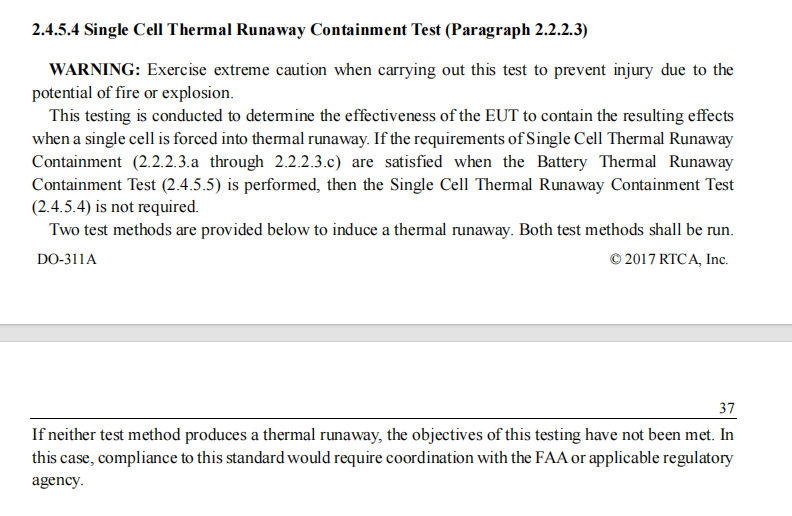
Battery safety is directly linked to public acceptance and commercialisation of the low-altitude economy. Through a systematic test framework, standards such as RTCA DO-311A-2017 give clear technical specifications for battery design, manufacture and application. Tests of thermal runaway protection, environmental robustness and so on keep the probability of battery failure within acceptable limits; they also drive technical standardisation across the industry, reduce the cost of repeated verification and speed up airworthiness certification of products.
As the low-altitude economy grows, battery safety requirements will rise further and the relevant standards and codes will continue to develop and improve. We will be watching closely.

First published on our WeChat channel: read the original