

In the North American market, all interior finish and ceiling materials must be tested and classified to ASTM E84 before they can be used appropriately in a building project.
ASTM E84 is the main fire test method in the United States for wall and ceiling interior finish materials, and an intermediate-scale test. The IBC (International Building Code), NFPA 101 (Life Safety Code) and others cite it as the test method for the fire performance of interior finish materials.
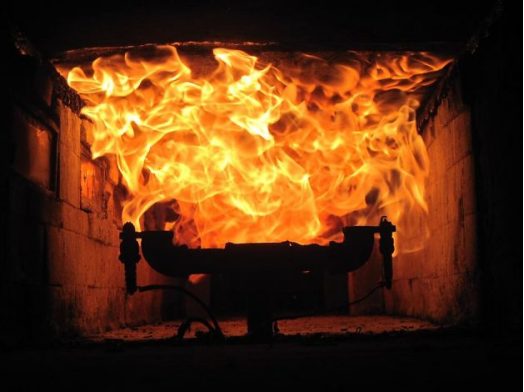
How ASTM E84 works
ASTM E84 is the classic method for assessing the surface burning characteristics of building materials.
The apparatus is like a miniature fire tunnel. The specimen is mounted in the ceiling position and exposed to a gas burner flame for 10 minutes.
Put simply, the material sits a "fire exam": how long can it hold out against the flames, and does it make matters worse (for example, by producing a lot of smoke)?
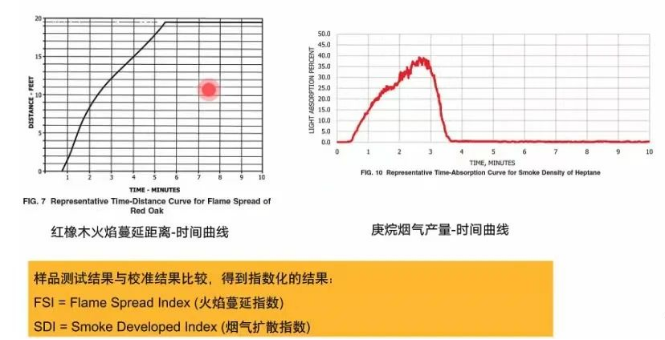
The test measures two main indicators, the flame spread index (FSI) and the smoke-developed index (SDI), and records how both change over time during the test.
The flame spread index (FSI) compares the surface burning characteristics of the test material with those of fibre cement board and untreated red oak: fibre cement board is rated 0 and untreated red oak flooring is rated 100.
The smoke-developed index (SDI) is determined by comparing the smoke produced by the test material with that produced by fibre cement board and by burning heptane.
Apparatus
The apparatus, known as the Steiner tunnel, is a fire test chamber for measuring flame spread and smoke density; more precisely, it is a horizontal rectangular duct with a removable lid, fitted with observation windows, two gas burners, and an air inlet and exhaust end.
The ignition source in ASTM E84 is two gas burners with a heat output of 5.3 MJ/min, located below the specimen, 190 mm from it, parallel to the fire end of the test chamber and 305 mm from it. The fuel is natural gas or methane.
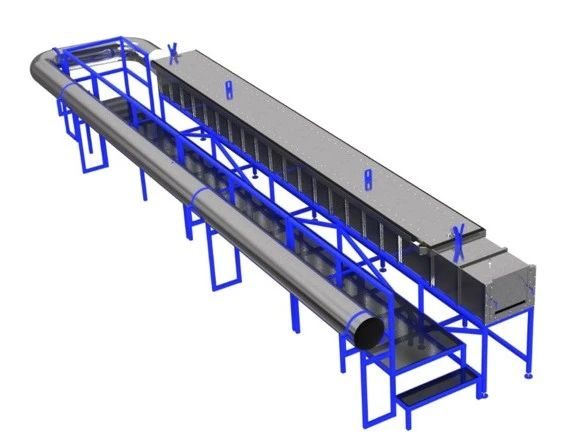
Specimen size
The test for surface burning characteristics of building materials needs a specimen more than 7 metres long!
At least one specimen is required, measuring (510 to 600) mm × 7320 mm, at the thickness used in practice (maximum 4 in). If the specimen cannot be made long enough, it may be joined to reach the specified size.
ASTM E84 test method
The method is used to determine the rate of flame spread of building materials (including solid plastics), and their smoke development at the same time.
Under ASTM E84, the tunnel method uses a steel duct 7.62 m long, lined with firebrick, with an open-end cross-section of 0.45 m × 0.30 m and windows along its side. The specimen is placed under the top of the duct, supported by its inner walls, forming a flat roof to the duct.
To determine the rate of flame spread, the specimen is ignited and the rate is estimated from the times at which the flame passes the windows: plotting window distance against the time the flame passes each window gives the flame spread curve. The apparatus must first be calibrated, and two preliminary tests are then run.
The first preliminary test is on a red oak specimen, whose flame spread and smoke development (the method measures the material's smoke development as well) are set at 100 by definition.
The second preliminary test is on an asbestos cement specimen, whose two values are set at 0.
The smoke development and flame spread curve of the specimen under test are then measured, and its flame spread index (FSI) calculated: if the total area under the material's flame spread distance–time curve, AT, is ≤ 97.5 ft·min (about 29.7 m·min), FSI = 0.515 AT; if AT > 97.5 ft·min, FSI = 4900 / (195 − AT), with AT in ft·min.
Procedure:
-
Preheat the tunnel until the floor thermocouple about 23 ft from the burner reads 150 °F ± 5 °F, let it cool until the floor thermocouple 13 ft from the burner reads 105 °F ± 5 °F, then install the specimen. Hold for 120 s.
-
Ignite, record the burning time and length burned, and end the test after 10 min. Record what happens during burning.
-
Record the photocell reading every 15 s, and record the condition of the specimen after burning ends.
ASTM E84 classification
Under section 6-5.3 of the NFPA 101 Life Safety Code, "interior wall and ceiling finish materials" tested to ASTM E84 (or NFPA 255, UL 723) are classified into three classes, Class A, B and C:
• Class A: FSI 0–25 and SDI not more than 450.
• Class B: FSI 26–75 and SDI not more than 450.
• Class C: FSI 76–200 and SDI not more than 450.
Materials are classified by the FSI (and smoke density) measured in the test. The lower a material's FSI, the lower its fire hazard. High-rise buildings and corridors should use materials with FSI < 25; materials with 25 < FSI < 100 may only be used where fire requirements are less strict; and materials with FSI > 100 do not meet flame retardancy requirements.
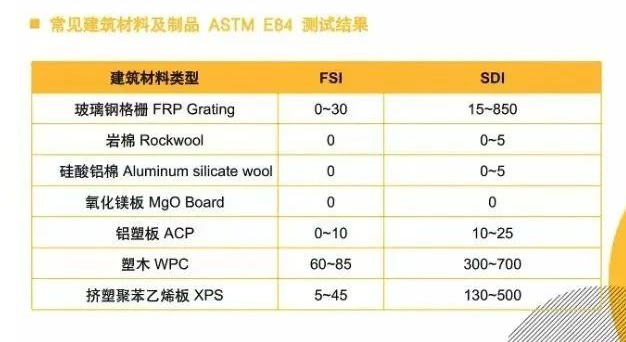
Similar methods include the Canadian CAN/ULC-S102 tunnel method and the small tunnel furnace method; in China there is the industry standard ZBG 5100-2-85 (fire performance test method for fire-retardant coatings), and in the United States there is ASTM E 69-50, among others.

First published on our WeChat channel: read the original