

The smart fire-extinguishing patch is a new kind of fire protection product, and its extinguishing performance, trigger temperature and safety have to be verified by rigorous testing before people will trust it. Here we share a typical test we carried out.
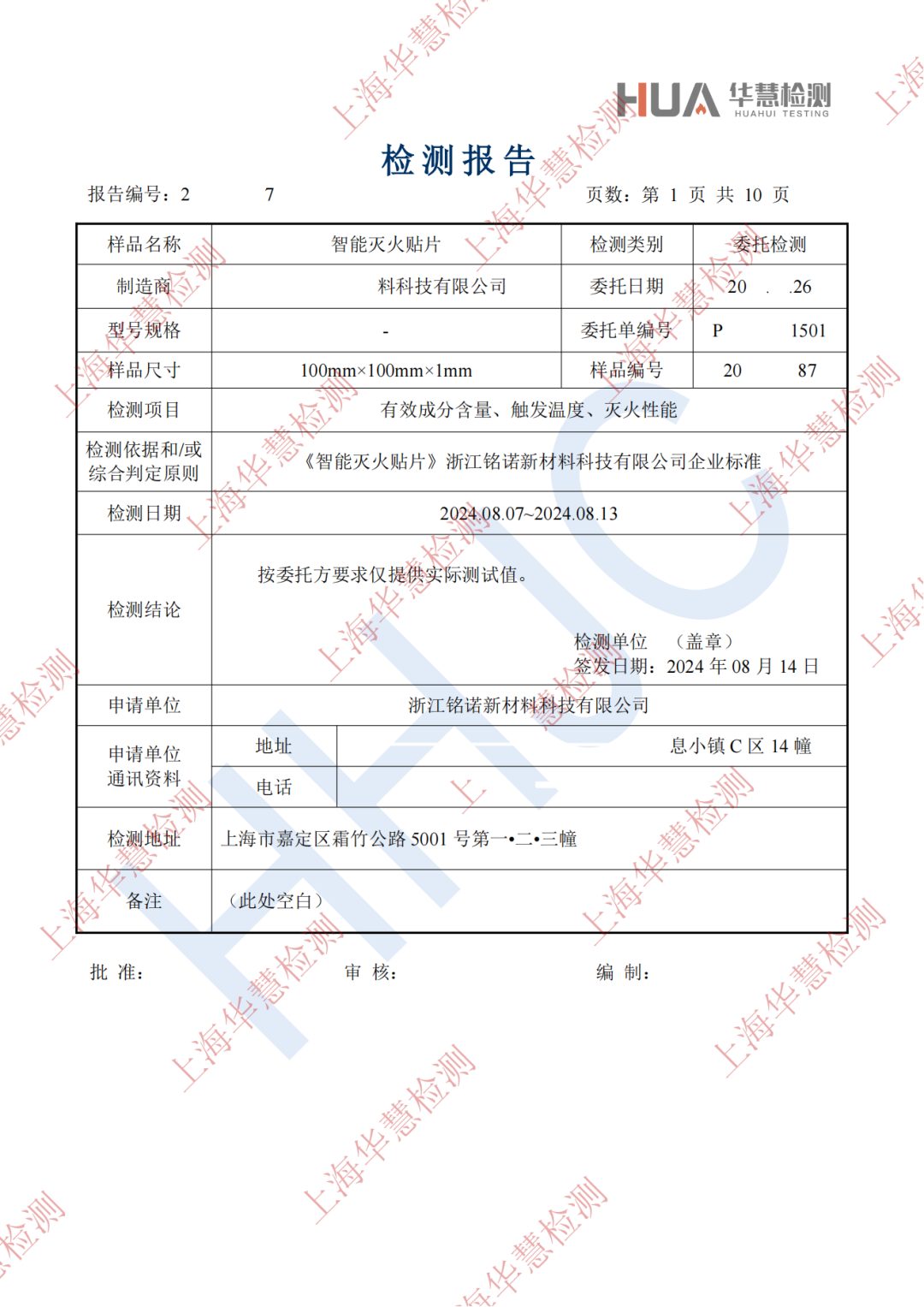
Commissioned by a new-materials technology company, the Huahui laboratory ran custom fire performance tests on the product to the company's own enterprise standard for smart fire-extinguishing patches. The aim was to assess how the product actually performs in different fire scenarios and to give the company sound, reliable test data.
The product is designed to put out fires in their early stage through a self-triggering mechanism, and is intended for homes, electrical cabinets, storage and many other settings.
After detailed discussion with the client, the Huahui laboratory set the following test objectives:
Trigger accuracy: verify how responsive the patch is at its set temperature (110 ± 10 °C);
Extinguishing performance: quantify how quickly and reliably it extinguishes class A (solid), class B (liquid) and class E (electrical) fires;
Structural safety: make sure there is no risk of re-ignition after extinguishment and that the integrity of the equipment or building structure is not compromised.
The tests covered three typical fire scenarios, class A (solid materials), class B (liquids) and class E (electrical), verifying trigger response, extinguishing performance and reliability in each. Custom test models and procedures were used so that the tests reflected real applications as closely as possible.
Class A fire test
Test model: pine wood crib (24 dry sticks, stacked crosswise in 4 layers) with an n-heptane pan for ignition.
Test conditions: enclosed distribution cabinet space, with the patch installed at an opening at the top;
Sample arrangement: patches spread evenly over a gypsum board substrate.
Requirement: the patch is triggered after the pan has burned for 3 minutes; the fire must be completely extinguished within 10 minutes without the crib collapsing, with no re-ignition during 10 minutes' observation after extinguishment.
Result: the patch was triggered after 3 minutes' pre-burn, the flames went out at 2 min 57 s, and the crib remained intact.
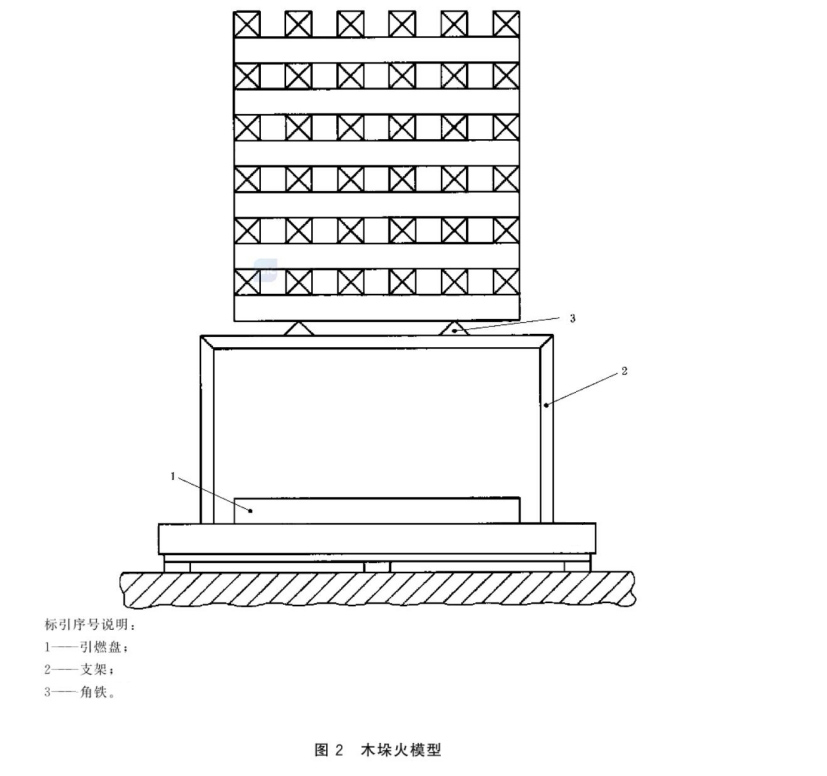
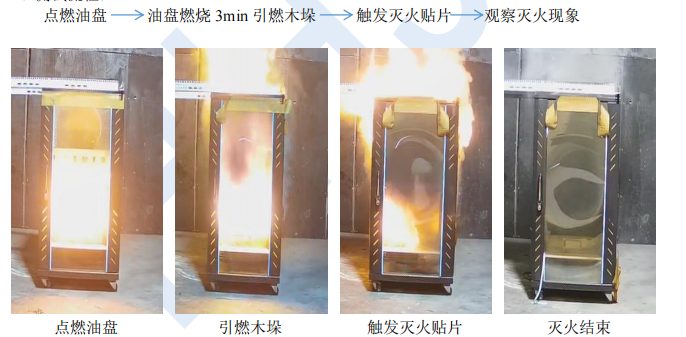
Test procedure
Class B fire test
Test model: pan of fuel and water mixture (2:1), ignited with n-heptane.
Test conditions: the patch is triggered directly in an enclosed space; extinguishing speed and the amount of fuel remaining are observed.
Sample arrangement: patch substrate of 1 mm galvanised steel sheet, simulating the surface of industrial equipment.
Requirement: the fire must be completely extinguished after the patch is triggered, with fuel remaining in the pan.
Result: the flames went out within 19 seconds with fuel remaining, meeting the pass criteria.
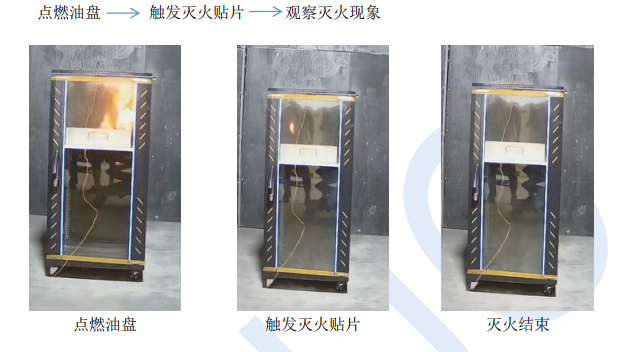
Test procedure
Class E fire test
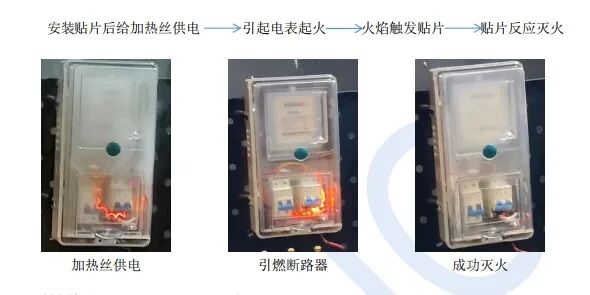
Test model: single-phase meter box with a built-in circuit breaker and heating wire; the heating wire is energised for 52 seconds to set the breaker alight, simulating a fire caused by a short circuit.
Test conditions: a blank test (without patch) is compared with a test in which the patch is triggered.
Sample arrangement: patches placed at key points on the top and side walls of the meter box.
Requirement: once the flames are completely extinguished, the meter box enclosure must be intact, with no re-ignition.
Result: the breaker caught fire after 52 seconds; the open flame was extinguished 1 min 42 s after the patch triggered, with no damage to the box and no second ignition.
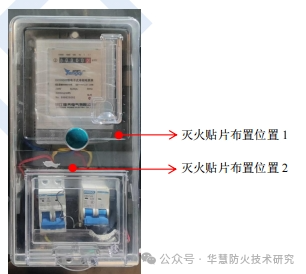
Sample installation
Heating with the heating wire
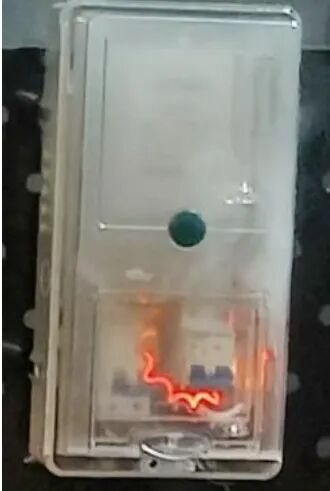
Blank test
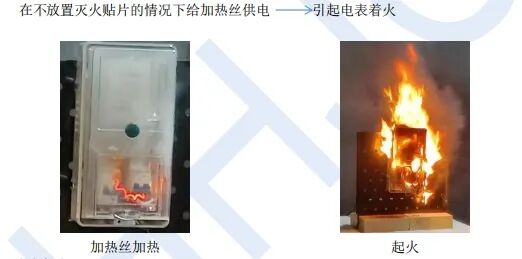
Comparison test
Video below, sped up 8×:
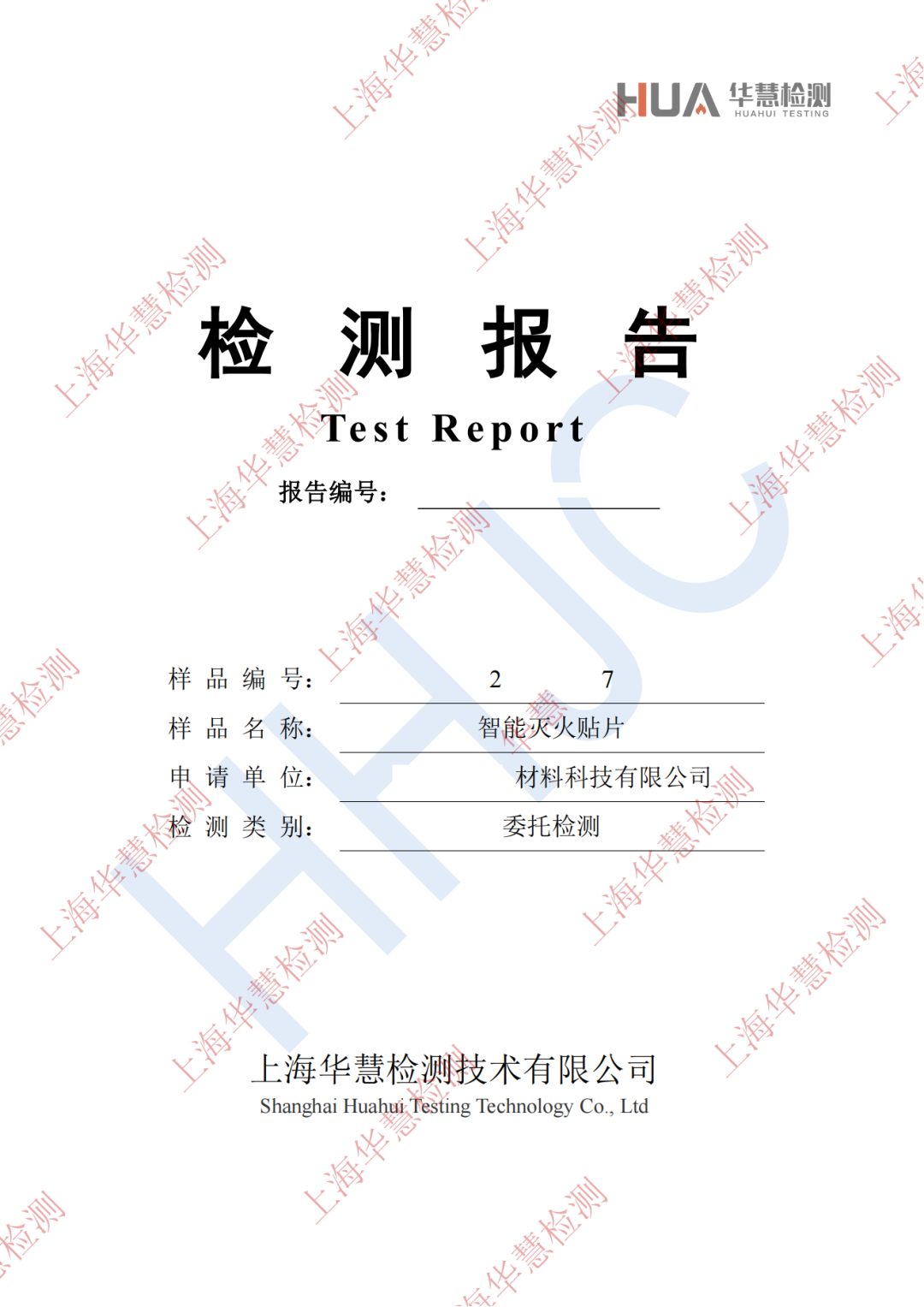
Report cover
Client and request details
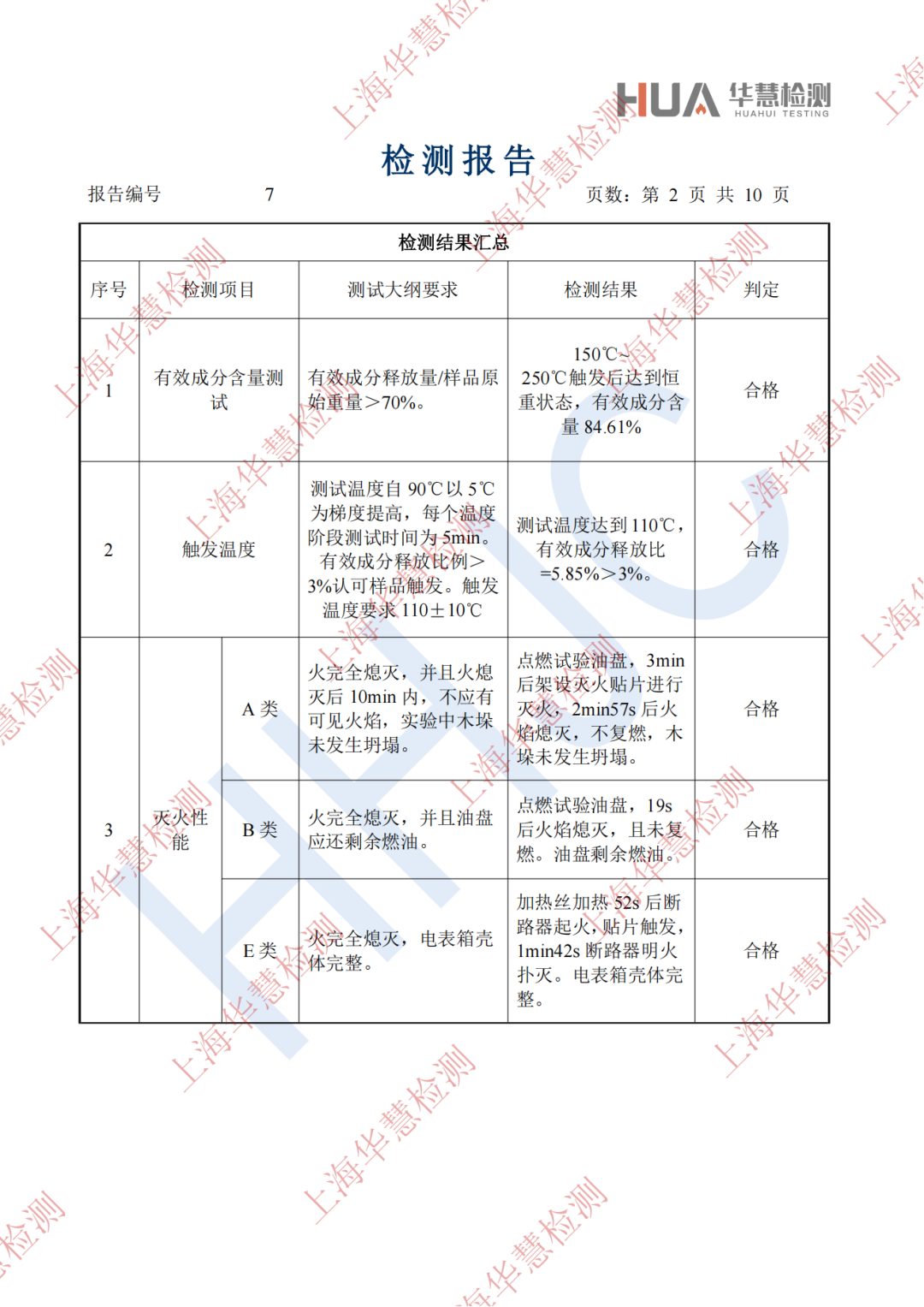
Results
Working from the client's enterprise standard for smart fire-extinguishing patches, Huahui designed stepped heating and multi-scenario extinguishing models. Besides the extinguishing performance tests, we also tested parameters such as the active ingredient content and the trigger temperature of the patch. The tests verified that the patch extinguishes fires well in all the different fire scenarios. The results support the product's market access and give the manufacturer data to base further technical development on, adding value from R&D through to market.
Our approach
For emerging products, the Huahui laboratory can design custom test programmes to an enterprise standard or to the client's requirements, making sure the test methods are sound and the data accurate. We carry out non-standard testing of all kinds of new fire protection products (such as extinguishing devices and flame-retardant materials), with technical support throughout, from test design and parameter optimisation to recommendations for corrective action. We are always happy to discuss your requirements.

First published on our WeChat channel: read the original