
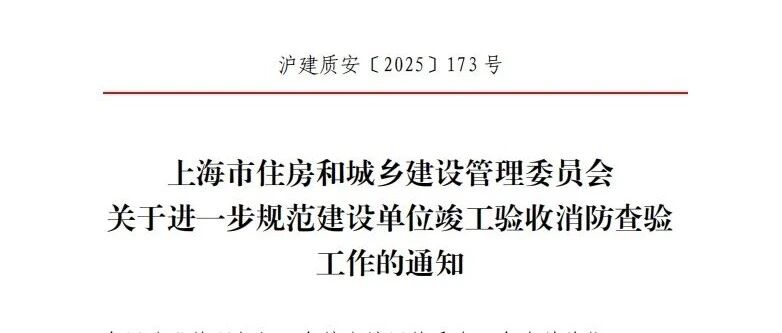
On 24 March 2025, to strengthen the management of fire acceptance of construction projects and enforce the developer's primary responsibility, the Shanghai Municipal Commission of Housing and Urban-Rural Development (上海市住房和城乡建设管理委员会) issued the Notice on Further Standardising the Developer's Fire Protection Verification at Completion Acceptance (《关于进一步规范建设单位竣工验收消防查验工作的通知》, 沪建质安〔2025〕173号). This change to fire protection verification at completion acceptance (竣工验收消防查验) has made waves across the construction industry, with far-reaching effects on developers (建设单位), fire protection technical service organisations (消防技术服务机构) and construction authorities at every level.
Below are some views from Huahui Fire as a fire protection technical service organisation. We welcome discussion.
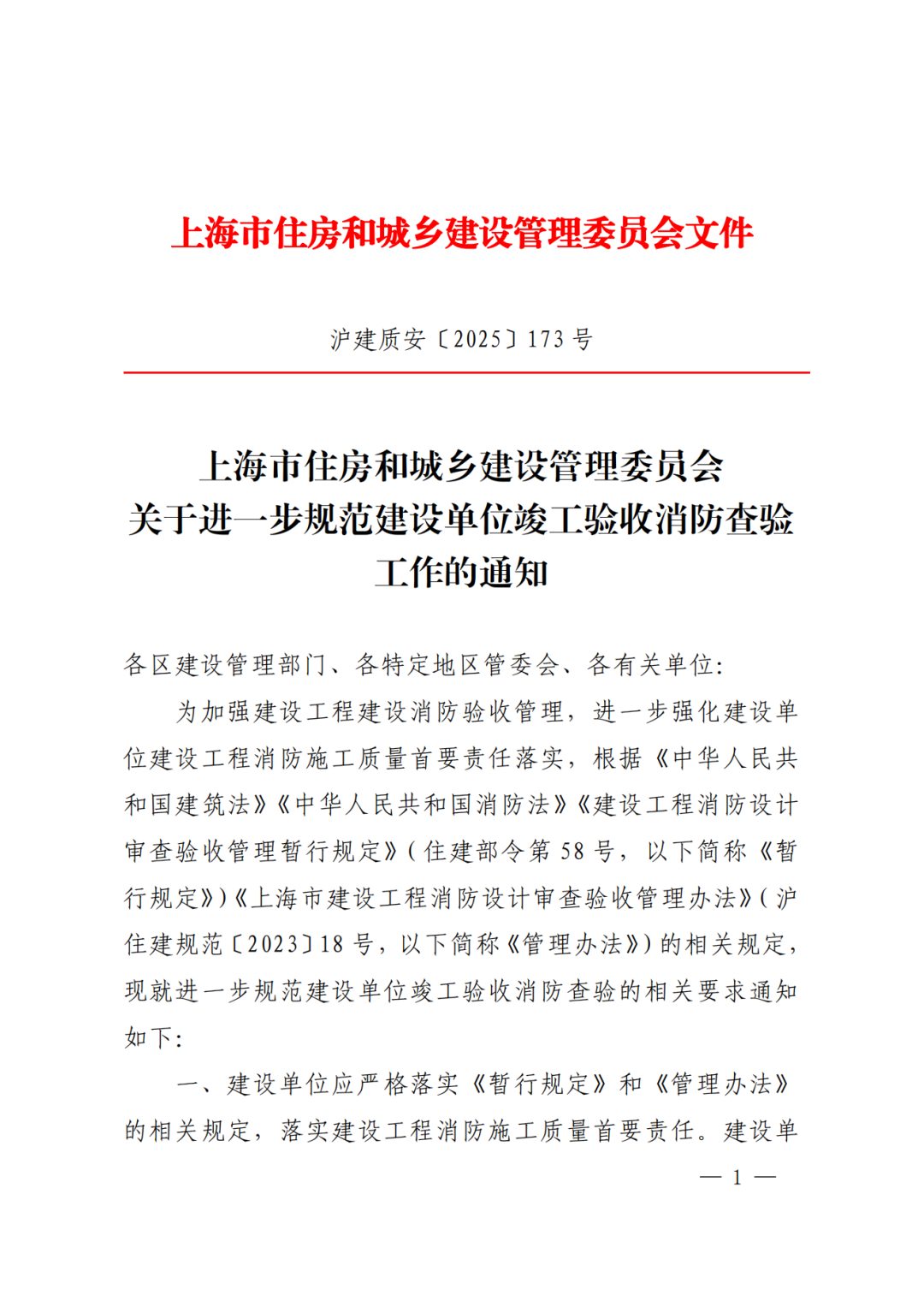
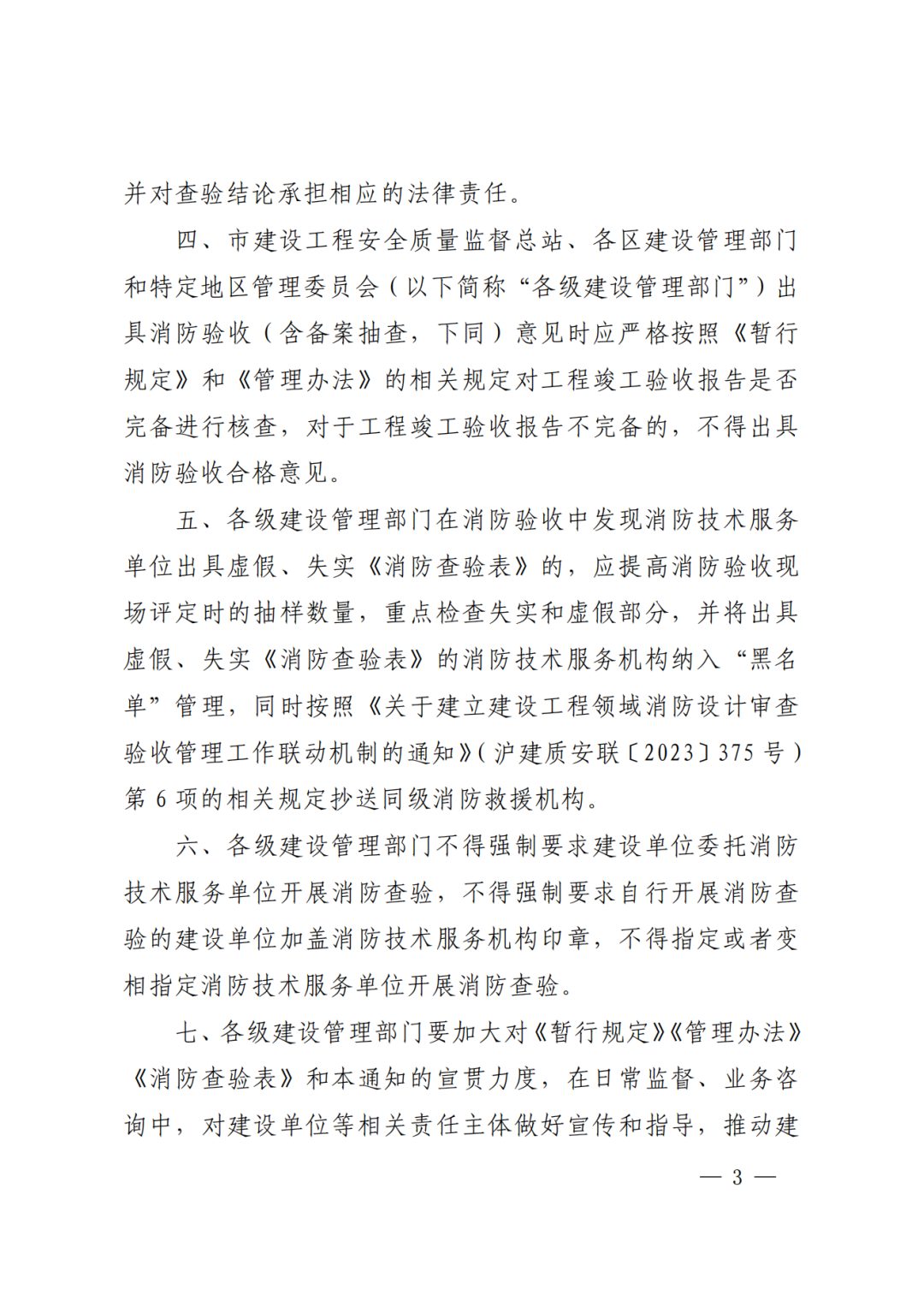
The text of the notice is attached at the end of this article.
The party responsible for fire protection verification
The thrust of the notice is still how the developer should carry out fire protection verification at completion acceptance in a standardised way. Under item 1 of the notice, the developer shall strictly implement the relevant provisions of the Interim Provisions (《暂行规定》) and the Shanghai Measures (《管理办法》), both named in full below, and fulfil its primary responsibility for the quality of fire protection construction. When the developer organises the relevant parties to carry out completion acceptance of a construction project, it shall verify whether the project meets fire protection requirements.
Fire protection verification at completion acceptance means that, when completion acceptance of a construction project is organised, the developer organises the design, construction, construction supervision, technical service and other organisations to verify whether the project meets the relevant requirements of MOHURD's Interim Provisions on the Administration of Fire Protection Design Review and Acceptance of Construction Projects (《建设工程消防设计审查验收管理暂行规定》, MOHURD Order No. 58 (住建部令第58号)) and the Shanghai Measures for the Administration of Fire Protection Design Review and Acceptance of Construction Projects (《上海市建设工程消防设计审查验收管理办法》, 沪住建规范〔2023〕18号).
The fire protection verification report at completion acceptance is prepared under the developer's direction and forms an annex to the project completion acceptance report (工程竣工验收报告); the completion acceptance report can be prepared only after the verification has been passed. Fire protection verification is therefore a necessary precondition for completion acceptance.
As the party responsible for fire protection verification, the developer clearly bears the greatest responsibility.
Mandatory inspection report dropped
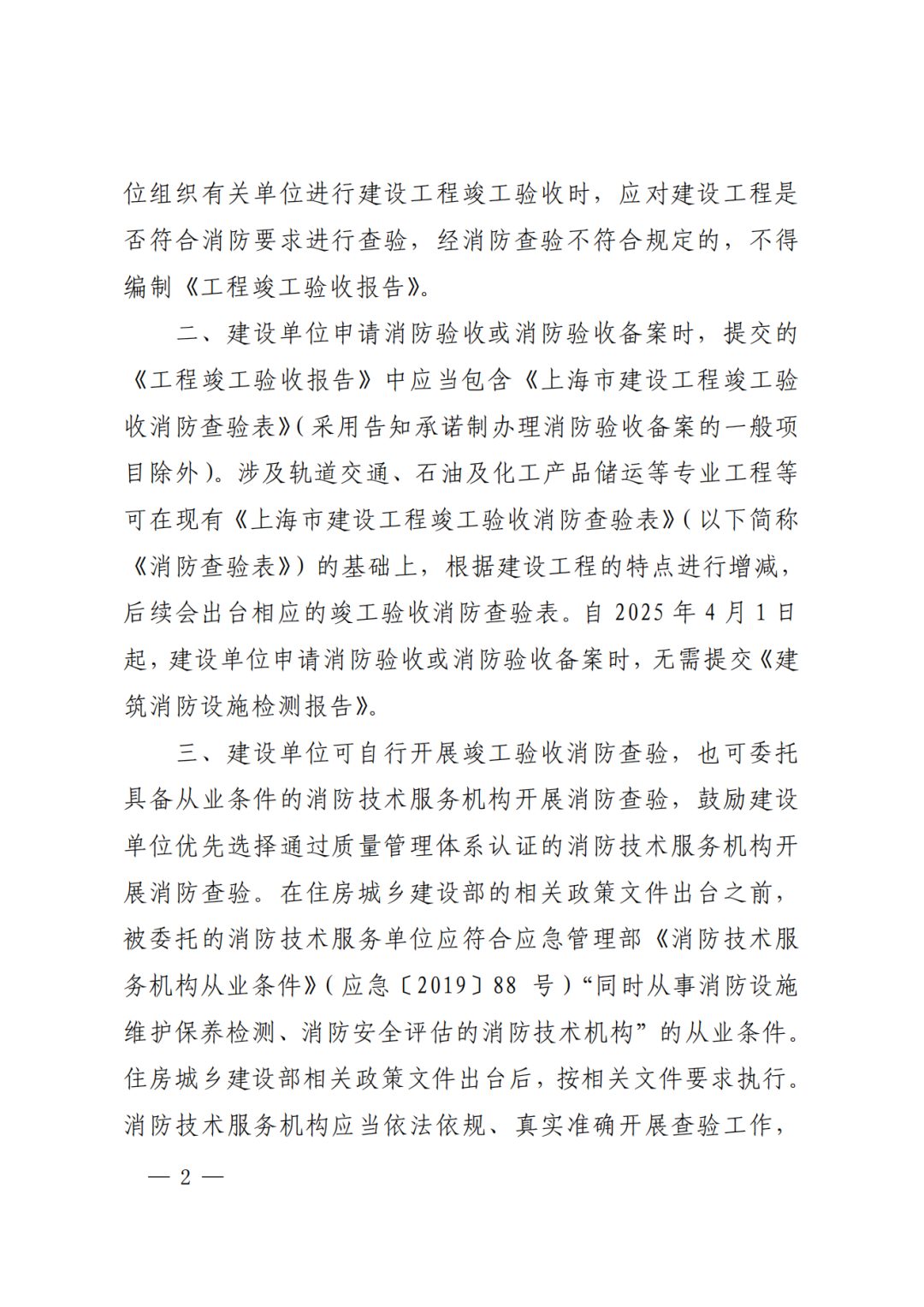
Item 2 of the notice states that, when the developer applies for fire acceptance (消防验收) or fire acceptance filing (消防验收备案), the Project Completion Acceptance Report it submits shall include the Shanghai Construction Project Completion Acceptance Fire Protection Verification Form (《上海市建设工程竣工验收消防查验表》). From 1 April 2025, the developer no longer needs to submit the Building Fire Protection Systems Inspection Report (《建筑消防设施检测报告》) when applying for fire acceptance or fire acceptance filing.
The mandatory requirement to submit a fire protection systems inspection report has been dropped outright. This policy may look like "loosening the reins" for developers, but in our view it actually puts the sword of Damocles of fire safety responsibility entirely in the developer's hands, which means the developer's responsibility is even greater. Developers need to be clear-eyed: "dropping the inspection report" does not mean "relaxing the standard"; it is a more flexible way of forcing the responsible party to take its responsibility seriously.
Verify in-house or commission a firm
Developers now have more choice. They can carry out fire protection verification at completion acceptance themselves, or commission a fire protection technical service organisation that meets the conditions to practise.
The construction authorities now focus on supervision rather than interfering unduly in the developer's own choice. It is worth noting, though, that the policy encourages developers to prefer fire protection technical service organisations certified to a quality management system, as a way of assuring the quality of fire protection verification.
Letting the developer verify in-house may look like "lightening the load", but it actually places higher demands on the developer's responsibility as the principal party and on its fire safety management capability. Fire protection verification involves complex technical standards, and a developer without a professional team may miss hazards.
Moreover, in the present situation the housing and construction authorities deal directly with the developer, with no intermediate third party to vouch for the work. To safeguard project quality, they will inevitably strengthen supervision during and after the works and step up spot checks and acceptance inspections. That is the inevitable trend, and it will also put more pressure on developers. If a spot check on site finds problems, the consequence may be an order to rectify within a deadline at best, or disruption to production and business at worst.
So in our view, professional firms remain irreplaceable. The Shanghai Construction Project Completion Acceptance Fire Protection Verification Form covers ten divisions of work: building fire protection, structural fire protection, building decoration and fit-out, fire water supply and water-based extinguishing systems, smoke control and extraction systems and ventilation and air-conditioning systems, building electrical systems, automatic fire alarm systems, lifts, other extinguishing systems, and fire extinguishers. Fire protection verification is a considerable amount of work, and the chance of problems is high. When the developer commissions a fire protection technical service organisation to carry out the verification, the firm knows the codes better and can avoid more risks, and having a firm vouch for the verification also takes pressure off the developer. After all, under lifelong accountability, the commission fee saved will never outweigh the cost of a single serious accident.
Of course, whether the verification is done in-house or commissioned, the developer and the fire protection technical service organisation must both carry it out lawfully, truthfully and accurately, and bear the corresponding legal responsibility for the verification conclusions. This means developers need to be more careful in choosing the verification route and the firm they work with, because the ultimate responsibility still rests on their shoulders.
It also sends a signal: the market will accelerate the exit of "rubber-stamp" service firms, and only firms with real technical capability that genuinely serve developers will survive.
Shanghai's reform of fire acceptance is, in essence, an upgrade in governance from "the government doing it all" to "devolving responsibility". Developers need to be clear-eyed: "verifying in-house" does not mean "relaxing the standard"; it is a more flexible way of forcing the responsible party to take its responsibility seriously. For developers without the professional capability, choosing a reliable fire protection technical service organisation remains the best way to reduce risk and keep the project compliant.
Our view
Under the present model, the housing and construction authorities deal directly with, and supervise, the developer, forming a two-party "government – developer" structure that lacks a key intermediate layer of technical checks and balances. And when developers check and correct their own work, problems in a project can easily be hidden. Meanwhile, Beijing, Guangdong and other places have piloted the introduction of fire acceptance on-site assessment organisations (消防现场评定机构) as a third-party technical force, forming a three-party system of "developer self-check – organisation assessment – government supervision".
We will venture a prediction: as supervision tightens and the market divides, assessment organisations will not be long in coming to Shanghai. In the end, construction quality will be controlled by the assessment organisations, which, as an intermediate layer, will share the supervisory burden and the pressure on developers. What do you think?


First published on our WeChat channel: read the original