

Taking a commercial building from fit-out to opening involves three core stages: administrative approval, construction management and safety acceptance. A slip at any stage can delay the programme or lead to an administrative penalty.
Shanghai's "One Network for All Services" (一网通办) reform, in force since 2024, has simplified the approval process, but supervision still involves several authorities working together, including market regulation, housing and construction, and fire. If you are not familiar with these procedures, you may face a delayed opening, higher operating costs or even penalties for non-compliance.
Below we set out the procedures for a commercial building in Shanghai, from fit-out to opening for business.
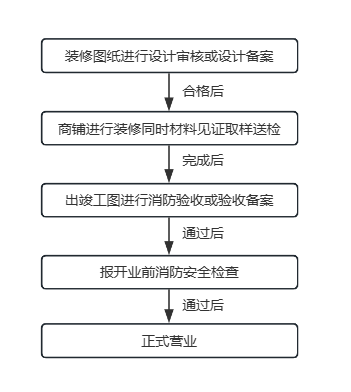
Fire protection filing for construction (消防报建/备案)
Fire protection filing for construction (消防报建) means the fire protection filing and approval (消防备案报批) together with the application for the construction permit for building works (建筑工程施工许可证). As the state has streamlined administrative procedures in recent years, both are applied for at the same window of the housing and construction authority, approved together and issued at the same time.
Under current national rules, fit-out works in an existing building with a total investment of RMB 1,000,000 or more, or a floor area of 300 m² or more, must go through fire protection filing and approval and apply for the construction permit at the housing and construction authority before work starts.
If the investment is below RMB 1,000,000, or the fit-out area is below 300 m², filing with the sub-district office (街道) where the project is located is sufficient.
For shops with a floor area of 300 m² or more, you then need to determine whether the works are general fit-out works (一般类装修工程) or special fit-out works (特殊类装修工程).
Special fit-out works are any decoration and fit-out activities that may affect the safety of people's lives and property or the public interest, including changes to the main building structure or load-bearing structure, changes of use, alterations to fire protection systems and alterations to the building façade.
General fit-out works are building decoration and fit-out works outside the scope of special fit-out works, i.e. works that do not change the main building structure or load-bearing structure, do not change the building's original use, do not alter fire protection systems, do not alter the façade, and involve no other activities that may affect the safety of people's lives and property or the public interest.
Depending on the type, you then go through the review of construction drawing design documents (施工图设计文件审查) and obtain the construction permit. For details, see the Shanghai service guide for construction permits for building decoration and fit-out works (上海市建筑装饰装修工程施工许可办事指南).
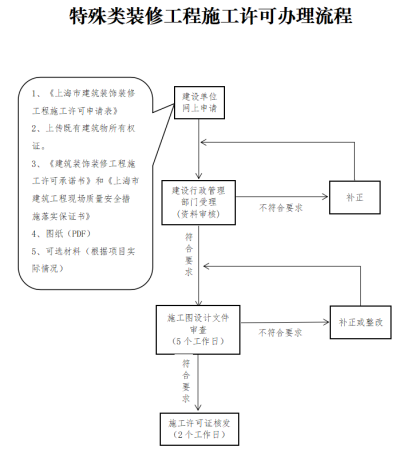
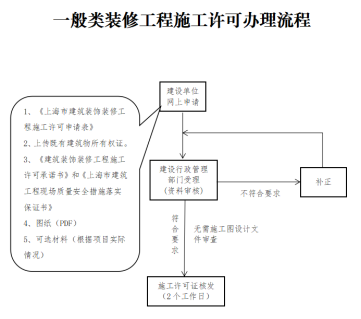
Construction and sample testing
Once the fit-out drawings have passed review or the design filing is complete, the shop can start fit-out works. The contractor must build strictly to the approved drawings and must not change the design without authorisation.
Under Shanghai's rules, fit-out materials that bear on fire safety, structural safety and other critical performance, such as fire-retardant coatings, insulation materials and electrical wires and cables, must undergo witnessed sampling and testing (见证取样送检). Witnessed samples should generally make up no less than 30% of the samples taken for the project.
Choose a suitably qualified testing body. The testing body should hold metrology accreditation (计量认证) from the Shanghai quality and technical supervision authority and be capable of testing the materials concerned.
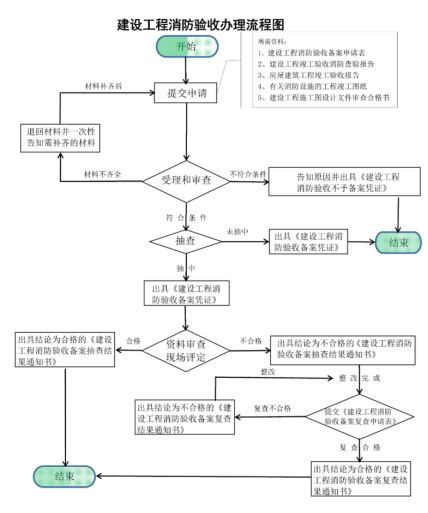
Fire acceptance or fire filing (消防验收或消防备案)
When the fit-out works are complete, the contractor should prepare as-built drawings (竣工图) reflecting the actual construction. The as-built drawings should accurately show the layout after fit-out, the locations of fire protection systems and so on, consistent with any changes made during construction.
The as-built drawings must bear the contractor's as-built drawing stamp and be signed by the responsible persons. They must also follow national and Shanghai drawing standards, with clear drawings and accurate annotation.
Documents required:
The construction project fire acceptance application form (建设工程消防验收申报表) (for fire acceptance projects) or the construction project completion acceptance fire filing form (建设工程竣工验收消防备案表) (for fire filing projects).
The fire protection verification report (消防查验报告), stamped by the design organisation, the contractor and the construction supervision organisation.
The project completion acceptance report (工程竣工验收报告), signed jointly by the design organisation, the contractor, the construction supervision organisation and other parties, as organised by the developer (建设单位).
Documents proving the quality conformity of fire protection products, such as test reports and certificates of conformity for fire protection equipment.
Documents proving that building elements, building materials and interior decoration materials with fire performance requirements conform to national or industry standards, and their factory certificates of conformity.
Documents proving that fire protection systems and electrical fire safety have passed technical inspection (issued by a qualified testing body).
Documents proving the legal identity and qualification grade of the contractor, the construction supervision organisation and the testing body.
As-built drawings of the fire protection systems (which must match the reviewed drawings).
⚠️ Note: projects with an investment below RMB 1,000,000 or a fit-out area below 300 m² follow the notification and commitment system (告知承诺制), which simplifies the documents to be submitted, but the applicant is liable for the truthfulness of its commitment.
Fire safety inspection before opening (开业前消防安全检查)
Under Article 15 of the Fire Protection Law of the People's Republic of China (《中华人民共和国消防法》), before a public assembly venue (公众聚集场所) is put into use or opens for business, the developer or the user shall apply for a fire safety inspection to the fire and rescue authority (消防救援机构) of the local people's government at county level or above where the venue is located; a public assembly venue may not be put into use or open for business without the permission of the fire and rescue authority.
So which venues must apply for the fire safety inspection of a public assembly venue before it is put into use or opens for business?
(1) Newly opened public assembly venues
Song, dance, entertainment, screening and amusement venues: karaoke halls, dance halls, video halls, amusement arcades, internet cafés, nightclubs, KTV venues and venues with karaoke rooms, venues with sauna rooms, and similar.
Hotels, restaurants, shopping centres, markets, cinemas and theatres, auditoriums, assembly halls, amusement venues, commercial fitness and leisure venues, waiting rooms of passenger bus stations, waiting halls of passenger ferry terminals, civil airport terminals, sports venues and similar, with a floor area of more than 300 m².
(2) Changed public assembly venues: where the venue's name, address, person responsible for fire safety (消防安全责任人), nature of use or similar details change, a new fire safety inspection must be applied for.
So how do you apply for the fire safety inspection before opening?
In July 2021 the Ministry of Emergency Management (应急管理部) issued the Notice on Implementing the Newly Amended Fire Protection Law of the People's Republic of China and Fully Introducing Notification-and-Commitment Management for Fire Safety Inspections of Public Assembly Venues before Use or Opening (《关于贯彻实施新修改<中华人民共和国消防法>全面实行公众聚集场所投入使用营业前消防安全检查告知承诺管理的通知》), which introduced notification and commitment management across the board for fire safety inspections of public assembly venues before use or opening. For this inspection, the applicant may choose to apply under the notification and commitment system or not.
Documents required to apply for the opening inspection:
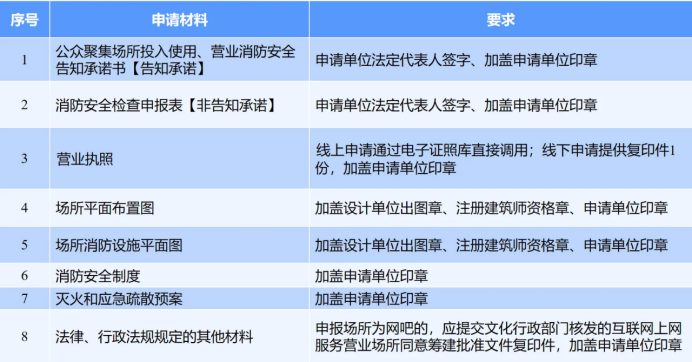
Applying under the notification and commitment system is not a shortcut, however. After the permit is granted, the fire and rescue authority will carry out an on-site verification (现场核查). If the venue does not match what was committed, the applicant may face a fine, temporary sealing-off of the venue or even revocation of the permit. Breaches of commitment are also entered in the applicant's credit record and subject to credit penalties.
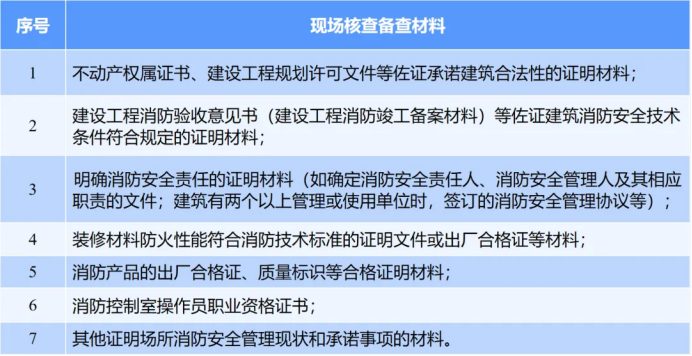
Documents to prepare for the on-site verification:
Finally
As the process above shows, there are many steps from fit-out to opening, but once you understand the key points and requirements of each, it is not difficult. However, because the process involves several authorities and disciplines, requires a large volume of documents, and demands a good understanding and application of the codes and standards, an operator without experience may spend a great deal of time and effort doing it alone.
The best approach is to work with a professional fire safety firm. Such firms usually have extensive experience and expertise and know each authority's procedures and requirements. They can help operators complete each step efficiently, with half the effort, so that operators can put more time and energy into running the business and lay a solid foundation for a successful opening and continued growth.

First published on our WeChat channel: read the original