

On 28 July 2023, to meet growing demand, the EU adopted its new Batteries Regulation (Regulation (EU) 2023/1542 of the European Parliament and of the Council of 12 July 2023 concerning batteries and waste batteries). It replaces the 2006 Batteries Directive (Directive 2006/66/EC, "the Batteries Directive"). Unlike the Directive, which first had to be transposed into national law in each Member State, the new Regulation applies automatically in all EU Member States. This is one of its main aims: a single legal framework that applies across the EU.
Implementation timeline of the new Batteries Regulation:
• 28 July 2023: the EU publishes the new Batteries Regulation (EU) 2023/1542 and repeals the Batteries Directive 2006/66/EC.
• 17 August 2023: Regulation (EU) 2023/1542 enters into force.
• 18 February 2024: the general provisions of Regulation (EU) 2023/1542 begin to apply.
• 18 August 2024: a range of new requirements become mandatory, including hazardous substances, labelling and marking, performance and durability, battery management system requirements, safety of stationary battery energy storage systems, conformity assessment, the declaration of conformity, CE marking and economic operators' obligations.
• 18 February 2025: carbon footprint requirements for electric vehicle batteries become mandatory.
• 18 August 2025: the Batteries Directive 2006/66/EC is fully replaced by the new Regulation, and supply chain due diligence and waste battery management requirements become mandatory.
• 18 February 2026: carbon footprint requirements for rechargeable industrial batteries become mandatory.
• 18 February 2027: LMT (light means of transport) batteries, industrial batteries with a capacity above 2 kWh and electric vehicle batteries placed on the market or put into service must have an electronic record, i.e. a digital passport.
• 18 August 2028: recycled content requirements become mandatory for rechargeable industrial batteries above 2 kWh and electric vehicle batteries.
The Regulation entered into force on the 20th day after publication (17 August 2023). It governs the entire life cycle of batteries, from production to reuse and recycling, to ensure that they are safe, sustainable and competitive, and it has a major impact on battery companies. The points that need the most attention are the following.
The "battery passport"
China is a crucial manufacturer and exporter of lithium batteries. Under the EU Regulation on batteries and waste batteries, from 18 February 2027 all rechargeable industrial batteries above 2 kWh, light means of transport batteries and electric vehicle batteries must carry a "battery passport" recording the battery manufacturer, material composition, recyclable content, carbon footprint, supply chain and other information before they can enter the EU market. Every battery must carry a QR code giving access to the passport. The requirement is stricter than anything before it: a traction battery without a passport will simply lose its eligibility for sale in Europe.
The battery passport is linked to many policies, is highly complex and involves cumbersome procedures, which makes it hard for companies to get to grips with. Its carbon emissions accounting also covers the whole life cycle of the value chain — material extraction, pre-processing, battery manufacture, transport, recycling and reuse — which makes the data calculations very demanding.
Built around EU regulatory requirements, customers' need for information and consumers' right to know, the battery passport discloses the main information about a battery to different parties. It takes the form of a QR code attached to each battery. Regulators, third-party testing and certification bodies and the public, each with different access rights, can scan the code to view the information in the passport and trace the battery's history.
A credible and complete roll-out of the battery passport depends on digital technologies such as blockchain. The EU's draft carbon footprint calculation method for traction batteries sets out detailed rules on data sources and calculation methods. Compared with the ISO standards now commonly used in China and elsewhere, the EU rules are more specific and more stringent, which shows how difficult compliance will be.
Hazardous substances
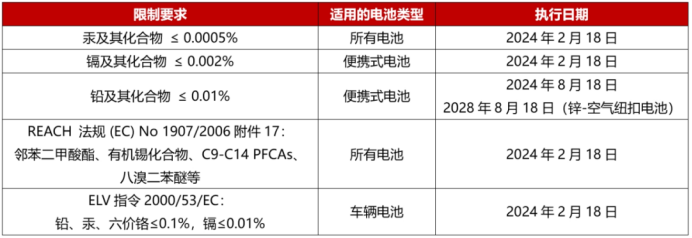
Article 6 of Chapter II of the new Regulation requires batteries to meet the restrictions on hazardous substances in Annex XVII to the REACH Regulation, the ELV Directive and Annex I to the Regulation itself, as follows:
Labelling and information
• General information: all batteries carry a label with basic information about the battery, including 10 items such as manufacturer information, battery category, chemistry, hazardous substances other than lead, cadmium and mercury, and critical raw materials;
• Capacity information: rechargeable portable batteries, LMT batteries and SLI batteries must carry a label with their capacity;
• Separate collection symbol: the crossed-out wheeled bin symbol. Batteries containing more than 0.002 % cadmium or more than 0.004 % lead must show the corresponding chemical symbol below the bin symbol (at least one quarter of the size of the bin symbol);
• Identifier: batteries must carry an identifier. The information it contains differs by battery type, and it must be readable by commonly available devices (such as handheld communication devices);
• CE marking and EU declaration of conformity: the CE marking must be affixed before a battery is placed on the market or put into service.
Final thoughts
The EU Batteries Regulation (EU) 2023/1542 applies to all types of battery and sets stricter requirements for their safety and sustainability. To ensure compliance with the latest rules, manufacturers are advised to work more closely with testing and certification bodies. Following the relevant standards, a certification body can assess the battery product comprehensively, systematically audit its management processes and system documents, and make a sound judgement on whether the product meets the relevant requirements of the new EU Batteries Regulation.
The new Regulation marks an upgrade of the EU's battery requirements to full life-cycle control. It will have a major impact on Chinese battery manufacturers and their upstream and downstream industries, and it brings greater challenges for the companies involved. We again remind companies to keep track of the latest requirements and ensure that their products are compliant and safe, so that they can enter the EU market in compliance.

First published on our WeChat channel: read the original