

Since its draft was published in December 2020, the new EU Batteries Regulation (EU) 2023/1542 has drawn close attention from battery manufacturers and their upstream and downstream industries, because its content and requirements differ substantially from the old EU Batteries Directive.
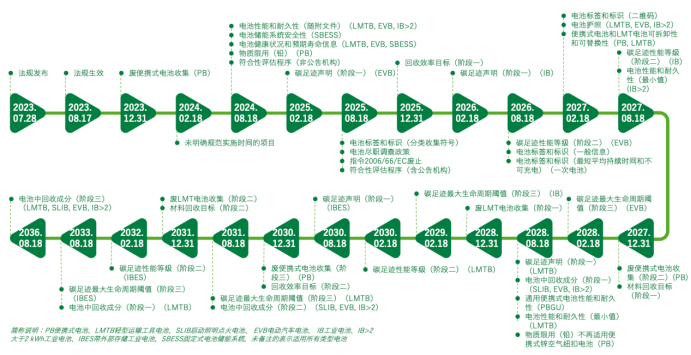
On 28 July 2023, the Official Journal of the European Union published Regulation (EU) 2023/1542 concerning batteries and waste batteries. It entered into force on 17 August 2023, replacing the Batteries Directive 2006/66/EC.
We have received many enquiries about it from manufacturers of cells, modules and battery packs, so let's take a look.

The new Batteries Regulation has 14 chapters and 15 annexes.
It covers restrictions on hazardous substances, carbon footprint, recycled content, performance and durability, removability and replaceability, safety, labelling and information, battery conformity, obligations of economic operators, due diligence, waste battery management, the battery passport, green public procurement and more. The requirements will be phased in, with different requirements at each stage.
The regulation defines battery service providers as installers, recyclers, maintenance and repair businesses, testing and certification bodies, and logistics and disposal companies.
The new regulation will progressively place broader, and in some cases entirely new, requirements on battery manufacturers, importers, distributors and service providers. The compliance milestones are shown below.
Scope
The new regulation applies to all categories of battery, whether or not they are incorporated into a product. By use, batteries are divided into portable batteries, SLI batteries (starting, lighting and ignition), LMT batteries (light means of transport), electric vehicle batteries and industrial batteries.
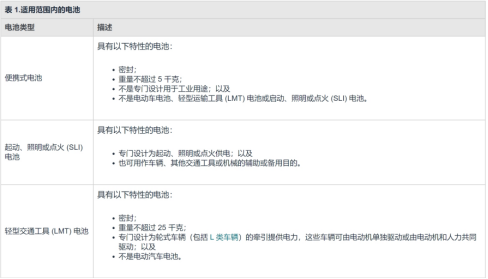
The specific requirements of (EU) 2023/1542 regulate batteries across their whole life cycle, to give better protection to the environment and to consumers.
Production
1. EU declaration of conformity: before a battery is placed on the market or put into service, the manufacturer must sign an EU declaration of conformity, valid for 10 years.
2. Carbon footprint declaration: the carbon footprint of each battery model produced must be calculated and reported in stages and its carbon footprint performance class shown, with the accompanying technical documentation demonstrating that the life-cycle carbon footprint is below the threshold set by the regulation. The new regulation sets carbon footprint requirements for EV batteries, LMT batteries and rechargeable industrial batteries (above 2 kWh), and requires a declaration and a label.
3. Design requirements: manufacturers face stricter design requirements; for example, LMT batteries must be readily removable and replaceable by a qualified professional during their service life.
Raw materials and recycling
1. Supply chain due diligence: companies must carry out due diligence on their supply chain and set up and operate a transparent battery supply chain control system, ensuring traceability for regulators and upstream actors.
2. Circular economy requirements: manufacturers must meet stricter circular economy requirements. The regulation sets the share of specific recovered elements in certain categories of battery, and the thresholds that recycled content must reach by given dates.
3. Waste management requirements: producers must register in the EU member states and take on obligations for managing waste batteries, ensuring the recycling rates set by the regulation are achieved.
Use
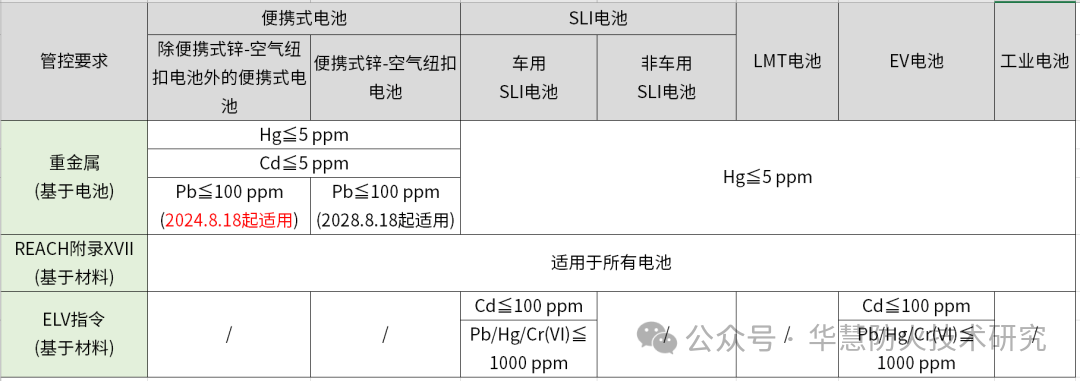
1. Hazardous substances: under the new regulation, all batteries must not only meet the heavy metal limits but also take account of the hazardous substance requirements of Annex XVII to REACH and of the EU End-of-Life Vehicles (ELV) Directive. Suppliers must be able to identify hazardous substances in the battery and provide information on their presence.
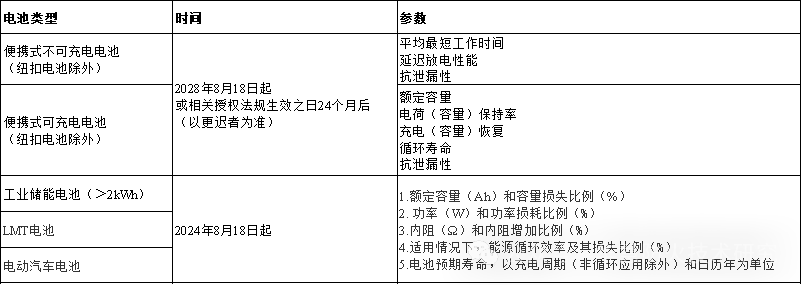
2. Performance and durability parameters: batteries must meet the specified limits for performance and durability parameters, including rated capacity, charge retention, charge recovery, cycle life and resistance to leakage.
Information and disclosure
1. New labelling and marking requirements: although different types of battery are subject to different requirements, since August 2024 all batteries must meet the EU CE marking requirements. Battery manufacturers, distributors and service providers must demonstrate that their products meet the specified requirements. The CE mark must be affixed before a battery is put into service, and the battery's QR code must contain the specified information.
2. Digital battery passport: from 18 February 2027, LMT batteries, industrial batteries with a capacity above 2 kWh and EV batteries placed on the market or put into service must have an electronic record, the digital passport, recording information on their manufacture, use and recycling to ensure product traceability. The battery passport must contain the specified information, and the electronic exchange system for battery information will give distributors, consumers, recyclers and regulators access to it.
3. Conformity assessment: batteries must undergo conformity assessment, verifying compliance on hazardous substances, performance, durability, safety, labelling, state of health, carbon footprint, recycled content and other information. Sustainability assessment of imported batteries is strengthened to ensure they meet EU standards.

Summary
The regulation will have a major impact on battery manufacturers and their upstream and downstream industries. Companies will need to invest more resources to meet its requirements, including improving production processes, strengthening supply chain management and increasing their capacity to recover and recycle batteries. Its implementation will not only reshape the EU battery market but may also have a far-reaching effect on the global battery industry. As landmark legislation, (EU) 2023/1542 will become an important reference for other regions drafting similar laws.

First published on our WeChat channel: read the original