

As we all know, lithium battery products that are to be sold, and especially exported, must pass UN38.3 certification, a prerequisite for transporting lithium batteries. Here is what it involves.
Background to lithium battery transport
Thanks to their high energy density, lithium batteries are widely used in consumer electronics, energy storage systems and electric vehicles. Because they contain high-energy materials, however, they can go into thermal runaway when subjected to external impact, short circuit, high temperature or other extreme conditions, leading to fire, explosion and other hazards. During transport in particular, damage to or abnormal behaviour of a lithium battery can cause extremely serious accidents, so higher demands are placed on its transport safety.
In the early days, a poor understanding of lithium battery behaviour led to frequent transport accidents, causing serious casualties, property losses and environmental pollution. International bodies such as the International Civil Aviation Organization (ICAO) and the International Maritime Organization (IMO) took the issue very seriously and jointly drove the development of unified rules. Among them, the United Nations (UN) published the Recommendations on the Transport of Dangerous Goods.
UN38.3 certification is one of the important standards within them. It requires lithium batteries to undergo a series of rigorous tests and certification before transport, to ensure that they can withstand the hazards they may meet in transit.

Overview of UN38.3 certification
UN38.3 refers to Part III, Section 38.3 of the UN Manual of Tests and Criteria for the transport of dangerous goods: the test requirements and criteria for lithium batteries. It covers the extreme conditions and test requirements that lithium batteries may meet during transport. The certification is intended to ensure that lithium batteries do not explode or catch fire during transport because of external factors (such as vibration, short circuit, high temperature or overcharge). Whether a lithium battery meets UN38.3 has become an important criterion in international transport.
Put simply, it is a safety test for transporting lithium batteries.
Scope of UN38.3 certification
UN38.3 certification applies to all types of lithium battery, including lithium metal and lithium-ion batteries. Whether transported as single cells or as battery packs, lithium batteries must meet the relevant UN38.3 test requirements.
-
All kinds of rechargeable lithium traction batteries (such as batteries for electric vehicles, electric road vehicles, power tools and hybrid vehicles).
-
All kinds of mobile phone batteries (such as lithium-ion and lithium polymer batteries).
-
All kinds of small rechargeable batteries (such as batteries for laptops, digital cameras and camcorders, cylindrical batteries of all kinds, and batteries for wireless communication devices, portable DVD players, and CD and MP3 players).
-
All kinds of primary batteries (such as lithium manganese batteries).
What the UN38.3 tests involve
T1 altitude simulation: simulates high-altitude transport conditions such as an aircraft hold. The test examines the stability of the battery's casing, internal structure and performance under the combined severe conditions of low pressure and low temperature, guarding against swelling, leakage or even explosion.
T2 thermal test: test cells and batteries go through extreme high- and low-temperature cycles, simulating transport across climate zones. This checks how the battery materials tolerate thermal expansion and contraction and how stable the electrolyte is, so that temperature changes do not trigger thermal runaway.
T3 vibration: the battery is fixed to a vibration table and vibrated at specified frequencies, amplitudes and durations, for example a linear sweep from 7 Hz up to 200 Hz and back to 7 Hz within 15 minutes, with an amplitude of 1.6 mm. This simulates the jolting of transport and checks for loosening of internal parts such as electrode connections and separator fixings.
T4 shock: cells are subjected to half-sine shocks of 150 gn peak acceleration and 6 ms pulse duration (large cells 50 gn and 11 ms; for batteries the acceleration is calculated from their mass), three shocks in the positive and three in the negative direction of each of three mutually perpendicular mounting positions, 18 shocks in total. These high-intensity shocks simulate impacts during handling and transport and test the strength of the battery casing and the effectiveness of its internal protection.
T5 external short circuit: the positive and negative terminals are shorted with a conductor of total resistance below 0.1 Ω, and the battery's temperature and appearance are observed throughout. If short-circuit protection fails, the battery discharges a large current instantly and heats up; this test ensures that the battery does not catch fire when short-circuited.
T6 impact/crush: in the impact test, a 9.1 kg mass falls freely from 610 mm onto the battery; in the crush test, the battery is crushed with a force of 13 kN ± 0.78 kN. These simulate severe external mechanical damage and test the battery's resistance to it.
T7 overcharge: the battery is charged continuously at a charging current above its rating until its voltage reaches the predetermined overcharge cut-off voltage, while it is observed for smoke, fire or explosion. This checks the reliability of the charge protection circuit.
T8 forced discharge: a fully charged battery is forcibly discharged in reverse to assess its safety under abnormal discharge and guard against hazards from reverse current.
For air transport, if the lithium battery is not installed in equipment, it must also pass a 1.2 m free-drop test (cells below 20 Wh, battery packs below 100 Wh).
Certification process
Sample preparation: the company submits samples of the lithium battery to be certified. The quantity depends on the tests and the testing body's requirements; generally at least 3 batteries per test group. Samples must be of the normal production model and representative, accompanied by a detailed specification giving key parameters such as chemistry, capacity and voltage.
Choosing a testing body: the lithium battery manufacturer needs to choose a qualified third-party laboratory for UN38.3 testing. Such laboratories usually need the relevant accreditation and must be able to test to international standards.
Testing: after receiving the samples, the laboratory carries out each test in sequence, recording data and photographing what happens throughout. If a test is failed, the company may modify the samples and retest once, although this may lengthen the schedule and increase cost.
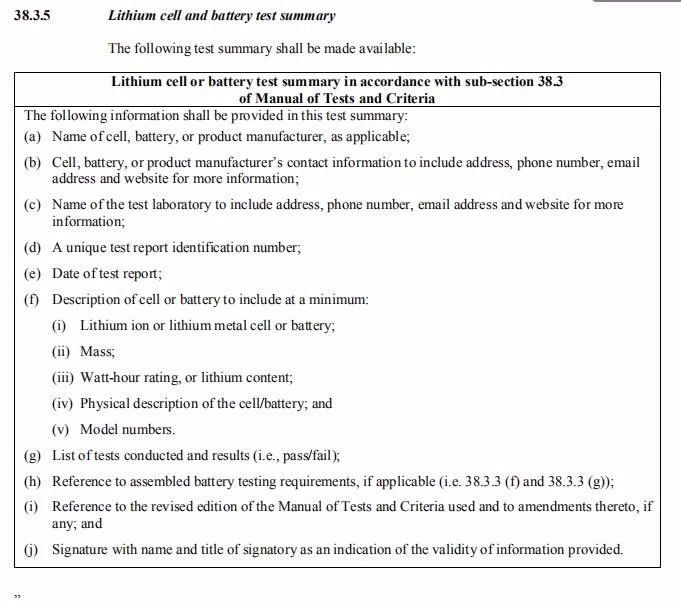
Report: when testing is complete, the testing body provides the manufacturer with a detailed test report. The manufacturer submits the test report and other relevant documents to the regulator or carrier concerned for review, to confirm that the battery meets transport safety requirements.
Certification: once the review is passed, the manufacturer obtains UN38.3 certification, showing that the battery meets the UN requirements for the transport of dangerous goods and can move safely in international transport.
Follow-up: after certification, any change to the production process or battery design, however small, must be assessed to decide whether the certification process needs to be repeated, so that the product stays compliant.
Legal status and compliance of UN38.3 certification
UN38.3 testing is mandatory testing to ensure lithium batteries can be transported safely by air, sea and land. The Civil Aviation Administration of China has issued its Specification for the air transport of lithium batteries to airlines, explicitly requiring lithium batteries to undergo UN38.3 testing by a CNAS-accredited laboratory before transport by air or sea. Airlines may accept lithium batteries for carriage only on receipt of a UN38.3 pass report and a transport identification certificate.
UN38.3 certification is therefore not only an important safeguard for the safe transport of lithium batteries, it is also mandatory. Worldwide, and especially in air transport, UN38.3 certification is a precondition for complying with the International Air Transport Association (IATA) dangerous goods regulations, and lithium batteries without it cannot be transported. In addition, many countries and regions have regulations on the import, sale and transport of lithium batteries, making UN38.3 certification an important threshold for market entry.
But a UN38.3 report alone is not enough to transport batteries. UN38.3 is only one necessary condition. Besides meeting the UN38.3 test requirements, battery transport also requires a transport identification certificate, an MSDS, a dangerous goods packaging certificate, a 1.2 m drop test report and other documents. Manufacturers who are unsure about these can have a testing body handle them directly, saving a great deal of effort.

First published on our WeChat channel: read the original