
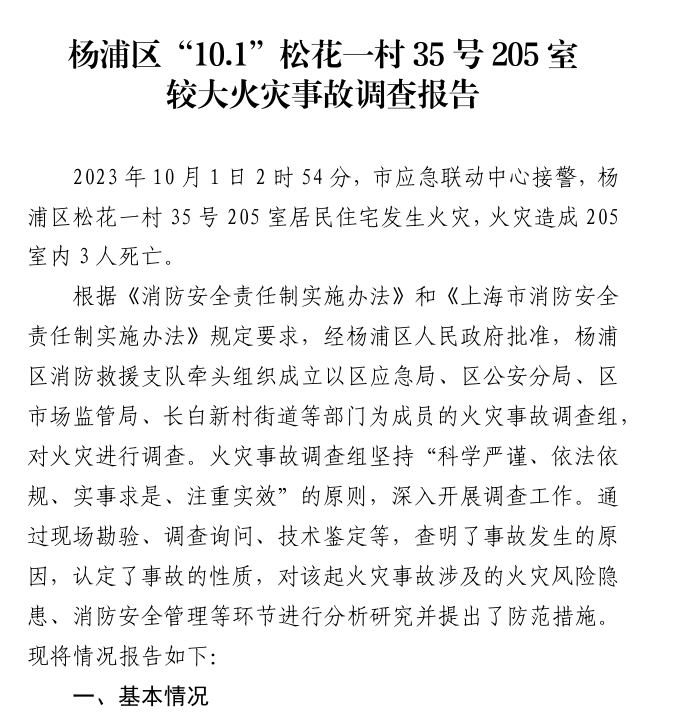
At 2:54 a.m. on 1 October 2023, on the eve of the National Day holiday, a sudden fire broke the calm of a residential block in the Songhua No. 1 Estate, Yangpu District, Shanghai. A resident of flat 305, surnamed Wang, was woken by a strange noise and found thick smoke pouring from flat 205 below. Knocking and shouting brought no reply, so the resident called the fire service at once. Fire and rescue crews arrived within minutes and the fire was out by 3:10 a.m. Rescuers brought three trapped occupants out of the flat; tragically, their injuries were too severe and all three died despite attempts to save them.
Cause of the fire
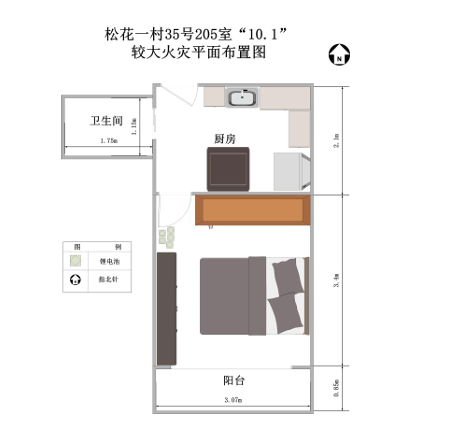
According to the published report of the fire investigation team, the possibilities of arson, suicide, smoking, domestic use of fire and an external ignition source were ruled out. At the point of origin in a bedroom, investigators found five lithium battery packs and associated debris, and examination showed that the batteries had undergone thermal runaway. The fire was attributed to lithium battery thermal runaway, although there was no evidence that the batteries were being charged when the fire started.
Why the fire was so deadly
(1) The fire developed extremely quickly. Lithium-ion battery fires grow fast and release a great deal of heat. Once alight, the five battery packs at the point of origin quickly reached intense burning, and because they had been placed by the bedroom door, they seriously obstructed escape.
(2) The fire load in the room of origin was high. The floor of flat 205 was covered with foam mats, cotton textiles and other highly combustible items, and the home held a large quantity of combustible household clutter. With such a fire load, the fire spread rapidly and produced large volumes of toxic and harmful gases.
(3) The occupants could hardly escape on their own. Of the three who died, two were elderly with limited mobility; their daughter had been physically disabled in a road accident many years earlier and was bedridden. All three had little ability to save themselves and could not get out.
Lithium battery incidents are becoming common
Thermal runaway is the lithium battery's deadly curse. In normal operation the electrochemical reactions inside the cell are steady and orderly, delivering a continuous supply of energy to the device. Once thermal runaway is triggered, however, it is like opening Pandora's box: the cathode and anode materials, the electrolyte and other components undergo a chain of violent, uncontrollable reactions driven by high temperature, releasing heat, sending the temperature soaring and leading to fire and explosion. The process is both rapid and highly destructive.
The Yangpu tragedy is not an isolated case. In recent years lithium battery incidents have occurred one after another across the country, from e-bike batteries catching fire while charging at home to battery faults in new energy vehicles causing smoke and spontaneous fires that endanger drivers and passengers.
With the rapid growth of consumer electronics and new energy transport, lithium batteries, thanks to their high energy density and long cycle life, have quickly become the mainstream form of energy storage. While they bring people convenient travel and efficient use of power, they have also quietly introduced safety hazards.
One major reason is the rapid expansion of lithium battery production. Many manufacturers have entered the market and quality varies widely. To cut costs, some skimp on raw materials, using inferior cathode and anode materials and electrolyte, so the batteries are flawed from the outset and far less stable. In production, poor process control leads to frequent problems such as uneven electrode coating and defects in cell assembly, sowing the seeds of thermal runaway.
Quality management
Regulators need to tighten the net of supervision. Starting from production licensing, they should rigorously vet the qualifications of new entrants so that only manufacturers with mature technology and sound processes can enter the industry. In routine supervision, they should carry out more frequent sample checks, go into production workshops, examine raw material records, production records and finished-product inspection reports, and penalise non-compliant production severely.
Take thermal runaway testing seriously
In use, lithium batteries may meet a range of abnormal conditions such as overheating, overcharging and mechanical impact, any of which can trigger thermal runaway and lead to serious accidents such as fire and explosion.
Around the world, many countries and regions require battery products to pass a series of safety tests, including thermal runaway tests, before they can be certified and placed on the market. International standards such as UL and IEC, as well as China's national standards, all include thermal runaway test requirements. Taking thermal runaway testing seriously is therefore essential for companies to comply with regulations and standards and to access both international and domestic markets.
Thermal runaway testing can also simulate these abnormal conditions, accurately assess how a battery performs under different scenarios, and identify potential hazards in advance, helping to protect lives and property.
If a battery does go into thermal runaway in service, knowing its thermal runaway characteristics is vital for the emergency services. The data and information obtained from thermal runaway testing help responders deal with incidents, draw up sound emergency plans and take effective measures to limit harm to people and the environment.

First published on our WeChat channel: read the original