
Published in 2020. Standards and rules cited may have been revised since; the current editions apply.
Plastics are light, moisture- and corrosion-resistant, good electrical insulators, can be formed in a single operation and are made from widely available raw materials. Plastic products are therefore used in almost every field, from the defence industry, transport and construction to household appliances and furniture, and they play an important part in the national economy. Plastics are, however, generally flammable. Fires caused by plastic parts in electrical equipment overheating or arcing are all too common, and this limits their wider use to some extent. Testing the flammability of plastics and researching flame-retardant technology are therefore extremely important in every country.
A number of methods have been developed in China and abroad for testing the flammability of plastics, such as the oxygen index method, the horizontal burning method, the vertical burning method and direct burning methods, and test standards have been issued for the burning behaviour of plastics, such as GB/T 2406-2008, GB/T 2408-2008, GB/T 2407-2008 and GB/T 4610-2008. The oxygen index is a way of expressing the relative flammability of plastics and other polymeric materials. It is a very effective way of judging how easily a material burns when it comes into contact with a flame in air, and it receives great attention worldwide. China has issued national standards for the oxygen index method.
Characterising the burning behaviour of a plastic by its oxygen index gives a specific number, with high resolution, good repeatability and convenient testing. The method is not only a way of testing the flammability of plastics but also a research tool that gives a better understanding of how polymers burn, and it is widely used in research on flame-retardant plastics.
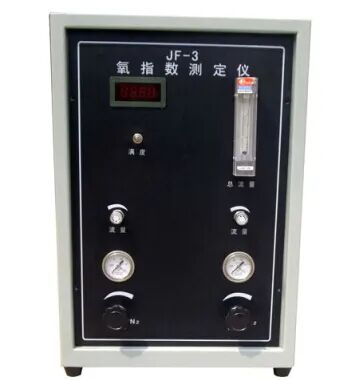
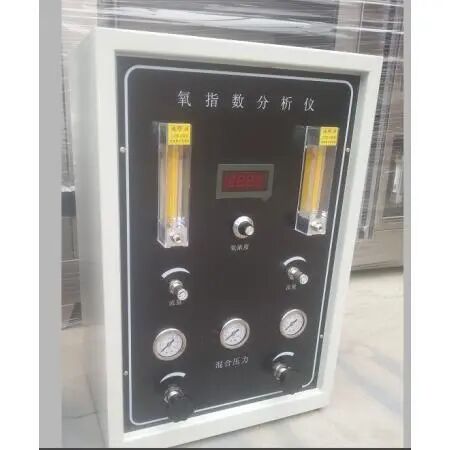
The principle of the method is as follows. A specimen of specified size is held vertically by a clamp inside a transparent chimney, through which a mixture of oxygen and nitrogen in a set ratio flows upwards. The top of the specimen is ignited, the subsequent burning is observed, and the burning time or the burnt length is recorded and compared with a specified value. If the specified value is exceeded, the oxygen concentration is reduced; if it is not reached, the oxygen concentration is increased. This is repeated, closing in on the specified value from above and below, until the difference between the two concentrations is less than 0.5 %. The oxygen index reflects how easily a material ignites and how hard it is to extinguish. A high oxygen index means the material needs a lot of oxygen to burn and is difficult to burn; a low oxygen index means the material burns easily. The method is simple to carry out and gives accurate results.
How, then, is the oxygen index used to assess the burning behaviour of a material? We should start with the limiting oxygen index. The limiting oxygen index is an indicator for assessing the burning behaviour of materials: the minimum oxygen concentration, in an oxygen–nitrogen mixture under specified test conditions, that will just sustain burning of the material. It is known in English as the LOI (limiting oxygen index) and is expressed in %.
To measure the limiting oxygen index, the specimen is fixed vertically in a transparent chimney with an upward flow of oxygen–nitrogen mixture. The top of the specimen is ignited and its burning behaviour observed. The duration of continuous burning or the burnt length is compared with the given limit, and a series of tests at different oxygen concentrations establishes the minimum oxygen concentration, expressed as a percentage of oxygen, that sustains burning.
The burning behaviour of the material at other oxygen concentrations, before the minimum value is reached, is called its burning behaviour at that oxygen index. In practice, however, when we speak of the oxygen index we nearly always mean the limiting oxygen index. When the oxygen index is used to assess burning behaviour, a high value means the material does not burn easily and a low value means it burns easily. It is generally accepted that materials with an oxygen index below 22 are flammable, those between 22 and 27 are combustible, and those above 27 are hard to ignite (flame-retardant).
In summary, the oxygen index gives a sensitive measure of a material's burning behaviour under certain controlled laboratory conditions and can be used for quality control. It cannot, however, be used to describe or assess the fire hazard that a particular material or a particular shape presents in a real fire; it can only be one element in assessing a given fire hazard. Although the oxygen index method is not the only criterion or test method, it offers good accuracy, repeatability and reproducibility and is easy to carry out. It is very widely used and has become an effective test for assessing classes of burning behaviour.
First published on our WeChat channel: read the original