
Published in 2020. Standards and rules cited may have been revised since; the current editions apply.

Fire-stopping materials are used mainly to seal penetrations and gaps in the boundaries of a building's fire compartments, so that flames and hot smoke from a fire cannot spread into the neighbouring compartment. The national standard GB 23864-2009 (China's standard for fire-stopping materials) keeps the performance requirements and test methods of the earlier industry standard that had proved sound and workable in practice. Drawing on the European standards EN 1366-3 and EN 1366-4 and on experience with the earlier standard, it sets clearer and more rational rules for fire resistance testing of the different fire-stopping materials and fire-stopping systems, and adds technical requirements for durability and some physical and chemical properties.

GB 23864-2009 applies to fire-stopping materials and fire-stopping components used in penetrations and construction gaps of all kinds in buildings, structures and other facilities. It also covers fire resistance testing and assessment of systems formed by fire-stopping materials and products installed in different ways, and of fire-stopping systems made up of fire-stopping materials combined with fire-resistant insulation.
1. The materials
By use, fire-stopping materials fall into three main groups: materials for penetrations, materials for gaps, and materials for plastic pipes.
-
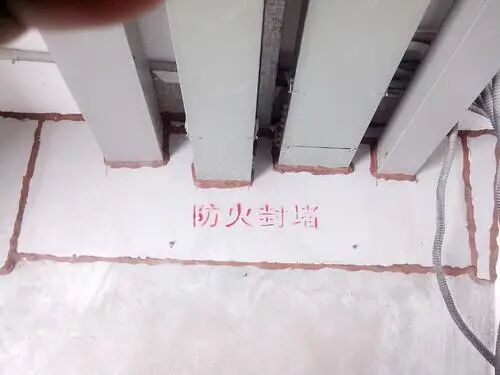
Fire-stopping materials for penetrations seal and close openings that pass through a structure, so that the structure as a whole keeps its fire resistance.
-
Fire-stopping materials for gaps seal and close gaps between fire-separating elements, or between a fire-separating element and another element (such as expansion joints, settlement joints, seismic joints and construction gaps), so that the structure as a whole keeps its fire resistance.
-
Fire-stopping materials for plastic pipes are the materials and products used where plastic pipes pass through openings in walls or floors, so that the structure as a whole keeps its fire resistance.
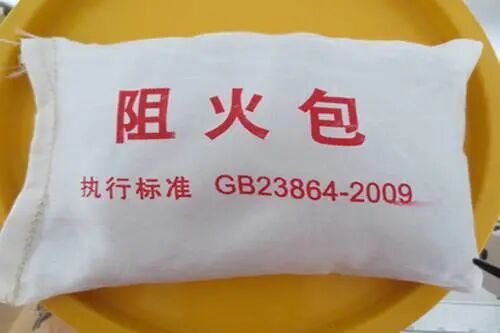
By composition and form, fire-stopping materials are divided into the following types:
-
Flexible organic sealant (fire putty): uses an organic binder, is flexible or plastic in use, and comes as a putty-like mass.
-
Inorganic fire-stopping compound: a powder based mainly on inorganic materials which, when mixed with additives, has suitable workability.
-
Fire-stop blocks: solid pieces of fire-protective material in defined shapes and sizes, easy to cut and drill, for sealing openings or cable trays.
-
Fire-stopping boards: boards made of fire-protective material, easy to cut and drill, for sealing large openings.
-
Foam fire-stopping materials: fire-protective materials that expand and foam once injected into an opening, sealing it.
-
Gap fire-stopping materials: solid fire-protective materials placed in a gap to seal fixed or moving gaps.
-
Fire-resistant sealants: liquid fire-protective materials with a fire-sealing function.
-
Fire-stop wrap strips: flexible strip products of fire-protective material that can be wound and rolled. They are wrapped around the outside of a plastic pipe and held with a steel band or by other suitable means. In a fire they expand and squeeze the softened pipe, closing the opening left when the plastic pipe burns or softens.
2. Requirements of the standard
Reaction to fire
-
Apart from inorganic fire-stopping compounds, the reaction-to-fire performance of fire-stopping materials shall meet items 2 to 4 below. A failure in reaction to fire is a Class A defect.
-
Textiles used for fire-stop pillows shall have a damaged length of no more than 150 mm, an afterflame time of no more than 5 s and an afterglow time of no more than 5 s, and burning drips shall not ignite the cotton wool or set it smouldering.
-
Flexible organic sealants and fire-resistant sealants shall be no worse than class HB of GB/T 2408-2008. Foam fire-stopping materials shall have an average burning time of no more than 30 s and an average burning height of no more than 250 mm.
-
Other fire-stopping materials shall be no worse than class V-0 of GB/T 2408-2008.
Fire resistance
Fire resistance of fire-stopping materials is graded by fire resistance time into three levels: 1 h, 2 h and 3 h. A failure in fire resistance is a Class A defect.
Determining the fire resistance limit: if any of the following specified losses of integrity or insulation occurs during the test, the integrity or insulation of the fire-stopping material has reached its limit state, and the time recorded is the fire resistance limit of that material for loss of integrity or loss of insulation.
- Loss of integrity: a cotton pad on the unexposed side is ignited, or flaming emerges continuously for 10 s.
- Loss of insulation: the temperature rise at any point on the unexposed face of the specimen reaches 180 ℃, the temperature rise on the surface of any penetrating item 25 mm from the fire-stopping material on the unexposed side reaches 180 ℃, or the temperature rise at any point on the unexposed face of the frame reaches 180 ℃.
Physical and chemical properties
-
Samples of fire-stopping materials shall be taken at random from a production batch or from the site of use.
-
Where a fire-stopping material meets the requirements of a given fire resistance level (1 h, 2 h or 3 h) and all other performance indicators meet the standard, the product is assessed as conforming at that level.
-
Where testing shows that, apart from fire resistance and reaction to fire (failures in which are Class A defects and are not allowed), the material has major (Class B) and minor (Class C) defects in its physical and chemical properties, the product may still be assessed as conforming at a given level if the following conditions are met, but the nature and number of defects must be stated:
-
flexible organic sealants, inorganic fire-stopping compounds, fire-stop pillows, fire-stop blocks, fire-stopping boards and foam fire-stopping materials: B ≤ 2 or B + C ≤ 3;
-
gap fire-stopping materials and fire-stopping sealants: B ≤ 1 or B + C ≤ 2;
-
fire-stop wrap strips: B ≤ 1 or B + C ≤ 2.
3. Normative references
GB/T 2408-2008 Plastics: determination of burning behaviour, horizontal and vertical methods
GB/T 2611 General technical requirements for testing machines
GB/T 5455 Textiles: burning behaviour, vertical method
GB/T 7019-1997 Test methods for fibre cement products
GB/T 8333 Rigid cellular plastics: burning behaviour, vertical burning method
GB/T 9978.1 Fire resistance tests for building elements, Part 1: general requirements
GA 304-2001 Fire-stop collars for rigid PVC building drainage pipes
First published on our WeChat channel: read the original